Dive Into The Minds of Industry Players: A Review of the New Music Seminar

If you currently work in the music industry, or aspire to, the New Music Seminar deserves your attention. I had the privilege of being invited by the Workman Group to attend and cover the three-day conference which brought together music and entertainment leaders committed to exploring ways to expand and grow the business.

The New Music Seminar started with a bang with a red carpet and performance at Webster Hall on Sunday, with a line-up which included ASTR, Cardiknox, Mayaeni, Born Cages, and Meg Myers. On Tuesday night, at 11:15 pm at Tammany Hall with a performance by the winner of the Artist on the Verge Awards 2014, VanLadyLove.

This slideshow requires JavaScript.

The three-day conference took place at the New Yorker Hotel in Midtown and occupied two floors with booths that for the following companies, Buzz Angle, GCA Entertainment, Showpitch, Music Times, Corbin Hillman Communications, ASCAP, Noise 4 Good, Steven Hero Productions and more. These firms offer services in royalties, publishing, digital distribution, data mining of online music consumption, music journalism, artistic representation, and artist and repertoire. In addition, the conference rooms on these two floors served as meeting places for panelists and discussions, and mini acoustic showcases with some of the artists selected for the Artists on the Verge Project 2014.

The New Music Seminar conference helps industry leaders and players better understand how consumerism and music is evolving and how they can continue to innovate. In addition, this same conference brings the New Music Seminar Music Festival. Musicians have the chance to perform for a large audience and industry players, and develop valuable partnerships with producers and managers.

While I have five full-length interview articles in the making with these five bands that were invited to the NMS Artists on the Verge Project – Juicebox, The Dirty Gems, Desert Sharks, Kim Logan and the Blackfoot Gypsies – I first want dive into what I learned from A&R representatives, music publishers and the staff of Pitchfork in some of the panels in the past three days. More specifically, I will take you through what label representatives look for in an artist before they invite them onboard, the types of criticisms new singer songwriters typically receive, and the dos and don’ts for publicists who work with musicians.

The A&R Movement: Where music is headed
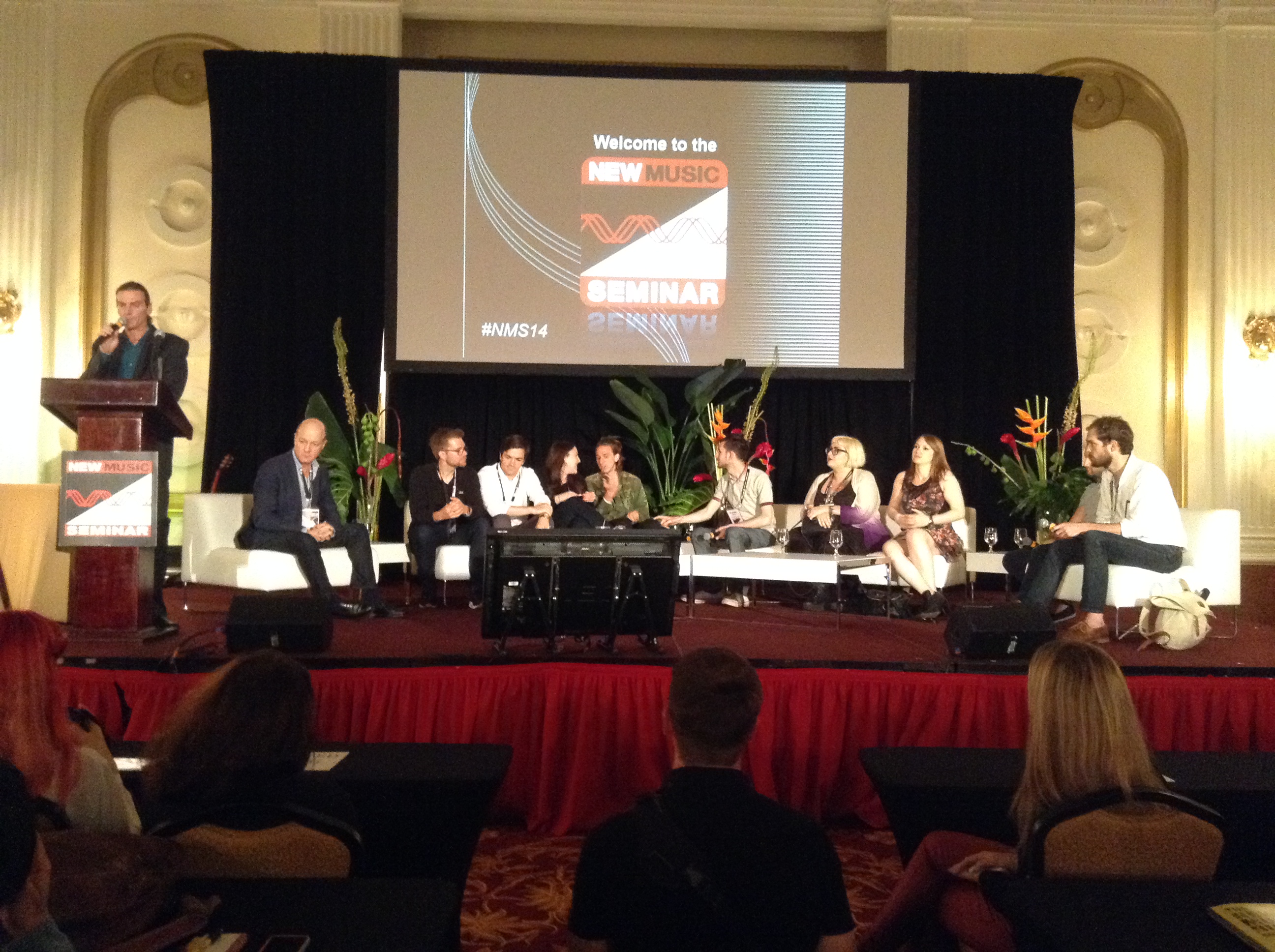
Let me start backwards. On Tuesday, the last day of the seminar, David Massey, President of Island Records conducted a conversation between nine A&R representatives: Tayla Elitzer (Capitol Records); Alyssa Castiglia (Island Records); Brandon Davis (Atlantic Records); Jon Coombs, General Manager at Secretly Canadian Publishing; Jenna Rubenstein, Creative at Insieme Music Publishing within Glassnote Entertainment; Austin Rice (Columbia Records); Jessica Strassman (Startime International); Patch Culbertson (Republic Records); and Dylan Chenfeld (Razor & Tie). Here are the essentials that musicians and A&R representatives alike should know about music today.

Trends in Music

Panelists emphasized which particular styles currently excite label reps. Electronic, rhythm and blues, and emerging trend of world music, deep house music from the UK are among these genres. In addition, there is a cool cross between electronic and indie, better known as Indietronica. Avicii is one artist who accomplishes this by mixing electronic dance music with bluegrass. Another artist who combines guitar driven music with electronic dance beats is The Chain Gang of 1974, who recently performed at the Governors Ball Music Festival.

On the topic of guitar music, another speaker claimed there has been a significant void in guitar-driven alternative music, providing musicians within this genre to re-emerge. He added that bands like this who entered the scene more than 10 years ago, including The Strokes and Jack White, still drive large performance crowds. The way I see it, there is no reason why someone now cannot come out and do the same. An audience for this music still thankfully exists.

A&R, Musicians and Social Data – What works, and what does not

One of the most important pieces of information an A&R rep must keep in mind is the difference between data and buzz. When researching an artist, data is crucial. One must put their personal taste aside and understand the consumers’ tastes. While start-ups like Buzz Angle, who are currently in their beta-testing phase, record data of online music streaming and purchases; the other type of public data most A&R reps use is Twitter. Retweets of videos, hashtags of performances, and robust discussion about the artist serve as valuable data. Additional social metrics includes plays and followers on Spotify, and views on Youtube.

If you are an artist, please note that an A&R person wants to know you are going to sell records. One of the panelists signed the New York City-based Indie Rock band, Born Cages based on how many times the band’s songs and videos were retweeted. Although he had not seen the band play a single show before signing them, he believed in them. In addition, after speaking to the band in person at the red carpet event, this group claims performing is their favorite part of their career.

In short, social media and staying relevant on the music scene is essential. A&R reps will also tell you that now, more than ever, musicians must create a marketing plan and build a fan base by themselves.

On the other hand, some social media presents a negative. The panelists mentioned a habit of some A&R reps adopt involves aimlessly following buzz about an artist on blogs. The problem with unsigned bands made ‘hot’ within the blogosphere is that these articles don’t help the A&R rep determine whether that band will be promising to sign. I agree with this claim. Unlike twitter, which marketers across the advertising industry have utilized to research the purchase intent of customers, blogging platforms do not provide this data or information about the consumer.

Key Performance Indicators – Play Live and Good Songs

Data has not entirely replaced a good ear for talent. Some of the reps on this panel claimed that a strong instinct about the artist must come before research. This might include the bands that one’s friends talk about. Most importantly, musical ability can be used to judge how well an artist performs live. As a rule of thumb, A&R reps do not think highly of a band that does not often perform.

If you love to play live but perhaps are not them strongest performer, there are ways A&R reps can find you help in establishing an excellent stage presence. In this case, the A&R rep might not sign you right away, but they might start developing a relationship with you, hopefully as partner on your journey. However, several panelists did agree that most of the time, the longer it takes a sign a deal with the artist, the better. There are A&R reps who have attended a musician’s performance 14 times and they regularly keep in touch.

What if you are an artist who loves playing live and plays well, but do not currently have any original music? A&R representatives will tell you, songs lead the way. Good songs have a way of rising to the top. If you don’t have any original songs, they do not feel compelled to bring you on board. Finally, selling singles and full albums still serve as an artist’s main source of revenue. This is one trend that has not changed.

So what has changed in A&R? The availability of information about the artist and their potential as an economically successful artist is now more public than it was 10 years ago. In addition, the competition on the musical landscape today escalates rapidly.

The Take Away

The most valuable advice this panel had to offer to the artist looking to make money with their music is this, always remember the music should be about your fans. Deliver the music your fans love. Thanks to social media, artists now have an excellent way to interact with fans and secure that base that is going to help the musician get attention from an A&R rep, and hopefully get signed.

Now, if you have always been musically inclined, enjoyed performing, but are just starting out as a songwriter, and might be looking to work with a label or music publishing group, keep reading this post. I am going to give you an idea of how it feels to have your music critiqued by A&R people and music publishers in the overview of this next panel.

Music XRAY Presents: A&R Live – Music Critique and Sound Selector Sessions

This panel was conducted by Mike McCready, Co-Founder and CEO of Music Xray. The players included Tayla Elitzer, Jenna Rubenstein, Alyssa Castiglia, Stephanie Karten, A&R from Robbins Entertainment, and Chloe Weise, A&R from RCA Records.

I arrived late to this discussion, but luckily, the guitarist from the Boston-based band The Venetia Fair, Mike Abiuso – who I had met at the opening night at Webster Hall on Sunday night – was able to fill me in on what I missed. He said that earlier in the program, “The critics assumed nobody would want to listen to a demo of a song because it is an unfinished product. When they [the critics] asked the audience however; many listeners said ‘yes,’ they would listen to a demo.”

Michael also explained the process of how this panel would critique music. They would read off the names of some of the Artists on the Verge, class of 2014, and then ask for a CD of their single and play it for the entire room to hear, and then publicly share their criticism. This type of workshop will help singer songwriters and performers in the early stages of their career in the following ways: 1) It will help aspiring musicians build a thick skin towards criticism; 2) This is a great opportunity to receive constructive criticism; and 3) They will learn what record labels search for in an artist who is looking to get signed.

Some of the Songs up for Critique

The first song I took notes on was “Insomniac” by The Dirty Gems. Upon listening to this track, the panelists said, “While the vocals were good and I liked the guitar in the forefront, I don’t see a lot of hit potential. Strengthen the verse a little bit.”

Afterwards, the panelists chose “Call on Me,” a Hip-Hop track by rapper Just So Smooth. The speakers pointed out, “No dynamics, the melody is static. The hook needs to be cleverer, along with lyrics. Also, the phrase “call on me” has been used before.”

The last song review I listened to was about the dance tune “Problem Boy” by Toni Atari. “The production is not great, and the vocals are a little bit muddled,” remarked the panelist. She also suggested the artist develop her lyrical content and the context in this song.

A Critique of the Artists on the Verge Awards 2014 Finalists

Fast forwarding to the final panel of the day The A&R Movement, I thought it was only fair to include the A&R rep’s point of view about the AoV Awards 2014 finalists – Garage Rock group from Philadelphia, June Divided; R&B singer from New York City, Kiah Victoria; and Pop Rock group from Provo, VanLadyLove. Although everyone now knows the winner is VanLadyLove, I wondered who the A&R reps thought would win.

One of the panelists gave Kiah their vote. Another panelist said, “Kiah commands a stage, but she would do well if she focused more on carrying her pre-choruses a little further.”

An A&R rep stated they would sign VanLadyLove. One of the reps then stated this band “has a cool sound and great stage presence.”

As for June Divided, one of the reps claimed he would put this band in the “to be watched” folder. Another panelist positively commented on the band’s energy, but claimed “Their style is a little dated,” and emphasized the group needs to focus on their audience.

The Take Away

All artist starting out on the music scene must listen to criticism in order to improve their chances of getting representation. Luckily, these critics do bring up a few valid points. For example, ask yourself, “Am I trying to be a writer or artist?” This question is important in dance music, a genre for which they suggest the following – “Focus more on sophisticated lyrics. In dance music, the lyrics are not very deep.

“The music also has to deliver the same magnitude as the vocals. This comes along with more songwriting practice.”

Additional advice they provide is this, “Think really well about where your song fits in this time period. A sound from six years ago will not fly now.”

They then offered this last piece of advice, which I found interesting, “There is a lot of risks these days, so you have a better chance with a radio-ready song.” While three of these panelists, Tayla, Jenna and Alyssa, would also agree with those A&R reps from The A&R Movement panel who claim that an artist does not need to be on the radio to be successful; they suggest a radio-ready song just so that a single has the best quality possible. A poor quality recording could turn off the A&R person and prevent them from giving a well-written song a chance.

So far, I have talked about the types of criticisms new artists on the independent music scene will likely receive from industry players. Now, I want to take you to the last segment of this review – advice for publicists working with musicians; the dos and don’ts they should apply to their practices.

Online Media Music Discovery

Jay Frank, Founder and CEO of DigSin served as conductor of this panel, which took place on Monday. The players included Mark Richardson, Editor-in-Chief of Pitchfork; Andrew Flanagan, Writer and Editor of Billboard; Joe Carozza, Senior Vice President of Publicity of Republic Records; and Andy Cohn, President and Publisher of The FADER. The discussions between panelists provide me with advice for what a publicist should do in order to increase coverage about their artist, and what to avoid.

Do Tell a Story to the Industry Player

As a publicist, when you pitch an artist to someone else in the industry, ask yourself what makes the artist different and why that industry player should care about them? The type of story you tell keep the reader interested. Although some artists might want to hold back on the story, encourage them to speak and share.

Don’t Blame Publications for not Creating Enough Attention

The publications tell the artist’s story behind their music. An artist must convince listeners to care about them through music. While I attest the writer has to care first about the artist and the music they create in order to tell a great story; the publicist must be a mover and shaker, the one who helps start a relationship between the writer and musician.

On this note, the writer’s job is to help present a face to a record label, one that shows the artist has potential to stay with a label on a long-term basis.

Do Use Social Media to Create Attention

Publicists should push this, especially since artists today are on the forefront of their social media, and this can be curtailed to create new stories. Focus on how to get people to pay attention to the artist’s social media.

Don’t Rely on a Viral Music Video to Create Attention

Joe says “Many artists come in my office and say, ‘I want to make a video [for my artist] and I want to know how to make it viral.’ This is the wrong mentality. You have to spot an elephant in the room and see how it is different from everything else that is out there.”

In other words, Joe means that publicists must not put so much faith in a music video that will tug at the heart strings of Youtube, Hulu or Google Play users. One of the reasons might be that the music video, like the written article, is a promotional tool; it does not define to the listeners why they should care about that artist. If the music does not stick, neither will the video.

Do look at the writers’ past work before pitching them

Any public relations expert will tell you to research the media outlets that will have the most chance of showing interest in the person, service or product you represented. Would you send a press release of an album launch by an independent hip-hop musician to a magazine that covers strictly classical music? Probably not. On the other hand though, journalists sift through hundreds of press releases every day simply because they don’t feel the story fits with the publication’s brand identity.

Luckily, the agent will not need to examine each media outlet front-to-back and split hairs in order to decide whether or not to pitch the artist to this publication. Instead, they must judge whether the writer really thinks about music based on previous articles they have written. Can the writer generate new ideas about how to present a musician to a producer or record label? The publicist should ask this question.

Don’t think nobody will cover your artist because they are not big

Publications like Pitchfork will not solely cover bands that everyone knows. They recognize there is good music out there, but the artist might have a small audience. If you are publicizing an artist who writes memorable music and writes it well, then chances are someone will want to cover that musician.

Final Thoughts

The panels that I spoke of are the ones I attended. So many more took place at The New Music Seminar, I just couldn’t be present for all of those discussions. During the seminar, I also split my time between scheduling interviews with bands, researching their work for questions, having conversations with them, and traveling to their shows all over the Lower East Side. Indeed, the three-day conference kept me busy, and the experience is worth the effort.

Many believe investigating secondary resources like books, websites, television, newspapers, magazines and additional publications that talk about the evolving music industry is the most convenient way to learn about this business landscape. It is only convenient if you sit down and conduct all of the research. Based on personal experience, studying the most accurate information will take weeks. You can save time to learn about the best practices by attending a conference. The greatest benefit one can gain from the New Music Seminar includes the opportunity to network and mingle with additional industry experts, music entrepreneurs, and build new business relationships within one stop.

Tom Silverman, the Executive Director of the New Music Seminar writes, “It is surprising that something so essential to human happiness can be so undervalued. The purpose of the New Music Seminar is to bring people together to discuss new ways to increase the value of music.”

He adds, “The opportunity for music revenue growth is even bigger on a global scale. The largest growth potential exists in parts of the world that never had a meaningful music business. Now, billions of mobile phones can deliver music to music-loving people.

“As we change our paradigm from one of selling music to one of selling the attention that music drives, we will experience a doubling of the value of music within ten years – and another doubling in the following decade (New Music Seminar Guide Book, p. 84-86, 2014).”

Bibliography

New Music Seminar. The New Music Business: Guidebook NMS 2014. June 2014, New York, NY, USA. Unpublished Conference Paper, 2014. 84-86. Print.

The 1st Day Experience of the Governors Ball Music Festival

Bridge to Randall's Island from Manhattan

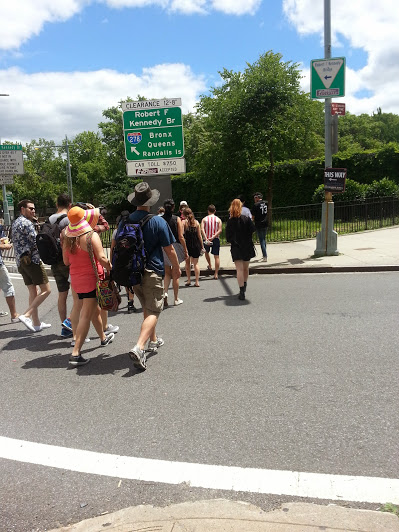
If you came to the Governors Ball Music Festival on Randall’s Island for the first time this year, you probably learned to expect the unexpected. For one, I learned the shuttle from 126th Street and Lexington Avenue to the West End entrance to the festival is far more convenient than walking the bridge, which stretches along the entire length of the Triborough Bridge. If you really want to experience the bridge, which results in a 30 minute leisurely walk or a 15 minute jog (at 5mph), go for it, as long as you are not running late for the show.

The Chain Gang of 1974 and Little Daylight at the Gotham Tent

I ran to the grass field underneath the Gotham tent from the East end entrance to catch the last few seconds of The Chain Gang of 1974’s performance of “Sleepwalking,” the single from the Los-Angeles based band’s second full-length release, Daydream Forever. Afterward, Kamtin Mohager introduced the closing song for their set, the hit that most fans recognize from their 2011 debut Wayward Fire, “Hold On.” The strength about this performance lays in the fact that the band was able to display plenty of gusto in their performance, and the lead singer’s efforts in paying attention to the audience members at the right hand and left hand corners of the standing area just beyond the stage was appreciated by the audience.

My only criticism at this moment focuses around the tent as a proper performance space. The speaker for the bass player might have been too loud, preventing me to hear the little nuances in “Hold On,” like the little trills in the last two minutes of the song that are produced by a synthesizer. However, this might also have something to do with the elongated tent. A highly raised canopy over the entire audience standing area and the sound control panel possibly made the sound bounce more than project.

I experienced the same loudness with the next band Little Daylight. Luckily, the timbre of the lead singer’s voice and the rhythm-driving synthesizers in the songs stirred my intrigue about this band’s musical style. Little Daylight is one band to research in the future.

This slideshow requires JavaScript.

Charging Stations and Conversations at the Miller Lite Tent

After Little Daylight’s performance which concluded at 1:30pm, I scouted the festival area to see the different business vendors, merchandise tables, game areas and food stations. By 2:30pm, the battery on my Samsung Galaxy had a life just below 50% and I knew I had to find a charging station quickly. At the festival, Citi Bank has a charging station for Citi Bank card holders. Then, the lounges reserved for VIP ticket holders had charging stations, but exclusively for these customers. My last hope was the Miller Lite lounge between the Gotham Tent and the Governors Ball Stage. I successfully found a station – a small bar table – where I could charge my phone, place my iPad mini, and chat with some interesting fellow concert goers.

The first visitor came from Melbourne, Australia. A college student who was traveling after completing a semester abroad in Los Angeles. He booked a ticket for the ball in January to see Outkast, and had come to the festival early where he waited to meet up with a friend. The other was a resident of Queens, who had moved to the states from the Philippines when she was 13 years old. She had also come to see Outkast, and while she planned to meet with friends for the entire three days, she claimed she wanted to attend the festival by herself for a few hours.

The young college student claimed that spending the first few hours of the festival alone enabled her to partake in additional musical acts and activities the festival had to offer without compromising her preferences. This reminded me of one of the perks of attending festivals alone – answering only to yourself.

This slideshow requires JavaScript.

The third stranger stood across from me from the bar table. He currently studies music business in college, and he came to the festival to see both Phoenix and Outkast. As I typed notes on my iPad mini, he told me about the festival last year and the shows that were cancelled due to Tropical depression Andrea – a storm that had not affected me, but certainly affected those who attended the concert. Luckily, many of the bands set to perform during that unfortunate storm were rescheduled the next day. Trust me, wet New Yorkers, who spent hundreds of dollars on a festival ticket never want to hear that the band they paid so much for and traveled long distances to see, cancelled the show.

The final visitor I spoke to came from Pittsburg, Pennsylvania, and he talked to us about the difference in security etiquette and people’s behavior at Bonnaroo versus The Governors Ball Music Festival. Apparently, Bonnaroo allows visitors to bring with them a specific amount of alcohol into the premise as opposed to Governors Ball. Based on experience where I saw a member of the security staff empty the booze from one man’s whiskey flask, I can attest this festival very strictly imposed a zero-tolerance rule. All alcohol had to be bought and consumed inside the festival gates.

Some Market Research: How Guests Used the Governors Ball Smartphone App

Governors Ball Smartphone App I asked these four visitors how they created their plan for the festival. They used the free Governors Ball Music Festival app. I too used the app and conducted a simple quantitative marketing research, a T-test in which I analyzed the number of times app users scheduled specific shows within their own course in comparison the number of app users who said they “liked” a band playing at the festival.

The data showed that more people scheduled bands than “liking” them and my initial hypothesis was the means for the samples of these two populations were very different. I then ran the test, and thanks to some help from one of my Facebook friends, I rejected my initial hypothesis. In layman terms, there was no difference in the mean of the two sample sizes of those visitors who included a band in their itinerary, and those who simply “liked” a band; those who scheduled the band perhaps did not bother to “like” the band.

All four concert goers claimed they used the app more for scheduling purposes than for fandom entertainment. I happily gathered some qualitative marketing research to help support the T-test results. Plus, it brought me great pleasure to find a way to mix what I learned in my Business School curriculum with social data from a large-scale musical event.

Janelle Monae and Bastille

As 3:00pm approached, I checked my Governors Ball Music Festival app and saw that I had to head to the Governor Ball stage for Janelle Monae’s set. During her set, I experienced the importance of little steps to the perfect spot within the audience that would give me an excellent view of the stage. While I got a view of the stage, I was so far away from Janelle Monae, I could only take pictures of her from a distance. Here was the best I could do; and in the midst of all my efforts, I indulged in the sounds of her hits “Electric Lady” and my personal favorite, “Queen.”

This slideshow requires JavaScript.

My experience with seeing Janelle Monae taught me that if I wanted to have a better view, a closer view of the stage and the artists performing, I had to arrive at a set at least 20 minutes early to beat the stand-stills of the crowd and squalor and ultimately, get a decent place for taking pictures. Luckily, whether a large mass of people dominates a large outdoor space or an intimate indoor setting, the performing artist can facilitate a sense of community among listeners. Bastille demonstrated this in their performance by performing covers of songs from the ‘90’s many of the audience members, especially those around the age of the band members, knew very well. These selections included “Rhythm of the Night” by Corona, and TLC’s “No Scrubs.”

(Please check out this great slide show of my pictures made possible by Google+) https://plus.google.com/photos/103337755454641381498/albums/6022561660631199729

Aside from creating a temporary sense of musical nostalgia among attendees; Bastille’s covers helped the audience sing along comfortably and confidently with the band. Of course, let’s not forget that members of the audience had come to listen to and watch live performances of Bastille’s original record, Bad Blood. Here is a snippet of one of their songs titled “Blame.”

At a particular point in the set, singer Dan Smith left the stage to travel through the crowded audience, followed by a single bodyguard while he sang the vocals to the song. Although this move easily excited the public, the tone of the atmosphere felt civilized. Everybody is respectful of each other’s space, including the musician’s. However, one audience member did overstep her – at least I assume it’s she – boundaries when she threw a bra on the stage. Dan picked up the undergarment and read the message penned on the inside of the cup aloud. I don’t remember the message verbatim, but I believe it suggested that Dan should Snapchat with her sometime. I recall that one of the musicians hung that bra on the keyboard and left it there for the remainder of the set.

(Here is a collection of all my footage from the Bastille show in one teaser. If you enjoyed it on my Facebook page, you’ll love it on my Google+ account) https://plus.google.com/photos/103337755454641381498/albums/6022559621574821937

This story covers what I did on the first day of the Governors Ball Music Festival. I look forward to sharing more content from the festival right here, and I will plan further ahead in the next days.

Holly Henry, Ready to Present a Different Voice

Holly Henry, Singer Songwriter Holly Henry, the 20-year-old musician based in Minneapolis experienced the turning point of her musical career when she performed Coldplay’s “The Scientist” on season 5 of “The Voice.” Getting all four judges to turn their chairs after her beautiful performance marked the first moment she introduced herself to the public as a major talent. When time came for her to choose an artist to work with, she picked country musician and producer, Blake Shelton.

“I said to myself, ‘I will choose who turns first,’ and Blake turned within two seconds. He was ready to work with me,” recalls Holly.

While the young singer-songwriter and multi-instrumentalist chose to work with a country music producer, Holly does not define herself as a country musician. After finishing her time with the reality television show, Holly met with producer and founder of the Grow Music Project, Chris Tyng to record and produce her latest single “Hide and Seek.” While Holly exhibits the same voice from season 5 of “The Voice” within this new single; the lyrical content within “Hide and Seek” resembles something different from the pop songs she performed on the reality show.

In the chorus of “Hide and Seek,” Holly sings I’m stuck in the corner/ I swear I adore you. I asked her about the inspiration behind these lyrics.

“I do have anxiety, and I wrote the song “Hide and Seek” about that, and how it affects my life and relationships with the people I love,” she says.

I investigated her repertoire of original music further by listening to her 2013 acoustic EP, The Immigrant. The lyrics in the chorus for the song “Paper Clips,” she sings Life has just tripped you up by your laces. Then, there is the title track in which she sings Be still your love, your broken heart/ ‘cause I will kill it.

“Paper Clips” was about growing up and how we all miss childhood,” explains Holly. ““The Immigrant” focused on someone loving you more than you love them. These are the ideas that go into the songs, but the lyrics are open to interpretation.”

According to her latest interview in a documentary of her experience with the Grow Music Project, Holly is most inspired by artists like Bon Iver and Lana Del Ray.

“The artists and singers I am most inspired by are the ones who know who they are, and who have a different voice,” states the young performer. “It’s hard to find someone unique… so when you do find somebody different you can say to yourself ‘Wow, I’ve never heard this kind of music before.’ That’s [they type of artist] that really intrigues me.”

The most intriguing quality about this developing artist is that while she returns with a voice we are all familiar with, we now have the opportunity to enjoy something more refreshing – beautiful and youthful voice that expresses an old soul. At the moment, Holly is searching for a producer who will help her create her first full-length record, one that will showcase the voice she looks to present to the world. It is my pleasure to welcome this young artist to a full-length feature article for the month of June to Music Historian’s Hear, Let’s Listen.

Holly claims when she tried out for season 5 of “The Voice” in early 2013, she did so on a whim.

“They [the show] always hold auditions every year, in 4 or 5 cities. That year, they held an audition in Chicago. My parents watched the show, and they really liked it, and I also found the show interesting. My Dad said to me “you should try out.”

“At the time, I was also in my gap year, I had just finished high school and I took a year off to pursue music. Not purposely the voice in the beginning.

“I went to their auditions in Chicago and went through three or four auditioning processes before reaching the final blind audition. I was not expecting to get called back at all, I didn’t think I’d get past the open call. I hadn’t planned for it, it all just happened,” explains Holly.

During this time, Holly had already published videos of herself performing her own songs on YouTube. These videos grabbed Chris Tyng’s attention.

“He actually listened to my YouTube videos way before I went on “The Voice.” He planned on contacting me but when he learned I was going on the show he thought “she’s probably not interested.” When he found out I got off the show, then he contacted me.

“I didn’t want to let that opportunity with the Grow Music Project go. Chris either chooses an artist, or an artist applies, for his specific program in which they record a song for free and he shoots a video documentary [of the project]. It is a first step into the industry. Chris is a great guy. He sits down and gets to know who you are and then helps show your voice to the world. I was happy to have someone help me make music that fits my persona.”

Holly Henry and Chris Tyng - founder of the Grow Music Project

So far, Chris has worked with Holly specifically on “Hide and Seek.” Holly claims she would love to work with him again. However, she is also open to working with other producers. I was curious as to what criteria an artist like Holly uses when hunting for a producer.

“Listen to what they produce,” she says. “Listen to other things they’ve produced and then figure out who they are – are they more high tech or very acoustic? Try new things; you never know exactly how you will work with someone.”

While Holly looks to continue her acoustic styling, as she presents in “Hide and Seek” and her first EP, she is also open to adding new elements to her compositions.

The Immigrant was [recorded as] just acoustic because we wanted to create something and put it out quickly. In general though, my music is not completely acoustic but more along the lines of “Hide and Seek” and some of the songs on my bandcamp website like “More Than Nothing” or “Secrets Spoken.”

“There was a lot less production on The Immigrant, whereas in “Hide and Seek,” we added cello, piano, drums and various instruments.”

Holly claims acoustic is also perfect for her because some of her songs which include topics about anxieties, reflections and love would clash with a very upbeat melody. While some producers might worry that her songs steer towards the mellower and possibly melancholy, Holly never received a negative message about her songs. As a matter of fact, she received plenty of encouragement from her fans. Holly Henry in Chris Tyng's studio

“When “The Voice” happened, the whole experience kick-started a fan base and this whole new way of life for me. They say very encouraging things, and I am very lucky to have people follow me. I receive messages all the time, both about my music and my struggles. People who struggle with anxiety and depression tell me “your music encouraged me to keep going and trying.” Honestly, that’s all I want to [hear and] do. I just want to help people out.

“People say my music is relaxing. It is not jamming music. It makes the listeners say “let me sit down and think about my life for a minute.””

The next steps Holly looks forward to most within her music career is releasing another album.

“I am excited to release new material to my followers. As of now, I have only released a single and an EP. I want to give them something new and complete, something I am extremely proud of.”

As she continues to address internal struggles within her songs, whether experienced by her or someone else, Holly describes songwriting as a therapeutic endeavor. Performing, however, does come with the territory, one she treads gracefully and with poise. One can see this in her performances both on “The Voice” and in a recent show at Lincoln Hall in Chicago.

“If I am feeling anxious, I can write a song and get my feelings out. Although performing music is quite frightening for me. Performing does come with the territory,” explains Holly.

“I was less nervous during the first time I sang on “The Voice” for the blind audition because I had been practicing that audition song “The Scientist” for two or three months. I had plenty of time to build up confidence for that moment. Plus, I didn’t know what to expect when I first went out.

“In the beginning, there was not too much fear to overcome, I was not very afraid. Towards the end of the show, I realized if I were going to do music, I would have to push through the anxiety. I might as well power through, and do what I love.”

I then ask myself, if this artist’s anxieties do not show anywhere in her performances – perhaps as a result of her perfect practice and discipline – then why does she choose to talk about it in her music?

“I’ve chosen to be public about it [the anxieties] not because I want pity or attention. I do it to let people know ‘It’s all right.’ I know so many people who have social anxiety, which can be quite crippling. I don’t have social anxiety, but it’s very common amongst others. It’s also nice to talk about it because you feel you’re not alone in your problems. I just hope I make people feel better about themselves,” she expresses.

Holly Henry in the Recording StudioPopular music listeners need an artist who treats professional musicianship and public recognition with greater dignity, humbleness and respect. Holly Henry fills this need both with her music and her persona. Now, Holly requires a producer to recognize this and showcase her talent to the world with an album that features her latest single “Hide and Seek.”

“There will be an album at some point,” Holly confidently expresses. “I have most of the songs written for it, but who produces it is still unknown. I’d love to work with Chris again. He understands what I want my music to do. He doesn’t pressure me into making my music something it is not.”

Most importantly, the best producer, whether it be Chris or someone else, should realize that in order for Holly to present the world a new voice, she must continue to deliver the same type of authenticity she exhibited in “Hide and Seek.” Recalling my previous interview with music producer Roger Greenawalt, the one thing a producer might ask in return from Holly is that she is ready to push herself and handle challenges, which might include performing more or welcoming more instrumentation. By having these needs from both the artist’s and the producer’s side, Holly Henry is ready to start the process of putting her new songs on a full-length album.

Alyson Greenfield Releases “Uncharted Places” on May 30th

Alyson Greenfield is one of those artists who are everywhere, both behind the scenes and center stage. Now she returns to the scene with new music and debuting her single “Uncharted Places.” Greenfield will release the track at the Roc-Elle Records’ curated Brooklyn Night Bazaar on May 30th at 8pm, performing alongside Hearts revolution, Ninjasonik and Demetra. See event details here.

Greenfield recorded “Uncharted places” at the Converse Rubber Tracks Studio with engineer Alex McKenzie, and then mixed the track with Roger Greenawalt. Watch some of her experience right here:

“I’m so excited to finally release Uncharted Places,” says the multi-instrumentalist singer-songwriter. “I’m also very excited about the new direction my live performance is taking. With the help of collaborators Interroben and Nate Morgan, we are able to produce a more dancey vice, which I hope translates into a more communal and vibrant feel.”

Alyson Greenfield performing at the Brooklyn Night Bazaar in Brooklyn on May 30th


Throughout the indie music scene in NYC, Alyson has become known for partaking in multiple projects. In the Fall of 2013, she directed and performed in the Tinderbox Music Festival. Earlier this year, she worked with film director Michael Carr to score a feature film The American Templars, and also had placements in the film SuperSleuths which premiered at the 2014 SXSW Film Festival. During this time, Alyson also formed a new synth-pop side project, Polyvox, with collaborator Joe McGinty, who also collaborated with Psychadelic Furs, and The Ramones. Additional highlights include becoming a regular at the Loser’s Lounge series at Joe’s Pub, and a featured performer at the 4th Annual Brooklyn Rock Lottery alongside band members of Oneida, Bad Girlfriend, Superhuman Happiness, and Rainer Maria.

Alyson is also known for participating in various musical communities throughout New York City. She talks about some of her experiences in this clip.

The Naked and the Famous’ Next Chapter: An Interview with the band’s keyboardist Aaron Short

The Naked and Famous Press Photo*: (L-R) Jesse Woods, Aaron Short, Alisa Xayalith, David Beadle, Thom PowersWhen I asked a member of The Naked and Famous, Aaron Short, to share one of his favorite moments as a professional musician, he told me, “Every time our manager tells us there is a free buffet breakfast included with our hotel room. It doesn’t take a lot to please us. Imagine how we reacted when a label from the UK wanted to sign us?”

One could definitely say Aaron has learned to appreciate the simpler things in life, especially as The Naked and Famous’ journey grows more exciting, opportunity-filled, successful and complicated. Continuing my conversation with Aaron, he then talked about the New Zealand-native Indietronica band’s big move to Los Angeles.

“Between the time we left New Zealand for our Passive Me, Aggressive You tour in 2010 and landing in Los Angeles in 2012, is a blur of 200 or so shows around the world. We were very ready to pick a spot to settle once we reached the end of it, and LA made sense to us for many reasons,” explains Aaron.

The favorable turn-out of their career in the U.S. provided one motivation for the band to stay in this country, and Aaron even mentions they did not want to “stray too far from a good thing.” Additional motivational factors include affordable avocados, rapid internet connection, and a peaceful house just outside of Hollywood. In this home, the band transformed one of the rooms into a little demo studio, a room that would become the birthplace of their latest album, In Rolling Waves.

As I thoroughly researched the band in the press, and listened to their music from their 2010 release, and 2014 album, I definitely felt a strong sense of artistic development. The Naked and Famous are currently between tours – having just finished Coachella and now taking on the Groovin The Moo Tour in Australia. Aaron very graciously took some time out to talk with me about the band and share the story of this group thus far. One of the parts within the story he shared that stood out for me was his forecast of a third album on the horizon, which he describes as “the next chapter in our book once this current tour is complete.”

While The Naked and Famous work towards completing their Australian tour, and what is most likely the band’s current chapter, I examine the earlier chapters of this band’s life through Aaron’s point of view. I am happy to welcome The Naked and Famous to Music Historian’s Hear, Let’s Listen.

Chapter 1: The Rule of Performing Live

When Aaron met Thom Powers and Alisa Xayalith at Auckland’s MAINZ music college in 2008, he did not consider himself a part of the band, nor really a musician. Instead, Aaron saw his future in co-producing within the studio environment. He credits Thom for being a “man with the plan.” Aaron recalls the moment they finished the band’s first EP titled This Machine.

“The demos we made doubled towards the end of term assessment submissions, which pretty much gained me that diploma. Thom was always a man with a plan though, and that [plan] was – make an EP, form a live band, get a song on college radio, play a few shows, and wing it from there, in that order.”

I wondered what Aaron meant by a “live band.” He explains, “Since day one, we’ve always had a rule that if something can’t be performed live, it shouldn’t really be in the recording. This law we followed was definitely more for us than the audience, and it dramatically changed our approach to writing, the way in which we recorded albums, and the live set up.

“What we have now is an incredibly exciting and active stage set up, which makes the songs much more satisfying to play. I find it is boring when I go to see a band play and hear a part [in their song] which sounds really cool, then I look around and realize no is actually playing.”

Learning this fact about The Naked and Famous’ approach to music also excited me. Based on what I initially understood from reading major popular music publications online; In Rolling Waves was the album that first incorporated this emphasis on the ability of successfully playing a song both live and in a recording. Luckily, the band has been doing this from the beginning.

Chapter 2: Push the Dynamics

Moving forward with the conversation, I wondered what changed in the recording experience of the band’s latest album compared to their first full-length debut in 2010, Passive Me, Aggressive You. When The Naked and Famous were writing their debut, the five members who – as Aaron explains – “draw from a massive range of musical influences” came to agree on one musical style. Aaron Short - keyboardist, pictures from North American Tour 2012*

“Though we all share many of the same favorites,” begins Aaron, “no one’s tastes perfectly match, which is beautiful. I personally come from a strong electronic music background compared to the rest, and this makes for an interesting dynamic when it comes to the production of our records.”

It is perhaps no surprise that, between the recordings of the two full-length albums, everything about the record-making experiences differed. Talking with Aaron, I felt Passive Me, Aggressive You was The Naked and Famous’ first chance to stretch their muscles as electronic musicians, helping create memorable and dreamy tracks like “Young Blood.” As for the second release, Aaron says:

“We put a lot more consideration into the parts being written and refined them to the point we felt they were as powerful as possible, without relying on the use of excessive production to make a track ‘big.’

“There is also this encompassing sense of being a little more grown up this time around. “Young Blood” was written as a demo in 2009, and we were 4 years on from that when In Rolling Waves was completed. You can definitely feel that in the themes of the lyrics, and the construction of the songs.

“We also made an effort to push the dynamics of this record; making those quiet moments even more delicate, and the darker and heavier moments more powerful than on the first record.”

The evolution in the lyrical themes between the two records will stand out to listeners. The lyrics in “Young Blood,” express a shaky love between two people – probably adolescents – who want to be together for no other reason than simply being together. The lyrics are:

We lie beneath the stars night/ Our hands gripping each other tight/ You keep my secrets hope to die/ Promises swear them to the sky…

Fast forward four years, the vocal timbre remains the same, but the tone behind the lyrics changed. Now, The Naked and Famous perform a slightly different tune in the song “Hearts Like Ours” which includes lyrics like:

Could we try to reinvent?/ Feed the head with common sense/ through the streets and avenues/ climbing up the walls with you…

The theme of growing up is evident to the listener in this song. Here, the story between the lovers may have started with the illusion of promise and might be now finishing at an impasse which is represented by the question ‘can we grow together and continue this journey, or should we part?’

The Naked and Famous, photos from their North American Tour 2012* Chapter 3: Cool Heights

One might say that time will change anybody’s attitude about their lover, life or even themselves. The same applies for artists. For The Naked and Famous though, their experiences as full-time professional musicians between 2009 and right now speaks louder than only the time that has passed between their album releases.

While the band did not make an additional full-length record between 2009 and 2014, The Naked and Famous did release B-Sides and Remixes which were extensions of their original works and compilations of songs that did not make the album. In addition, the band created a live film of their Passive Me, Aggressive You tour cycle in a live film they released in 2012 titled One Temporary Escape. Aaron says:

“We made it available for free download in HD and with fully mixed audio, as a nice way to wrap everything up before moving to the second album phase. Our live shows reached a pretty cool height at that point, and we want people to see how much better the show looked as opposed to watching if from one of the 10,000 shaky distorted mobile uploads on YouTube.”

Now, the band can expect plenty of additional mobile uploads from fans after “conquering two incredible weekends at Coachella” something the band has looked forward to for years. They are currently touring Australia, which according to Aaron, has involved enduring colder weather than they are typically used to, along with an overloaded van and plenty of long drives.

While Aaron did not mention anything in regards to a live film of the In Rolling Waves tour, fans can keep up with the band by following The Naked and Famous on Twitter – @tnaf – and Instragram – @tnaf. In the meantime, more information about their tour is available on their website thenakedandfamous.com. If you are a New Yorker, you have a chance to see The Naked and Famous perform amongst an exciting line up which includes Jack White, The Strokes, Fitz and the Tantrums, and many more on Saturday, June 7th at the Governors Ball Music Festival. Click here to get tickets.

The Next Chapter?

I feel fortunate to have caught one of the members of a band that is currently experiencing a riveting stage within their career. In addition, my conversation with Aaron reminds me of a piece of advice I received once during my time as an undergrad in Music History – “do what you love, and the rest will come.” Aaron’s experience perhaps parallels these words well. Press Photo*

For a musician though, ‘doing what you love’ is not always easy. Their career might involve relocating to faraway places, and taking on experiences filled with challenges like cross-country tours and squeezing in time for some publicity. Yet, getting to these experiences and achieving these benchmarks is part of the job, and the reward waiting for some, after the successful turnouts at shows, the large album sales, and the additional promotional merchandise, is a peaceful home and the beginning of another album. Although we so far only have a hint of news about a third record, The Naked and Famous would definitely say “We’re getting there.”

*All photos were published with permission from CRS Management in New Zealand

Let Your Heart Hear It First: An interview with John Elliott and Performance Review

John Elliott at the Cantina Royal in Williamsburg, Brooklyn John Elliott’s songs appeared on the television shows “Grey’s Anatomy” and “One-Tree Hill.” He even co-wrote a song within one episode of “Californication.” Yet, for most of his career, John remained an independent artist.

“It’s a serious balancing act,” explained the San Francisco-based singer-songwriter. When I asked him about the benefits and challenges of staying independent in the music industry, John honestly and humbly answered, “Sometimes the benefits outweigh the challenges and sometimes it’s the other way around. I’ve mainly stayed independent because… I just haven’t met the right people yet. Actually, I might have just met the right people the other day. We’ll see how that goes.”

He adds, “I do have someone working with me who started as a fan, and now because she believes in what I make and I [in turn] believe in her, she has become a valuable member of the team. I think that’s a rare relationship to find. I would love to continue to build a team, but it has to be with the right people.”

Since high school, during his first attempt to write music on a blank tape from 1993, John knew he wanted to pursue music as a career. So far, he has entirely self-produced all his records, including his latest Good Goodbyes – the first record on which he played every instrument, and the one that perhaps presented the most challenges. Now, as he continues the journey he started long ago, John Elliott reflects on the radical experience of relying solely on himself to bring his music to fruition. It is my pleasure to welcome John as the featured artist for the month of March on Music Historian’s Hear, Let’s Listen.

In the title track of his record, which is composed in a major key, John sings the following lyric, “I can’t let a good thing go even when it starts to bleed,” followed by, “Even when I know it’s dying and it’s time to set if free/ I’m afraid I won’t be treasured/the way she treasures me.” John wrote this song in 10 minutes one morning, without even writing the lyrics down.

He says, “I don’t question songs that come [to me] like that. They are just pure and right. If I look at it now and try to analyze it, I would say it’s [the song] about moving on from something without knowing what’s next, which is a scary thing to do. People always say “let it go, let it go” as if that’s something safe or easy. I think it’s a little disingenuous to claim you can just lightly skip into the future, unencumbered by the past, never to return or look back or wonder.”

“Of course,” he continues, “the album is called Good Goodbyes, so I understand that moving on and elsewhere can be, and often is, a good thing. The rest of album definitely lives under the umbrella of that song.”

As a critic, I find it comforting when the title track of the artist’s album is born with little effort and yet holds so much meaning that analyzing the lyrics might take 10 days.

John confirms, “It’s not about how “easy” it is to write something, it’s about how right if feels. I know when I write well, with honesty, passion and heart. When I try too hard, it’s no good.”

Other songs on his album like “Yin and Yang Collector,” “Monogamous” and “Friends Back East” seem to tell a definite story. I wondered whether these songs had a story and whether John spent more time trying to write them compared to “All These Good Goodbyes.”

“Generally, it’s doesn’t go well if I start by trying to write something with a message. That’s tricky. It’s better if the story, images, or lines are strung together by emotional truth of some sort. If you get that right, a message “might” emerge. The best writing is a little mysterious, but somehow makes perfect sense to your soul. You have to get your head out of the way and let your heart hear it,” explains John. John Elliott on Guitar at Cantina Royal

John describes the lyrics on his album more as poetry than storytelling. He also recalls a moment when he performed another one of his songs from Good Goodbyes, “Still I’m Not Still” for a producer. “That’s not a song,” remarked the producer, “that’s a meditation.” While John admits the producer might have meant to say this as a negative remark, John received it openly and happily. He claims “I loved it.”

Like most artists who perfect their craft (and the art of letting a song take its form without exercising too much control is one of the ways to be perfect), John has written, and rewritten a myriad of songs that did not make his latest record. By the time a song does make it on his album, he has “obsessed over every line” both lyrical and musical.

Listeners, of course, are another important part to any musical experience, and John’s music is no exception. “Every listener brings his or her own unique perspective to the experience, and might hear something radically different than what you intended,” adds the artist.

In the case of Good Goodbyes, I couldn’t help but feel that John really went out on a limb and made himself very vulnerable, especially since he was the sole creative and functional driver of this record. On his past albums, John included a number of different players in the process. He claims the making of his latest record “happened during a very solo time in my life and as the process of creating it continued, I realized it was important to me that I remained true to that.

“It’s quite unnerving to rely solely on your own intuition with creative choices that have no objective basis. It’s also, eventually, quite satisfying.”

Good Goodbyes also taught John how much he relies on other people for approval about his music. Although he enjoyed the experience of producing and only answering to himself, he still needed a second set of ears. After putting the record through seven revisions, John invited mastering engineer JJ Golden to help frame the final product.

“I tried to bring all the disparate pieces and sounds together into something cohesive,” he explains. “It’s a collage, and it has some sonic flaws, but hopefully that gives it character.”

Watching John during one of his live shows on his nation-wide tour back in November, I listened to and watched an artist whose music brought a character out of him, one who believes in himself so much and manages to attract an audience that believes in his sound and performance.

I walked in to Cantina Royal, a restaurant in Williamsburg just in the nick of time to see John Elliott. Secured with a Brooklyn Lager, I traveled down a red-light lit hallway to a performance space behind a gritty grey door.

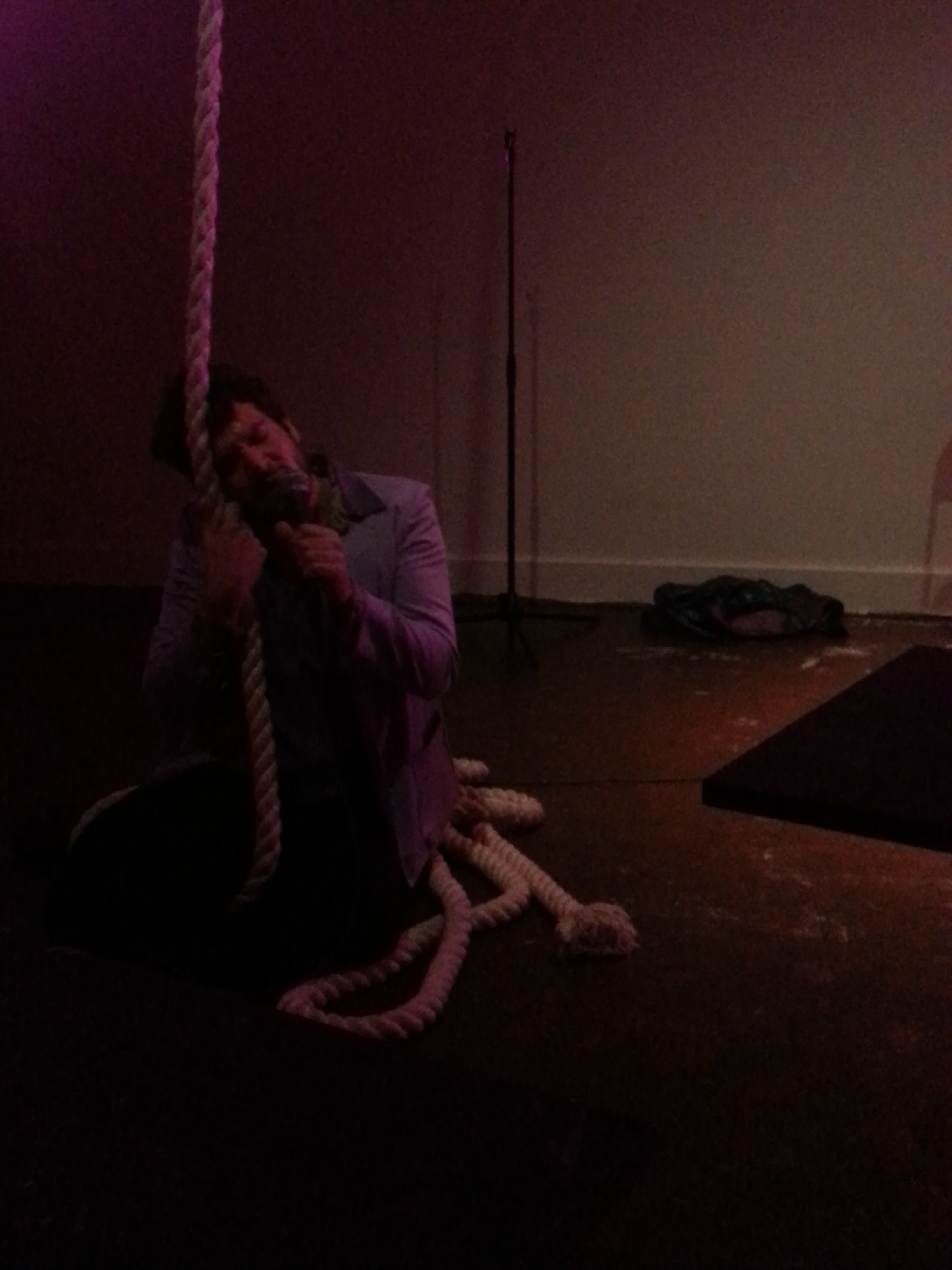
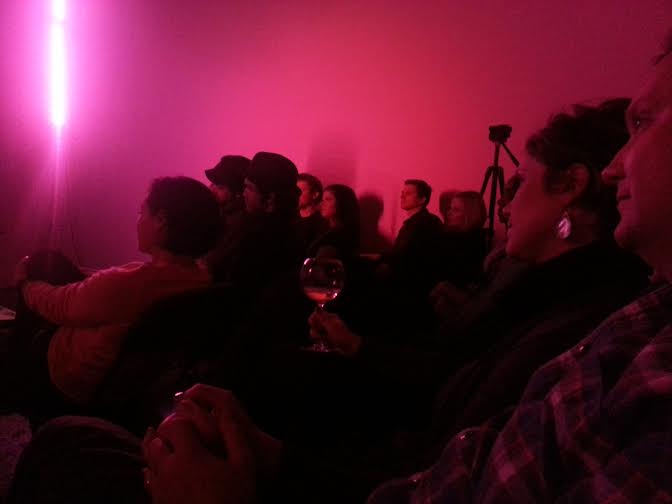
In this performance space, there was no stage but a clear floor. There was plenty of room for audiences to take seats in rows of mobile chairs and mini tables. Pink and blue lights covered the space designated for acts. In the far left corner of the room, I noticed the uncanny detail of a rope that extended from the high ceiling and coiled out on the floor.

Most chairs were filled, and the only available seat was at a table occupied by a couple. As I sat down and prepped myself for a night of intense observation and musical analysis, I occasionally peeked at the flirtatious exchanges between the man and the woman next to me. Underneath the table, the guy caressed his girlfriend’s bare knee as she sketched a picture on some scrap paper. Both shared a package of very low caloric snack of seaweed sheets. Perhaps they decided this food paired well with beer? I was not sure whether this combination was romantic or strange.

Returning to John’s performance set, I knew I was in for a performance I would never forget. And I was right.

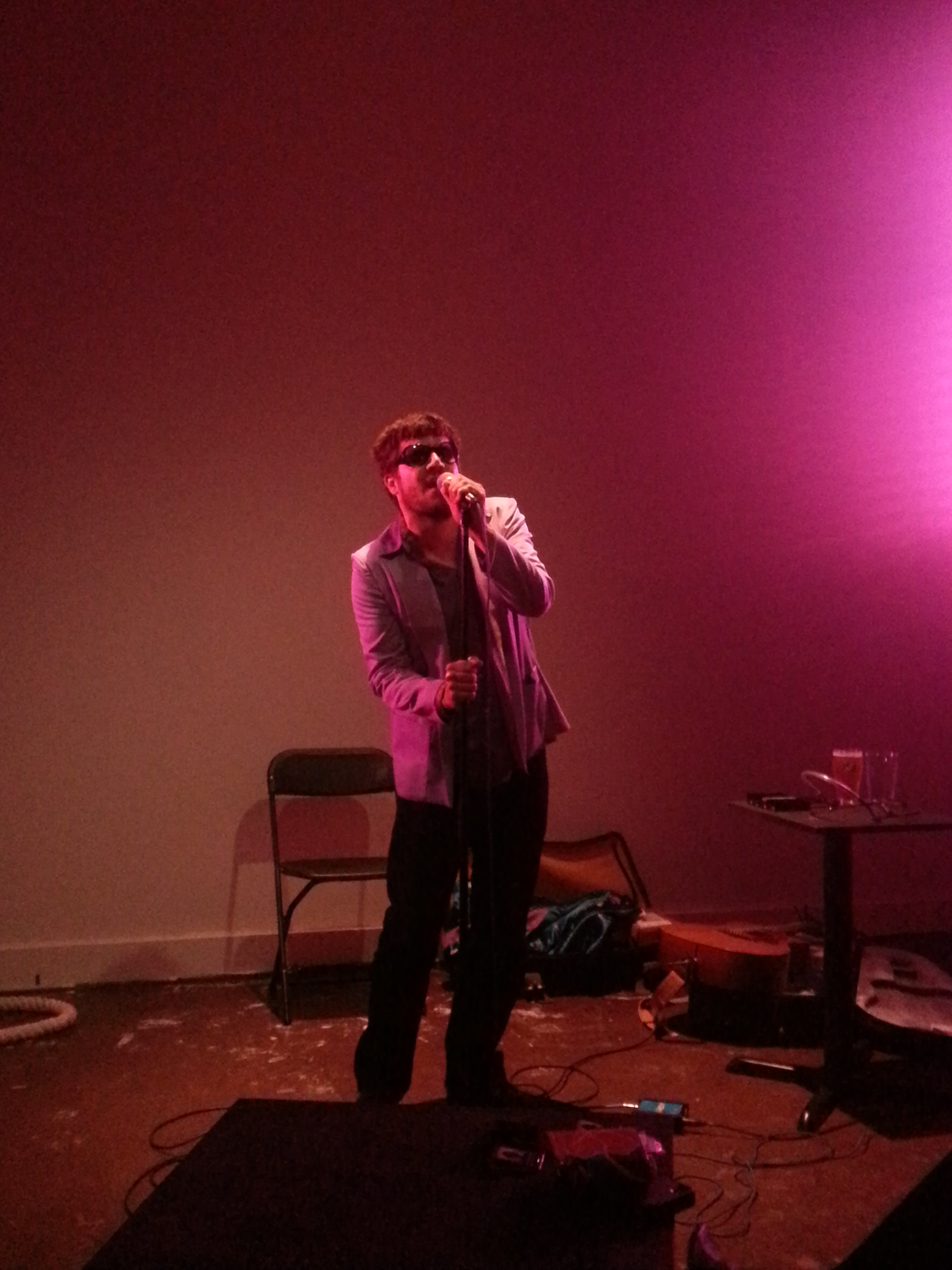
During his song “Monogamous,” which is primarily built on ambiance created by electrical and synthesized instruments playing held out notes, there is a long period in which John does not sing. On the record, the artist can get away with this, in a performance it is a different story. John knew he had to fill up that silence with something, so he started to swing on a rope in the far left corner of the room; a move several audience members found amusing. John Elliot in Williamsburg, November 2013

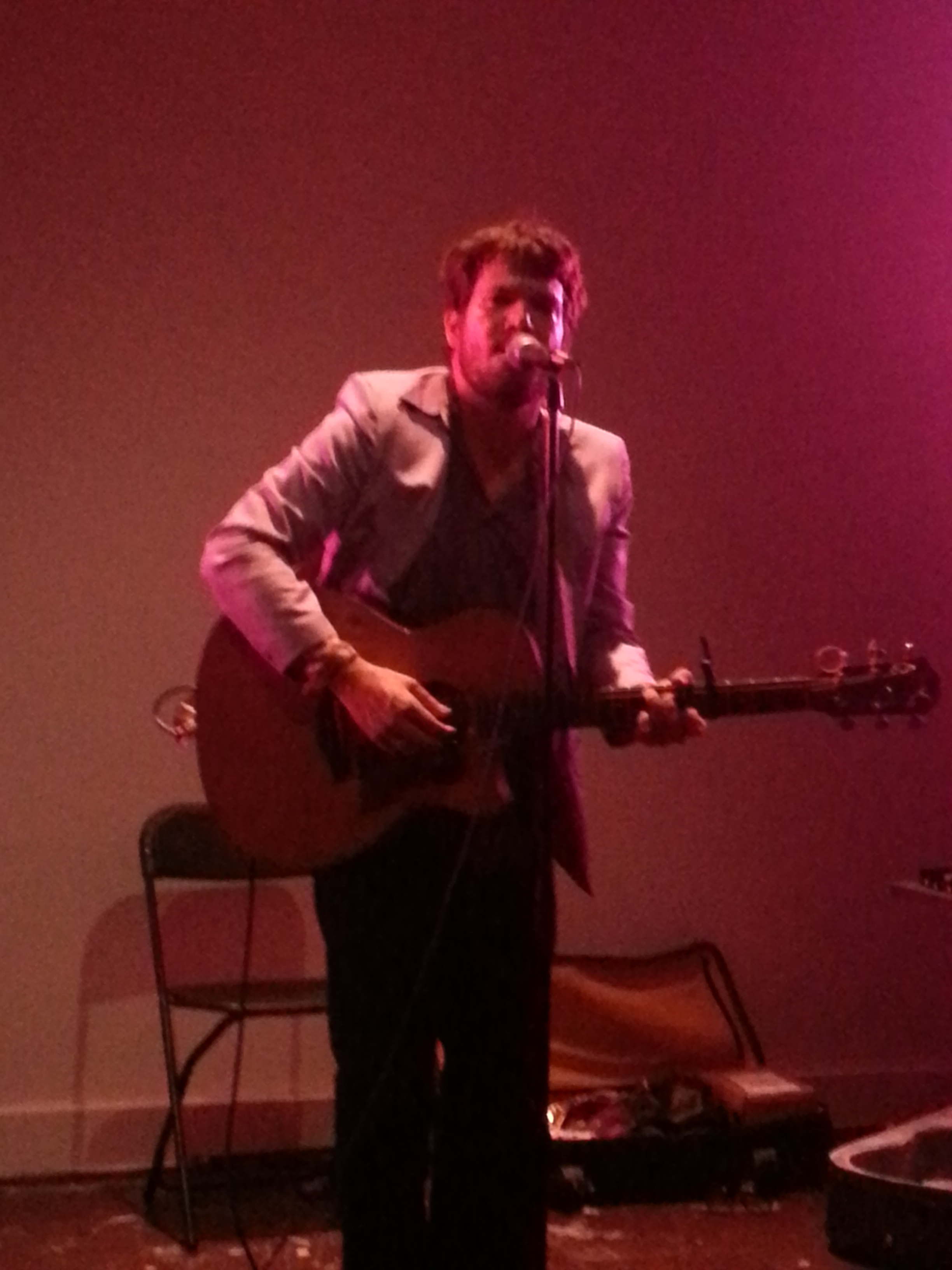
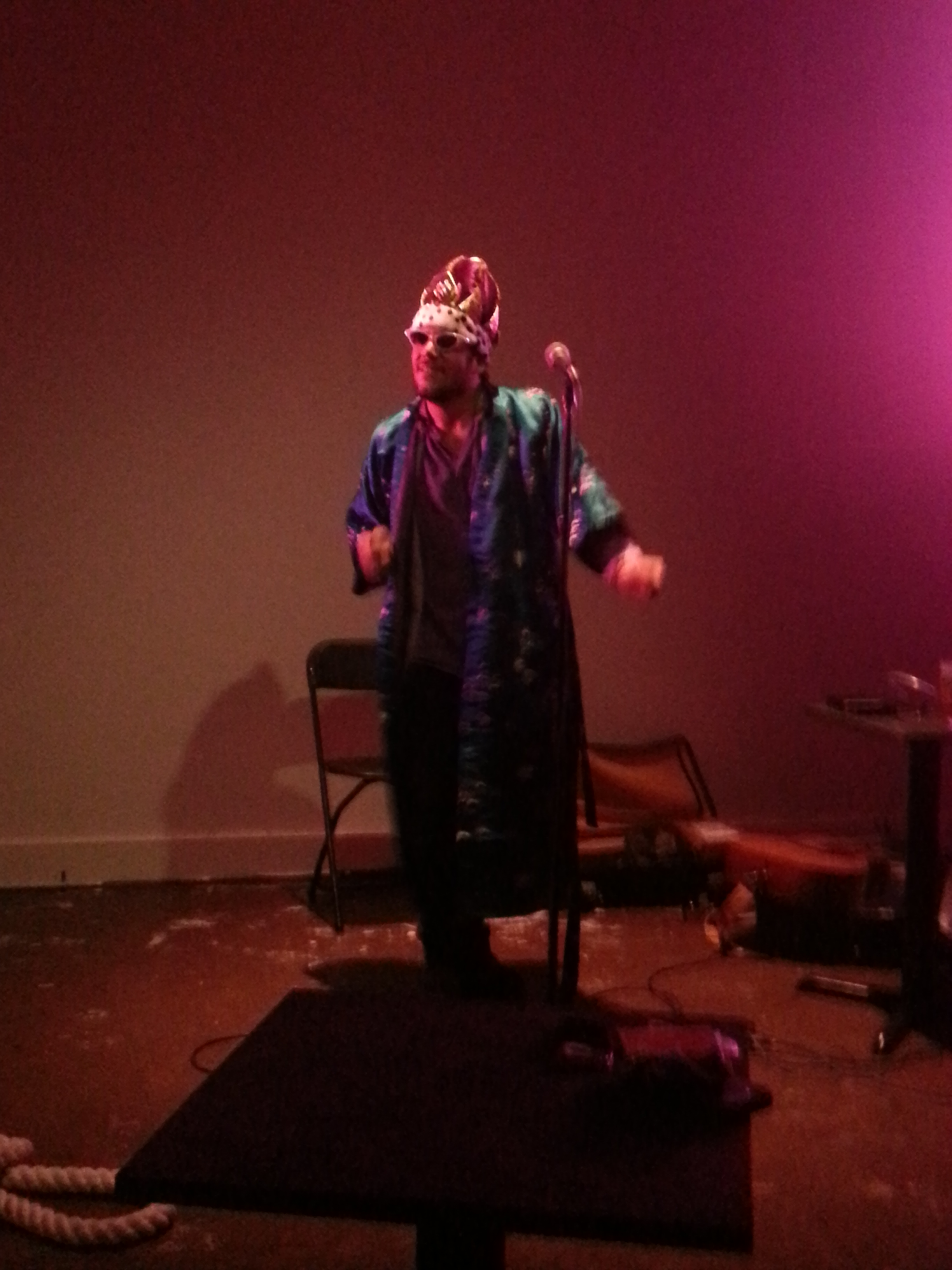
For his next song “Yin and Yang Collector,” John had a costume change. He dressed as a king, one that somebody might find in a frat house in New Orleans as opposed to one in a dramatic film about Henry VIII. During this song, he picked up his guitar and started playing like a true singer songwriter. But, I soon learned the surprises were not yet over.

John did not finish “Yin and Yang Collector.” Instead, he looped into another song, a cover of “Somewhere Over the Rainbow,” then transitioned back to “Yin and Yang Collector.” An artist successfully and easily accomplishes this only when the tonic of another song is the dominant or the predominant of the song they initially sing. This makes for easy modulation, and often, one will not find artists doing this during a performance but rather in their private time practicing.

John Elliot at the Cantina Royal in Williamsburg, Brooklyn in 2013As I looked back to the couple, I noticed the woman started sketching a new picture, one of a masked face that imitated the appearance of John’s costume. It made sense then and there that something about John’s performance successfully captivated the imagination of one and perhaps multiple members in the public.

When I asked John what audience members said about his music during his tour, he remarked that most of what he heard has been “positive!” That or complete silence,” he adds. “A few people said it’s their new favorite. One person told me how much they liked this album more than the last.

“I just finished a show in Bellingham, Washington. Someone told me [I put on] the most entertaining show they’ve ever seen, so that was nice. But really, I have to remind myself to make what feels right to me and then let it go.”

John recalls a few moments from his tour in which listeners did not enjoy his set. During his show at Cantina, he humorously told the audience about the reception of one of his songs.

“This song went well in Austin, but horribly in Oregon because it was a song about people in Austin. Then it went well in Pennsylvania.”

Humor is just part of John’s nature, it is no way a coping method of dealing with the downsides of being a musician. Sharing your creation with the world comes with the territory, and that is why so many individuals who probably have songwriting talent will not pursue anything with music. Luckily, John understands this territory well, having traveled it before. He claims:

“The album is out there now. I hope people listen to it and like it. I’m very proud of it… And I’m thinking about what to make next.”

Currently, John is in between touring for Good Goodbyes. His agent is currently booking shows in the Midwest for 2014. In the meantime, he tackles the toughest component of any business plan, the marketing of his product. Audience at Cantina Royal watch John Elliott, November 8th, 2013

“Promotion is the greatest challenge of releasing an album independently. Truth is, I had some good plans in place, and then I went on tour and lost track of things. I want more people to hear it… I funded this album myself with savings from tours and other music income.”

When I asked him about the most important lesson he learned about being an artist and a businessman, he openly claimed, “The most important lesson I’ve learned as an artist is that everything happens in waves and you must learn to ride them. The most important lesson I learned as a businessman is that I’m learning as I go, and sometimes I luck into great decisions. In general… I need help on that side.”

John’s story of making and promoting Good Goodbyes is honest. It reminds listeners that like heroes in our favorite novels and films; if a musician does not go through any struggle, whether it is letting go of an old relationship, a bad habit or faulty belief, or a challenge of understanding business or making music, there is no reason for that listener to care about the artist. As for John’s music on Good Goodbyes, which is now available on iTunes, his website http://thehereafterishere.com/recordings, on Spotify, and, of course, at his live shows, the album will draw listeners into his world of expression, one that reaches the soul on an esoteric yet comforting level. Perhaps it is no surprise why his songs appeared in the hit television shows among audiences that fall within the 25 – 40 year age range. John presents us with something worth listening to, but we have to get out head out of the way and let our hearts hear it first.

Just Listen: Trumpet Grrrl Brightens Days with her latest music video “Rain Boots”, public performances and upcoming record

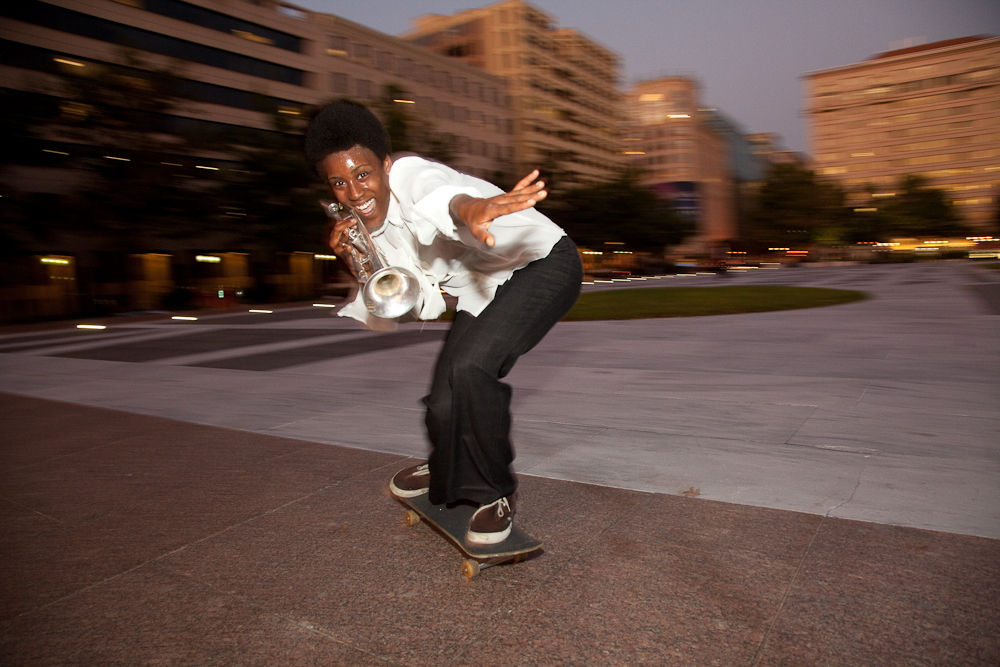
New Press Photo of Trumpet Grrrl. Courtesy of Cultured ProductionsThose who follow Trumpet Grrrl – a young musician who moved from the Burtonsville, MD to New York City to achieve her dream of being a singer songwriter – will tell you her music is “fun, quirky, soulful and creative.” These adjectives also accurately describe the music video for her new single from her third album in the works, Just Listen, called “Rain Boots.”

In her music video, Trumpet Grrrl skateboards to a second-hand clothing boutique in Brooklyn with a box of her clothes. One of these items is a pair of cute girly rain boots. She trades them in for cash, and in a funny turn of multiple events, these boots get in the hands of several different owners, and somehow find their way back to our heroine.

This music video was made possible with the help of Cultured Productions. Trumpet Grrrl explains:

“The Cultured Productions team thought of the serendipitous theme, and I added my own flair with the dancers and skateboarding. The whole process took about 6 weeks from planning to release. We filmed in one day.”

As I listened to the lyrics within the song, “You only think of me when it’s raining/ pick me up while complaining/ walk right over me/ kick through the mud with me,” I wondered whether the topic of the song focused on something more than rain boots; perhaps a relationship or friendship? Trumpet Grrrl says, “During an overcast day, I left my house, and realized I left without my umbrella. “Rain Boots” spawned from the line “You only think of me when it’s raining.” I intentionally wrote the lyrics in a manner that listeners could interpret in multiple ways.”

Researching her last two albums, It All Starts Here (2012) and The Basement Tracks (2011), and a track recorded with producer Matt Shane at Converse Rubber Tracks studios called “Afghan Palace”; I sensed Trumpet Grrrl developed from a newbie on the music scene to a must-be-heard talent. So, I invited her to be this month’s interview feature on Music Historian’s Hear, Let’s Listen.

Trumpet Grrrl picked up the trumpet at the age of 10 and has been hooked since. Private lessons and summer camps served as the starting platform for her classical music training. In later years, the trumpeter would perform at Carnegie Hall and the National Symphony Orchestra on a fellowship. In 2008, she received a Bachelor’s of Music in Trumpet Performance from the University of Maryland, College Park.

“I love the beautiful sound you can get out of the trumpet,” the musician explains. “I feel I can truly express my emotions through the trumpet; I tend to fumble when it comes to words. I also have a very active brain, which is easily calmed by music. In the end, the fact that music is awesome kept me ‘hooked.’”

Trumpet Grrrl by Larkin GoffDuring her final months of college, Trumpet Grrrl formed the rock band La Coterie where she played keyboard, sang lead vocals and composed music. Two years later, she left the band to start her solo project. Here, she taught herself to play the trumpet and piano simultaneously.

Watch her Youtube videos, and you know Trumpet Grrrl has proven herself a multi-instrumentalist. She claims that playing two instruments and singing at once provides room for varying tonal colors and harmonic motions. The challenge is the quick change of putting down the trumpet and getting her right back on the keys, which according to the musician, can lead to a fallen trumpet. During live performances though, Trumpet Grrrl says her skills creates a “wow!” factor for the audience.

Since she went on her own, Trumpet Grrrl has written all her own songs and has developed her own style of music. “My sound is original, soulful and emotional,” explains Trumpet Grrrl. “I tend to attract fans from varying genres. Based on this I’ll say indie soul, jazz, pop rock.”

Trumpet Grrrl also claims that patience is one of the biggest lessons she learned over the past three years.

“Trying to force myself to compose never works; I have to let the song come to me. Over time, I’ve gotten better at expressing thoughts in different ways and in a concise manner. The fewer words I use to express something, the better. Additionally, I have a better feel of which chords and song structures I want when writing.”

Now, as she prepares for the completion of her third EP, Just Listen, which is set for a date in late summer or fall of this year, Trumpet Grrrl sums up the experience of making this record.

“In my first two albums, I literally did everything myself. I played all the instrumental parts, recorded on home equipment, produced it all and did my best mixing. For the first time, I will record with GRAMMY award-winning producer Scott Jacoby and have a band – a guitarist, bassist and drummer – play the songs. Scott is producing and recording; he has a great ear for little flairs and additions that can make a song pop! Recording my third album [has been] amazing.”

Trumpet Grrrl. Photo taken by Larkin Goff “Rain Boots” is just one song from Just Listen that pops. Trumpet Grrrl claims that she will release two additional songs from the EP before its official debut. The performing artist also says “while fun is the most important reason to make a music video, the primary business of creating a music video is promotion.”

Earlier in 2013, Trumpet Grrrl participated in a Twitter chat run by @GoGirlsMusic, held weekly on a Thursday, called #ggchat. Here, she inquired about companies that produced music videos and was referred to Cultured Productions. She claims the company’s investment in social media was a key decision factor.

Trumpet Grrrl’s low and sultry voice and her trumpet skills blows listener’s minds. “Rain Boots,” which Trumpet Grrrl also produced with Jacoby, is catchy, and memorable, especially as it exudes a New Orleans jazz band charm with splashes of pop and soul. Enthusiasts of indie films will find charm in her music video for “Rain Boots” as they watch how much joy someone can experience in simple pleasures while living in the complicated, urban, cluttered and fast-paced landscape of New York City. This music video is bound to brighten someone’s day.

Prior to recording songs for Just Listen, Trumpet Grrrl also wrote the cheery, experimental and gospel-imitating track “Up!” from The Basement Tracks. If listeners seek a minor-key song with a cool electric guitar solo to help drive away their daily blues or mentally travel to another place, then “Afghan Palace” will fulfill this musical and emotional need.

When I asked Trumpet Grrrl on what she hopes fans of her music take away from Just Listen, she responds, “Whatever feelings it gives the listener; I love hearing their various emotional responses and thoughts. It’s always relative to what they’ve experienced in life.

“Since moving to NYC, I have also played on subway platforms. Nothing makes my day like the reactions I get. Some [people] will start dancing, draw pictures of me, miss their trains to listen and some just stop to encourage me to follow my dreams. It really warms my heart when I get a “thank you,” and when my music is received as a gift and brightens someone’s day.

“I have written a fair amount of songs with the intention of cheering myself up and fans tell me it does the same for them. [That’s why] I named the album Just Listen because that’s all I want. I truly believe my music will [brighten] people’s day if they just listen.”

Trumpet Grrrl reminds us that consistent and constant performance, and playing an instrument or many in addition to singing, makes a good musician a memorable and well-received one. Whether the audience observing the show is passing through the subway, sitting inside a comfortable landmark performance space, or surfing on Youtube, listeners respond well to confident performers. Trumpet Grrrl finds happiness in performing, and in turn, this brings her pleasure and contributes to her development as a singer-songwriter and artist.

A World of Wonderful Machines: The philosophy behind Yuzima’s new LP

Yuzima Philip, Press PhotoNew Yorkers might recognize Yuzima for his performance of “Hey Jude” at the annual Beatles Complete on Ukulele concert. While the concert approaches, Yuzima is currently celebrating the release of his latest LP, THE MACHINE.

The singer songwriter describes his earlier works – Sound Opera – Project One (2012) and Powerful (2012) – as statements, larger than that of his additional work Glasnost (2011), all adding up to THE MACHINE (2013). “The songs on THE MACHINE are bigger, more pop, and more political. Everything is more,” he explains.

“Get Things Done,” is the first song on the album that gives the listener any idea about the meaning of the record’s title. The vocalist mentions within his lyrics how everyone should have dreams so that they can avoid becoming part of “the machine.”

In my first full-length interview feature for 2014 on Hear, Let’s Listen with Yuzima, I come to understand the machine he describes only operates properly with contradictions, politics, and musical craftsmanship.

“Everything is a machine – your family, your neighborhood; they all have systems, habits and levers,” explains Yuzima. “We all know what makes our families work: who’s who, who’s a bully, who’s artistic. It’s a system.

“People like to think of things in a very compartmentalized way: allies and enemies, etc. Life in essence is about competition. We’re all the current players in the way life works.”

He adds, “You can’t escape “the machine.” The minute you exit one you enter another. It happened in the 60’s going into the 70’s where many learned that the alternative of the system was another system. On the other hand though, you can “escape the machine”, in the instances of, being yourself, getting out a bad relationship, and more. In the end, the artist wants to be free.”

THE MACHINE Poster

As I listened to the song “Get Things Done,” I wondered whether Yuzima feels that there is a moment where individualists want to be a part of the machine – a collective in which individuality is lost. According to Yuzima, this is “the irony of human nature.” He enumerates:

“People want to be alone – just in a crowded room… We’re all working together while competing against one another.”

Yuzima helps express this contradiction through his music. The first few tracks of his record include a fragmented musical form. For example, “Black Graffiti” has a guitar that produces riffs which follow measures with specifically placed rests. There is a disruption in the harmonic flow of the chords. Yet, the clear and imagistic storytelling keeps the listener moving throughout the discord of the song. Half-way through “Black Graffiti,” a listener will soon start putting together in their own minds how to sing the song back in a continuous flow that follows the harmonies from the music and Yuzima’s vocals.

By the time listeners get to “Sex City,” they no longer have to make the inner effort to put a fragmented song together. Instead, Yuzima delivers a more easily audible tune that listeners can immediately sing back. In this song, he sings, You were spotted on the outskirts of town/ looking for a new drug…

Yuzima reminds listeners of experimental independent music that no matter what message is being expressed within the song; chord progressions, vocal melodies, harmonies and rhythm come first. Meanwhile, his vocals include a hint of soul that resonates deeply with the listener, especially when the lyrics tell a story about love, violence or societal troubles. “Black Graffiti” and “Sex City” are such examples. Then, there is the simple political message in the song “Guns,” expressed through lyrics guns kill.

Yuzima claims that while he freely makes political statements in his songs, he does not classify himself as a political artist. He says:

“I write about what is happening to people and what they are going through; kind of like a documentarian. If you don’t write about what is really going on, you’re playing pretend.”

While Yuzima may repeat some of the lyrical practices artists before him implemented, like politically themed messages – which I believe veers toward the prosaic – and compositional experimentation; the clear artistic reflection between song structures and titles – a practice he has implemented throughout all of his music – presents something new for the independent musical culture.

“Anarchy,” for instance, includes several musical ideas, like an electric guitar riff playing with drums against the fragmentation between the song and the lyrics. The song evokes a feeling of disorder. Listeners can guarantee that all his songs on THE MACHINE will accomplish this reflection between song structures and titles.

“Music for me is an art form from top to bottom,” he enumerates. “I’m thinking of these songs from the beginning to the end. Some songs, you want to be easy while some you want to be more ambitious.

Yuzima, Press Photo “In order to be ambitious, you need to break rules. Yet, at the same time, you need to get to the point – for instance, the drums on “Anarchy” have a monochromatic hard hitting sound to them. The guitars have a militant feeling to them with discordant notes, and the chorus is a ground shaking explosion.”

Clearly Yuzima is the type of experimental musician who makes a plan for each of his songs, putting a great deal of effort and love within each track. On this note, he makes a point to keep his collaborating and recording process very restrained. Yet, Yuzima openly listens to feedback from reliable colleagues, including mastering engineer Nathan James, who “throws the magic” on the music.

At the end of our conversation, I learned the machine is a system that feeds on overused politics and the contradictions produced by human nature. This system exists in all dimensions within our present societies, the societies that once existed, and the ones yet to emerge. I also learned that philosophy has always been the hidden hand behind Yuzima’s most pop-inspired material, including THE MACHINE. Yuzima shares the quote from Red Plenty that inspired the theme of his LP.

“Capitalism created misery, but it also created progress, and the revolution that was going to liberate mankind from misery would only happen once capitalism had contributed all the progress that it could, and all the misery too… At the same time, the search for higher profits would have driven the wages of the working class down to the point of near-destitution. It would be a world of WONDERFUL MACHINES and ragged humans.”

While these philosophies might have inspired political and social movements, Yuzima does not serve a political agenda through his music. Instead, Yuzima wants to express the nature of machines – systems that leave little room to reinvent the wheel but at the same time require changes, usually brought about by the continuation of time, in order to survive. The artist successfully conveys this idea through his music by accomplishing two different goals simultaneously. The first developing the symbolic relationship between the titles of songs and structures which validate each title’s specific tone. The second, breaking some of the compositional rules of pop music through fragmentation, the imbalance in the volumes of the electronic instruments, and that unsettling industrial noise.

THE MACHINE Cover Art Yuzima’s THE MACHINE inspires lovers of experimental indie music to embrace a new listening experience. This might be why writers described Yuzima as a “rising indie luminary,” while fans deemed his music to be “bad ass” and “flawless.”

Yuzima will perform songs from his latest LP for audiences on January 11th at Pianos NYC. In the near future, he also plans to debut three music videos for THE MACHINE online. THE MACHINE is currently available on iTunes, Cdbaby and Bandcamp.

Experimental Classical Music Exists in a World of Art: My Conversation with Ian Fiedorek, composer of Fallout Symphony

Ian Fiedorek Experimentation with classical music quietly lingers around the New York City music scene. Singer songwriter Ian Fiedorek, and the composer the project Fallout Symphony states the following about experimental culture and instrumental music in the city, “I don’t think too many people are thinking in terms of the classical structure, the four-movement structure … but there’s an incredible wealth of experimentation happening in New York generally. By nature, categorizing or pigeonholing this music can be difficult, as it should be.”
Ian recently completed the shooting of a music video for Fallout Symphony’s second movement “Jim Crow”, with the help of film directors Nasa Hadizadeh and Robert Dume of Cultured Productions. This fashion-charged short film which captures the avant-garde beauty of the song. The themes of paranoia and overcoming bigotry addressed in the lyrics – “I’m your guardian angel now, tearing this all down to timeless/ There’s an ancient bigotry that’s always set in drunken stone/ I will stop their hateful words tonight” – are emotionally conveyed in the music and video.

Watching this beautiful video, I could not help but raise the following question – why experiment with images that, while aesthetically pleasing to the eye, do not capture the historical aspect of the song’s title?

Ian answers my questions and also talks to me about this experimentation, and touches on the following for this type of musical among today’s listeners. It is my pleasure to welcome Ian to a full-length interview feature for the month of December, right here on Music Historian’s Hear, Let’s Listen.

Musical Background

Ian began studying classical piano at 7 years old and grew up a pop/rock aficionado. He appreciated classical music for its long-form structures and physical challenges, two attributes that attracted him intellectually. As a mode of expression, he states “nothing was as viscerally impacting as picking up a guitar at age 13 and writing songs. Fallout Symphony is something of an amalgam of these two components of my musical upbringing.”

After studying music at NYU and Cal State Los Angeles, Ian entered the NYC music scene as a guitarist for Harlem Shakes. Then, in 2012, he continued as a solo artist. Ian does not see these life events as transitions, but as “lateral movements between projects.” He explains: “Studying music was beneficial, but it was mostly an excuse to devote my time to making music. Performing in Harlem Shakes and other bands while working on my own material is all part of an intuitive progression in my view. I never thought in terms of ‘going solo,’ I always viewed myself as a singer, songwriter and composer who dabbled in a couple of different projects on the side.”

Harlem Shakes and Fallout Symphony differ immensely from a musical perspective. One is an indie rock band that is very performance-centric, mobile and public. The other is a 30-piece orchestra that is restricted to recording music in a studio, Ian spends hours after rehearsal mixing and editing.

Fallout Symphony is a far more insular experience than Harlem Shakes or other bands I’ve been in – there’s a moment in the timeline of production where it’s very collaborative, but generally, it’s you alone in a studio putting together the most detailed and thorough score possible, then later, the clearest final mix.”

Fallout Symphony

Creating a band is easy, and many of them emerge spontaneously in NYC. One might agree that the cultural scene in large urban and cosmopolitan areas are often saturated with the typical pop-rock band, the guitarist, drummer, bassist, a keyboardist, and a lead singer. Very rarely do we hear about symphonic groups emerging on the popular music scene. When I asked Ian about what classical musicians are doing on today’s musical scene, he responded, “I haven’t met many artists experimenting in this particular way [the classical structure].”

Ian describes Fallout Symphony as an ambitious, kaleidoscopic effort, and bold musical vision; one which mixes symphonic elements with vocals and a lengthy lyric sheet – something unusual in classically influenced music. I asked Ian about his greatest influences:

Igor Stravinsky’s The Rite of Spring was an influence on me – his use of non-linear musical cues and motifs was a large reason I structured Fallout Symphony to be through-composed, in many ways quite unstructured. Only a few of my motifs loop around and appear again. Mainly, the entire 40-minute duration is all new sections. I relied on the lyrics to be the glue of continuity, helping the piece cohere.”

The song and video for “Jim Crow” Ian Fiedorek in his music video for "Jim Crow"

As I thought about what Ian meant by continuity, I recalled how the lyrics “Now I know I dress like Jim Crow,” sung after “I am your guardian angel now…” contrasted each other. I wondered whether Ian did this on purpose.

“The lyric is,” Ian explains, “’Now I know why you dress like Jim Crow’ – as in, you are in ‘tattered rags.’ They have brought you to a breaking point, you are a non-entity to ‘them’… These lyrics are all of a piece I would say, or at least are intended to be so. It is about overcoming the bigotry, whether tangible or ethereal, foisted upon the “you” character in the story.”

According to Ian, if we had to identify the “you” character of the story in “Jim Crow” by watching the music video, “you” would come in the form of a tall and brunette young woman with deep set eyes. One moment, she gracefully models the most beautiful 1930’s inspired clothing, the next moment curled up in the corners of a dark room appearing frightened and confused or reaching out to touch an invisible figure.

When the video’s main character is dressed in her glamorous garb, she is often sitting down on a couch in a foyer with a piano. At this piano sits Ian, playing. In other shots, he stands behind the young woman. Both characters in the video have their own inner story stirring simultaneously. This is visually represented during the first two minutes and 30 seconds of the song in which two different coherent musical ideas are played at the same time. Although these two characters visually appear together in certain scenes, they never interact with one another, at any time within the video.

Screen shot of the music video for Fallout Symphony's second movement "Jim Crow"“Certainly, having the two characters never interact was intentional – authorial intent perhaps is not particularly germane – but I believe the male character,” who is Ian, “is something of a figment, a specter, in her [the main character’s] troubled mind.”
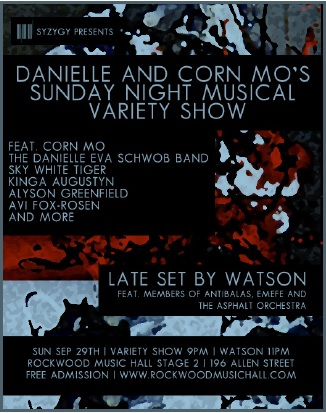
Then, there is the main theme of the music, a theme that talks about the inescapable oppression cast by society. In this case, Jim Crow is relevant to this theme; but I did not feel the music video reflected this theme at all. I inquired about the artistic inspiration and the intention.

“We did not want the video to be too ‘on-the-nose,’” explains Ian. “We felt, instead of literally translating a narrative of overcoming bigotry, it would be more effective to let the lyrics do that heavy lifting, and instead create a more general narrative for the video about conquering one’s own ailments and mental spooks.”

The video for “Jim Crow” was shot in one day, on a budget that Ian describes, was lower than what the final product presents. He credits co-directors Nasa and Robert for “wringing the sponge of all its possibilities.” In addition, Ian believes the video “came to fruition in the way any good piece of art does – with some really good planning and some very happy accidents.”

Ian asserts, “I believe the video as an entertaining piece of work in its own right, complements and contextualizing the music to be heard from new angles, with heretofore undiscovered wrinkles.”

The audience looking for this musical and visual experimentation

The making of Ian’s video was supported by the donations of fans and people interested in Ian’s music – a type of support that allowed Cultured Productions to put the finishing touches on both music and artwork, and the replication of the Fallout Symphony CD. When I asked Ian about receiving this support, he responded, “It is fantastic. Art exists for the community, and to have that community support its creation is a blessing.”

Through the video for “Jim Crow,” Fallout Symphony exhibits that postmodernist classical music through the help of visual imagery makes a greater emotional impact on listeners. Ian helps listeners understand that music exists within a world of art, surrealism, culture and most importantly, a community that wants to hear experimental classical music.

It is my pleasure to share with readers this beautiful video. Thank you Ian and Nasa.

Celebrate Eclectic Music at Rockwood with Syzygy, Danielle Eva Schwob & More!

The Fall of 2013 is transforming into a busy season for music in New York City. Indie lovers and musicians alike can expect a trend of eclectic musical performances; bands from across several genres playing in one set under one roof. This Sunday, September 29th, the Musical Variety Show presented by the musical collective Syzygy will kick-off this Fall’s indie music season at Rockwood Music Hall. ‘Danielle and Corn Mo’s Sunday Musical Night Variety Show,’

Entitled ‘Danielle and Corn Mo’s Sunday Musical Night Variety Show,’ the event will feature performances by its two hosts and guest artists like Sky White Tiger, Kinga Augustyn, Avi Fox Rosen, Alyson Greenfield, and more. Watson, which features members Antibalas, EMEFE and The Asphalt Orchestra, will conclude the night with a late set.

Corn Mo, who is currently a part of .357 LOVER and a former member of the Polyphonic Spree has become known as a “regular fixture in New York’s indie rock and experimental scene.” He has an unmatched knack for story-telling and performing, and has toured with acts such as They Might Be Giants, Wheatus and Ben Folds.

The London-born cross-genre musician, Danielle Eva Schwob – whose “hard edged pop songs (NY Times)” fuse glittering synthesizers and electric guitars with honest lyrics – is best described as a catchy avant-garde pop/rock performer. Both musicians will host the show, and Ms. Schwob will appear with her band and Corn Mo will perform solo.

Sky White Tiger’s front man and multi-instrumentalist, Louis Schwadron; classical virtuoso and stunning vocalist, Kinga Augustyn; Sardonic indie songwriter Avi Fox-Rosen; and the sonic-wizard, singer and multi-instrumentalist, Alyson Greenfield will all perform. The night will wind down with a late set by downtown improvisers Watson, an all-star group of musicians hailing from Afrobeat stalwarts EMEFE and Antibalas, and the radical five-piece street band The Asphalt Orchestra.

Danielle and Corn Mo’s Sunday Musical Night Variety Show marks the second installment of SYZYGY’s acclaimed series, the first of which took place at Le Poisson Rouge and welcomed Sxip Shirey, Todd Reynolds, ETHEL, Danielle Schwob and Bridget Kibbey.

The show will take place at Rockwood Music Hall, Stage 2 and will start at 9:00pm. Admission is FREE, and everyone over the age of 21 is welcome. Rockwood Music Hall is located at 196 Allen Street. The closest subway is the downtown F train which stops on 2nd Avenue and East Houston Street.