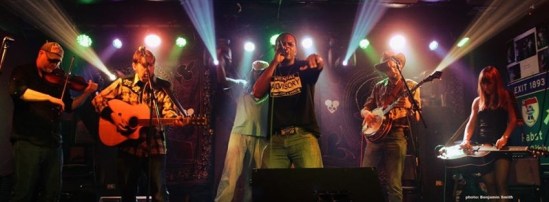
Celebrate Eclectic Music at Rockwood with Syzygy, Danielle Eva Schwob & More!

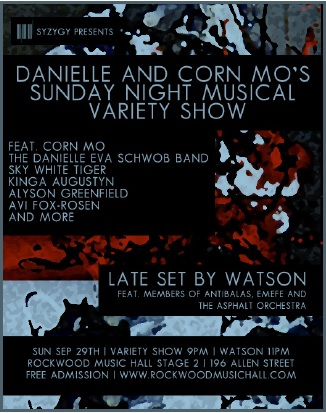
The Fall of 2013 is transforming into a busy season for music in New York City. Indie lovers and musicians alike can expect a trend of eclectic musical performances; bands from across several genres playing in one set under one roof. This Sunday, September 29th, the Musical Variety Show presented by the musical collective Syzygy will kick-off this Fall’s indie music season at Rockwood Music Hall. ‘Danielle and Corn Mo’s Sunday Musical Night Variety Show,’

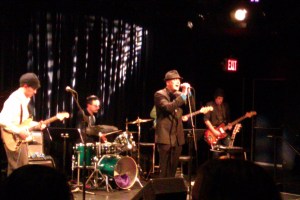
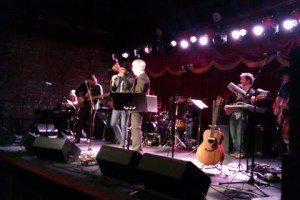
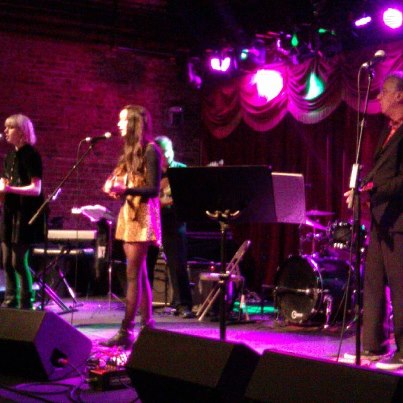
Entitled ‘Danielle and Corn Mo’s Sunday Musical Night Variety Show,’ the event will feature performances by its two hosts and guest artists like Sky White Tiger, Kinga Augustyn, Avi Fox Rosen, Alyson Greenfield, and more. Watson, which features members Antibalas, EMEFE and The Asphalt Orchestra, will conclude the night with a late set.

Corn Mo, who is currently a part of .357 LOVER and a former member of the Polyphonic Spree has become known as a “regular fixture in New York’s indie rock and experimental scene.” He has an unmatched knack for story-telling and performing, and has toured with acts such as They Might Be Giants, Wheatus and Ben Folds.

The London-born cross-genre musician, Danielle Eva Schwob – whose “hard edged pop songs (NY Times)” fuse glittering synthesizers and electric guitars with honest lyrics – is best described as a catchy avant-garde pop/rock performer. Both musicians will host the show, and Ms. Schwob will appear with her band and Corn Mo will perform solo.

Sky White Tiger’s front man and multi-instrumentalist, Louis Schwadron; classical virtuoso and stunning vocalist, Kinga Augustyn; Sardonic indie songwriter Avi Fox-Rosen; and the sonic-wizard, singer and multi-instrumentalist, Alyson Greenfield will all perform. The night will wind down with a late set by downtown improvisers Watson, an all-star group of musicians hailing from Afrobeat stalwarts EMEFE and Antibalas, and the radical five-piece street band The Asphalt Orchestra.

Danielle and Corn Mo’s Sunday Musical Night Variety Show marks the second installment of SYZYGY’s acclaimed series, the first of which took place at Le Poisson Rouge and welcomed Sxip Shirey, Todd Reynolds, ETHEL, Danielle Schwob and Bridget Kibbey.

The show will take place at Rockwood Music Hall, Stage 2 and will start at 9:00pm. Admission is FREE, and everyone over the age of 21 is welcome. Rockwood Music Hall is located at 196 Allen Street. The closest subway is the downtown F train which stops on 2nd Avenue and East Houston Street.

A Union of Bluegrass and Hip-Hop, Urban and Rural: an interview with Rench of Gangstagrass

Like many individuals, I initially questioned the thought of bluegrass and hip-hop in the same song. Then, I listened to the Brooklyn-based group Gangstagrass and became more confident and intrigued by this amalgam. When I watched Gangstagrass perform live at the Mercury Lounge earlier this year, I felt like I stumbled upon an exciting discovery on the New York City music scene.

“We get a tremendous amount of positive responses from people,” said Rench, the producer and guitar player of Gangstagrass, who also goes by the official title ‘Mastermind. “They say “Wow. I like hip-hop and I love bluegrass, and this is the kind of music I’ve been searching for my entire life.””

Gangstagrass Facebook Banner

In my full-length interview feature for the month of June, Rench talks about the events that helped Gangstagrass gain substantial attention from the public; how the union of bluegrass and hip-hop works; and why this union matters in today’s musical landscape. It’s my pleasure to welcome Gangstagrass to my blog on Music Historian, Hear; Don’t Listen.

From a one-man project, to a band, and to a theme song for a television show, and more!

According to Rench, Gangstagrass gradually evolved from a one-man project inside his own recording studios in 2006, Rench Audio studios, to a group composed of long-time musical collaborators and temporary instrumentalists in 2010.

“I met T.O.N.E.-z while working at a recording studio. We worked together in a few sessions, where I created beats for him, and we started talking from there,” said Rench. “I eventually recorded some of his albums in my studios.”

Rench arranged the beats and the instrumentation on T.O.N.E.-z’s latest solo album Hennessy and Moonshine released earlier this year.

“At the time I started Rench Audio Studios, I already had a band called B-Star which played honky-tonk hip-hop. Dolio the Sleuth was part of that group. I have been working with him for about a decade now.

“These are MC’s I already knew and I was able to draw on these existing relationships. I would call them up and say “Hey, can I put some of your hip-hop vocals with bluegrass music” and they said “sure man, go ahead.”

Rench, the group's Mastermind, performing with Gangstagrass at the Mercury Lounge on March 30, 2013 “Once I saw how many people were into this one particular project, I thought of making an actual band. I had been involved in the Brooklyn country scene and knew many musicians. I actually recruited people through word-of-mouth, and I was able to pick out a couple of them and bring them on board.”

Some of the bluegrass players that Rench originally recruited stayed in Gangstagrass for a while. The group also experiences a wave of musicians that frequently come and leave as they pursue separate projects or go into different directions.

The transformation of Gangstagrass from a project into an actual group opened the door to what would later be “a big stroke of luck.” In 2010, the band’s song “Long Hard Times to Come” featuring T.O.N.E.-z was selected as the opening theme for the television show on FX, Justified.

“They [the producers of the show] were looking for a bluegrass and hip-hop song, and we happened to be doing it,” enumerated Rench. “It was the perfect type of exposure for Ganstagrass.

“When we tried to explain our music, people tried to make sense of bluegrass and hip-hop mixed together and how that sounds. They don’t think that combination works well. Having people listen to what I make without explanation is the perfect exposure, and that’s what Justified has been doing by playing 30 seconds of Gangstagrass at the beginning of each episode.”

The positive reception of “Long Hard Times To Come” resulted in an Emmy Nomination in July 2010 for Outstanding Original Main Title Theme Music. The public’s growing interest in Gangstagrass encouraged Rench to make a full album later that year titled Lightning on the Strings, Thunder on the Mic.

“After the theme song was picked up, I knew I definitely had to get some original Gangstagrass music out there. I made the songs on Lightning on the Strings, Thunder on the Mic to sound a lot like the Justified theme with the same rapper and players. That album mostly featured T.O.N.E.-z.”

Rench also states that he applied the compositional formula in “Long Hard Times To Come” to the other songs on Lightning on the Strings, Thunder on the Mic. The album that followed Lightning on the Strings… was Gangstagrass’ 2012 release, Rappalachia, a record that displayed more the band’s versatility.

Rappalachia… explores different ways of combining bluegrass and hip-hop and welcomes different techniques and rappers,” elaborates Rench.

“I wanted to branch out a little and not stick closely with the same [compositional] formula, so I took the production in different directions. Sometimes I would start with a hip-hop beat and build with a bluegrass clip. On other songs, I would start with a bluegrass sound, build a beat around that, and then have the rappers build their rhymes. Some songs involved a more organic approach, like having the bluegrass band play a whole song through while others had more of a sampling approach.

“Some highlights also included working with new high-profile rappers like Kool Keith, Dead Prez and Nitty Scott to bring out different elements.”

The introduction of new rappers and new songs excited Gangstagrass followers. One rapper that stands out in my mind is the female Brooklyn-based rapper, Tomasia, who appears on the Rappalachia track, “Big Branch.”

Tomasia rapping in "Big Branch" with Gangstagrass at the Mercury Lounge “The song “Big Branch” is based on actual events that happened,” explained Rench. “When I brought the song to Tomasia, she took it upon herself to research the rural mining issues that affect many communities in Kentucky. Tomasia put herself into that role and wrote from that perspective so well.

“She is brilliant at writing these narratives from different perspectives with a lot of depth and clarity. I was really thrilled, and that song is a great example of reaching different people and seeing their struggles in us and our struggles in them.”

Rench’s last statement about “Big Branch” helped me see that both bluegrass and hip-hop include topics about the average person’s everyday struggle. Of course, one genre pertains to the struggles of rural life while the other focuses on the struggles of urban life. Then started I wonder whether these two genres have more in common than just lyrical subjects. Rench observes the similarities and differences of these two genres while working in the studios and performing with Gansgtagrass.

The Union of Bluegrass and Hip-hop

(Left to Right) Rench, R-Son, and Jon West on the Fiddle “When I work with the rappers and bluegrass players, we find a lot of common ground musically. Both these genres share improvisational elements and each has a different word to describe these elements. For example, during a jam session, we stand around in a circle and take turns improvising. In hip-hop, this is called a cipher while in bluegrass, it’s called a pick. Basically, they are both the same thing.

“Sometimes rappers will freestyle while the bluegrass players are improvising solos, and they will click. The artists from both genres approach improvisation with the same impulse – creating a dialogue within music and turning it into a conversation.

“As you mentioned,” added Rench, “both of these genres have a history of focusing on stories of outlaws, struggle, heartbreak, and hard things in life. Hip-hop and bluegrass help create a catharsis by singing or rapping about these stories.”

While the players in Gangstagrass have established a common ground musically and lyrically, the differences in performance within bluegrass and hip-hop balance each other nicely. Rench says:

R-Son performing with Gangstagrass“As a genre, Bluegrass is very virtuosic-focused and lacks an exciting performance element. Traditionally, it involves people fine-tuning their skills and ability to perform accurately and passionately. Bluegrass performers typically stand in one place and focus on their instrument and playing something amazing.

“We had to focus on the idea that our performance would be more like a party. So we asked the bluegrass players to move around more and interact more with the rappers.”

According to Rench, members of Gangstagrass “make sure to have fun on stage.” Rench adds, “It’s really exciting to perform and interact with these guys on stage.”

During a performance, the rapper often sings to the audience then turns his or her attention to the neighboring banjo player and says “take it away.” The instrumentalist can really focus on a solo and the rappers can freestyle a new verse.

When I went to see Gangstagrass perform for the first time back in March, I couldn’t remember the last time a room of 70 or more people had so much fun watching musicians that were also enjoying themselves. I believe this experience helps individuals with varying musical tastes accept and embrace the fusion of bluegrass and hip-hop. One question I do ask myself though is whether Gangstagrass’ union of bluegrass and hip-hop might help shrink the divide between rural and urban audiences. I ask Rench for his opinion on this thought.

Why this Union matters in today’s musical landscape

(Left to Right): Rench on Guitar, Landry McMeans on Dobro, and R-Son “I think the music industry has perpetuated this idea that there is white music and black music, rural music and urban music. Each style has a separate chart, separate radio stations, separate websites and separate everything, as though separate groups of people listened to these genres. That’s not the case.

“People have Johnny Cash and Jay-Z on their iPods on shuffle. They listen to all kinds of stuff and appreciate a variety of different music that comes from different places in the country.

“I sometimes do see our fans discussing how these two [bluegrass and hip-hop] can integrate so well. I’m happy to the extent that this happens. If Gangstagrass can bring this up in discussion or give people a little hint that we are not so divided, I think that would be fantastic.”

Gangstagrass’ music definitely generates discussion. Some listeners feel excited that Brooklyn-based rappers are talking about issues that affect rural communities. According to Rench, when listeners commented on Tomasia’s rap in “Big Branch,” they often expressed, “I can’t believe you found this incredible rapper from Kentucky.”

Sometimes, Gangstagrass stimulates debates among purist listeners. Rench explains:

“Sometimes, we receive responses from bluegrass purists who say “I don’t think you should have rap in here, the lyrics will be too violent.” In reality however many bluegrass songs were inspired by violent imagery, especially in the tradition of murder ballads that are far more violent than any of the subjects that the rappers describe.”

First-time listeners also exhibit amazement at the fact that bluegrass and hip-hop can work well together.

“Many people think bluegrass and hip-hop would not work well,” says Rench, “and it’s certainly true that it can turn out badly or come out wrong. It happens sometimes.

“I take the project of bringing out the best of both worlds very seriously. I don’t take this as a novelty. It’s a great thing to do – making a full project out of the idea that these two genres can be brought together and have something cool come out.”

Gangstagrass is currently on the road, touring in various cities on the mid-Atlantic coast and stirring conversations and discussions among hip-hop and bluegrass listeners. By the middle of July, the band plans to hit California and make a stop overseas in the Czech Republic, before hitting the road on the East coast again in August.

In addition to the on-and-off touring, Gansgtagrass plans to release another album either in the Fall or early next year.

“I don’t know what to call it [the album] yet, but we’re exploring ways of bringing together a lot of the same rappers and bluegrass players that we are working with now,” enumerates Rench.

The Mastermind is exploring whether something beyond bluegrass hip-hop exists. “We don’t necessarily need to be locked in being half bluegrass and half hip-hop,” claims Rench. “I’m using this album to explore whether this is not just bluegrass hip-hop, but blending them together into a new sound – something that does not have a name yet.”

Apollo Run’s “Here Be Dragons” Saga: Bass player Jeff Kerestes Shares the story from start to finish

Apollo Run (Left to right: Jeff Kerestes, John McGrew and Graham Fisk)

The most successful bands establish a memorable sound, the one that encourages listeners to return to performances and purchase the group’s music. In the process, artists might find that the music they create does not fit a label. Jeff Kerestes, a professional bassist of the Brooklyn-based band Apollo Run, briefly explains this experience.

“When we changed the band’s name to Apollo Run we did not know how to categorize the music. It was all new to us, the three part harmonies, the bass, the drums… We were wondering “what’s here?” Let’s explore it.”

It was at this moment the band decided to name this phase of their musical development “Here Be Dragons.”

“In the old maps,” explains Jeff, referring to maps of the globe dating as far back as the 1500’s, “signs that read “here be dragons” were drawn to represent uncharted territories. The music was uncharted territory for us.”

In Music Historian’s full-length band interview for May, Jeff talks about how Apollo Run’s “Here Be Dragons” exploration started; where the course has taken them; the possible conclusions of their journey; and what awaits the band in the near future. It is my pleasure to welcome Jeff to Hear; Don’t Listen.

The Beginning: John McGrew and the Sit Backs

One night in 2007, the Arizona-native with a jazz degree from Arizona State University, was celebrating his one year anniversary of living in New York City. Through the husband of a friend, Jeff learned of a band that was looking for a bass player – John McGrew and the Sit Backs. Jeff joined this group in December of that year. Here, he met singer John McGrew and drummer Graham Fisk.

“John and Graham hit it off right away,” recalls Jeff. “The band also had another bass player, a guitarist and keyboard player.

“In this group, all the songs were fully-written by John and the members of the band would play these songs and perform under the moniker John McGrew and the Sit Backs. At that time, John was working a day job just to pay the band. In New York, there is almost nobody that will play another person’s song for free.

“Eventually though, paying the band became expensive, and John decided to leave his day job and do music full-time. Since John McGrew and the Sit Backs was the best experience I had at the time, I decided to stay, and so did Graham.

“Afterwards, John decided he wanted to change the name of the band because all three of us would be writing songs, not just him. We were ready to create a new sound.”

At this point, it was 2009, and John, Jeff and Graham decided they wanted to bring a new approach to music making – one in which all three members could use their ability and talent to the fullest and tie it together into a series of songs.

The Middle: Developing Ideas and Completing Songs Together Apollo Run at the Bowery Electric, April 5th, 2013
“One of the most exciting parts about Apollo Run is that we all write, and we will bring different ideas to each other.

“For example, John and Graham were both in a Cappella groups in their college years. Sometimes, John will have a great a Cappella line, and we’ll develop a song from there or, he will come to us with a song that is almost finished, and we’ll complete it together.

“Graham also writes songs on piano, and sometimes he will come in with a song that he has not finished, and we will hone out the rest of the parts – the vocal harmonies, the bass line, drums and the key board.”

Jeff enumerates on this example through a few stories about some of the songs on “Here Be Dragons” vol. III.

“One of the songs on our last record, “Sirens,” we wrote while we were on tour. I was playing chords on a ukulele during the car ride. In this time, we created the hooks of the song. Then, when we halted for rest stops, we would refine the lyrics and the vocal lines.

“For “Desire,” Graham came in with a partially developed idea for the song. We composed fifty to sixty percent of it in the studio. By the time we finished the other songs for the third volume; we had to complete “Desire.”

“This was one instance in which we were putting too much thought into how a song is “supposed to sound.” When this happens, it becomes very difficult to complete the song. Once we played the song several times through though, it came out right. We played [“Desire”] until it felt right.”

Naming the Band: “Many names can put you in a box and we did not want that”

Prior to recording any of the “Here Be Dragons” records, the band applied the same intuitive effort behind finding the band’s new name.

“Naming the band was difficult,” recalled Jeff. “We really wanted our music to dictate the name and not the other way around. For example, when you hear the name Led Zeppelin or Pearl Jam, you think about the music of the band, not their name. The words don’t mean much on their own until you define them with music.”

“We did not feel we could categorize our sound,” adds Jeff. “Many names can put you in a box, and we wanted to avoid that.”

Listeners will have a difficult time putting Apollo Run’s music neatly in a category. One might feel that the opening piano melodies to “Autumn Song” that paid homage to art songs from the Romantic period; or that the doo-wop-feel of “That’s How it Felt” belongs more to pop; or that the “Devil in Disguise” makes a slight nod to the swing-jazz genre.

The eclectic sounds of each “Here Be Dragons” album might also make listeners wonder what made the band chose the name Apollo Run. For this simple reason: it felt right.

According to Jeff, all the members liked the mythology behind the Greco-Roman God Apollo, who ruled music, poetry, and light. In addition, John who is also an astronomy enthusiast repeated the phrase “Apollo Run” to himself several times. The more he heard it, the more confident and comfortable he felt with the name.

The Music: “You never know where your inspiration is going to come from…”

(Left to Right) John and Graham at the Bowery Electric As my conversation with Jeff continued, I became curious about what influenced the lyrics behind their songs. I learned that for these three musicians, “influence comes from everywhere.”

“You never know where your inspiration is going to come from; it can be from literature to what’s going on politically. A couple of our songs are inspired the book series The Game of Thrones. Sometimes John will come to us and say, “I wrote a new song, it is inspired by The Game of Thrones,” says Jeff jokingly.

Then, some of the inspirations for Apollo Run’s songs come simply from gazing up at a clear night sky.

“Our song “Stars” is basically John’s take on what he hears from looking at the stars. As they twinkle back and forth, John hears they are singing “oh-way-oh,”” explains Jeff.

Apollo Run plays on romantic imagery while celebrating the union of many musical ideas. In addition, fans’ responses to the band’s music have been supportive and unusually phenomenal.

This brings me to what might be the beginning of the end to a great expedition, a possible musical theater production of “Here Be Dragons.”

The End: A Theatrical Reception?

During the summers, John, who has a background in musical theater, works at a drama camp in Oakland, Maine called Acting Manitou. Every year, John helps students put on a play. According to Jeff, “the kids really liked Apollo Run’s music” and they wanted to make a play using the band’s songs.

“Last year, the kids asked whether they could put on a play using Apollo Run’s music, and they did,” enumerates Jeff. “Graham and I went to perform the music for the production. The result was amazing.

“The play takes place in a dystopia. In the story,  a ruler is overthrown and then another ruler takes over. The replacement, however, turns out to be much worse than the initial leader. During this story, there is a love story taking place between two characters. The play references the many faults and issues within our society.”

“After the experience, we decided to bring the play down to New York City and invited Broadway actors for a reading.”

At the moment, the musical has only developed to a reading of the play by professional actors. John says “I do not know where it will go from there.”

Beyond the Saga: A Fourth Album with a New Focus

If the “Here Be Dragons” saga does not end with a big bang, then fans can look forward to a fourth album in the near future. Jeff says the band is in the process of creating a new record that will focus on this idea: now that the territory has been explored, it is no longer uncharted.

“We are currently in the writing stage,” he explains. “The songs are very exciting right now.

“The album’s title will depend on the shapes the songs will take.”
Apollo Run (left to right): John McGrew, Graham Fisk, and Jeff Kerestes In the meantime, the band continues to receive a positive reception from fans all over the country. Jeff recalls Apollo Run’s first national tour from November, which was to promote their third volume and first full-length album “Here Be Dragons” vol. III, as a career milestone for the group.

“That was pretty big for us,” enumerates Jeff. “We started on the west coast in San Francisco, then drove all over the country for a month. We traveled to my hometown in Arizona, then to San Diego, and several other places before concluding the tour in Maine.

“Our fans traveled great distances to come see us perform, and it was rewarding to see them enjoy our music.

“We love what we’re doing and taking that everywhere with us is great.”

Jeff also invites fans to watch Apollo Run’s music videos for the following songs on “Here Be Dragons” vol. III that just premiered today on their website – “Devil in Disguise,” “Bending the Light,” and “Act IV.”

Apollo Run reminds listeners that while establishing a solid sound is a necessary component for a successful band, creating music is not about fitting neatly into a category. Reflecting on my interview with Jeff, I realize that a band’s potential relies on their ability to explore new musical territory despite the uncertainties or possible dangers. Apollo Run’s exploration helped them arrive to the destination they sought – a definition of their sound. In addition, their expedition contributed greatly to their artistic development. The result is the complete “Here Be Dragons” trilogy.

What awaits Apollo Run fans after the HBD saga remains a mystery, but it is one that listeners will look forward to discovering. One thing is certain. The band will apply the same virtuosity, dedication and meticulousness to each song and its various components. As Jeff says, “Many bands are known for doing one thing really well in their music. We work to making everything sound well.”

Todd Carter a.k.a The Looking “Songs for a Traveler” Album Release Party

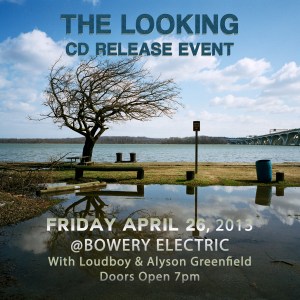
The Looking Album Release Flyer

The Looking Album Release Flyer

You have read about Todd Carter a.k.a. The Looking’s exciting listening party for his newest rockin’ cover album, Songs for a Traveler. Now, everyone has the chance to hear these great songs for live at The Looking’s album launch party at Bowery Electric on Friday, April 26th!

“I have been interested in American folk songs since the time I started playing music in Indiana,” Todd says. “It was the thought of mixing my love for 80’s and 90’s alt-pop with these old songs that resulted in Songs for a Traveler.”

Todd will spin songs from the 1950’s, like “Sail Around” and “Long Black Veil” into lush, dreamy soundscapes that climax in full rock fashion, with the help of his backing band. The band features John Andrews, Gerald Menke, Chris Morrissey, Adam Kromelow, and Bill Finizio. NYC Ukulele Troubadour Roger Greenawalt and Violin Virtuoso Ernesto Villa-Lobos will also join Todd as guest performers.

Loudboy, led by John Andrews (Botanica, Angela McCluskey, Morely), and Brian Viglione of the Dresden Dolls will open the show at 7:00pm.

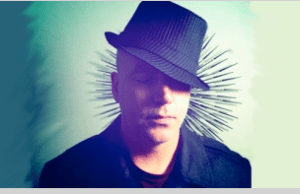
Official Press photo of Todd Carter

Official Press photo of Todd Carter

Experimental indie-songstress Alyson Greenfield, who has recently found fans in WNYC, Converse and AOL.com, will close the night.

Collected Sounds describes Todd’s vocalism and performance as “intriguing and fascinating.” The Chronicle claims his work is “eclectic and provocative.” IndieMusic.com says Todd’s voice is “like nobody else you have heard before…majestic.”

Make the weekend of April 26 one filled with the American classics you love made great for Rock ‘n’ Roll. Todd’s album launch party for Songs for a Traveler will start at 8:00 pm. The opening show begins at 7:00 pm. Purchase your tickets here and save your spot at the Bowery Electric.

Todd Carter a.k.a The Looking Make Old Folk Songs Great for Rock ‘n’ Roll

The Looking perform at Symphony Space on February 25, 2013 Todd Carter (a.k.a. The Looking), the New York City-based singer songwriter, is in the process of releasing their third album, Songs for a Traveler. In this record, Todd turns American folk classics and old country songs from the years 1850 to 1950, like “Wayfaring stranger,” “900 Miles,” “River in the Pines,” and “Blue River” into rock ‘n’ roll.
My personal love for rock music motivated me to talk with Todd about his newest album, which is set for a release date in April of this year.

In our conversation, I learned that Todd’s love for the archaic folk songs The Looking covers in their latest record doesn’t stem from a deep understanding of American folk music. Instead, he has developed an appreciation for how some of the crazy, romantic and mind-boggling themes and stories within these songs easily transition into the rock genre. This is why I am happy to introduce Todd Carter as the subject of my March full-length interview feature on Music Historian’s, Hear; Don’t Listen.  

The Perils and Romance in Travel-Themed Songs

I asked Todd what he liked about these folks songs and he said:

“I love travelling, and a lot of these folk songs have some sort of traveling theme in them. “900 Miles” is about a man trying to get back home to find this woman, but he’s lost on a train somewhere. “Hobo’s Meditation,” “Wayfaring Stranger,” “River in the Pines,” all share this theme.

“It really comes down to, not necessarily being about the music but how much I love these songs. It’s about taking the listeners on the journey of these songs. I just want to articulate that and present it in a way that is really available to people.”

To enumerate on this point, he took me through the process of recording “Blue River,” a ragtime song that was popularly performed by jazz singer Sophie Tucker in 1928.

“We ‘unragtime-ized’ the song by taking it out of its original 4/4 time signature and made it 6/8. We put some heavier guitar in there and we thought it would be fun to leave some of the jazzy influence. We also removed some of the lyrics that are found in the original version, which are really hokey.

“I really wanted to move it to another dimension.”

Some songs on The Looking’s latest record underwent fewer modifications. This enabled Todd to focus on conveying the tone and themes they presented. One example is “River in the Pines,” a song made famous by Joan Baez. He explains:

““River in the Pines” is a wild song that takes place around the Chippewa River in Wisconsin. It’s about a logger named Charlie, who falls in love with a woman named Mary. Later in the song he dies in a river accident; and at the end, Mary also ends up in the grave, but it is unclear how she got there. You think she was so bereft by Charlie’s death that she couldn’t handle it anymore. There is something romantic and a little hard core.”

The Story of Finding These Songs

Stories about danger, loneliness, and suggested taboos that one learns about on the road have graced many rock songs. Based on my experience, I always felt rock ‘n’ roll was a more popular and familiar genre among urbanites than American folk, especially in New York City. So then, I became curious about what motivated Todd to release a rockin’ cover album of folk music.

“Last year, I completed a residency at The Underground on 107th and West End, and I had two hours to perform every Wednesday night,” says Todd. “So, I started to gather a repertoire of more songs I could perform besides my own.

“I found some old Bob Dylan, which led me to look at Townes Van Zandt, which led me to examine all the versions of “Wayfaring Stranger.” We also found some old Gospel tunes like “Angel of Death” written by Hank Williams.

“My band and I started experimenting with these songs; and we started playing them live for the audience in different arrangements and keys.

“I really enjoyed playing the songs and started recording a lot of them in my studio. Then, I tried to figure out which ones I liked most and got the idea that I really wanted to make a record.”

Todd’s Musical Influences and Performance Background

Todd Carter aka The Looking at Symphony Space 02/25/2013 When I first listened to Songs for a Traveler, I had no prior knowledge that these songs were covers of folk and old country tunes. I simply judged them as originals. In doing so, I developed the following thoughts on The Looking’s record: the lyrics express an old country feel and tonally, the songs convey rock ‘n’ roll. Then, I picked up subtle influences of classical music, like the minor to major key modulations, and the simple duple meter in the song “Blue River.”
This led me to ask Todd about his performance background. He enumerates:

“Growing up, I loved listening to Michael Stipe from R.E.M. As you listen to Michael’s vocal evolution, you hear that he started becoming more of a crooner. Although he was never exactly a crooner, it was interesting to hear.

“During my early years, I was into Brit pop, and bands like New Order and Joy Division. I mixed that with my old-time love for country music – Johnny Cash, Ray Price, and Bob Dylan.”

Todd adds, “I started out singing in my parents’ garage in Carmel, Indiana. I played a lot of punk rock and didn’t have any real training until I moved to New York in about 2000, when I decided to study at the Mannes School of Music. That’s when I became really interested in vocal training.

“I began to study with various teachers. I eventually trained with a singer at the Metropolitan Opera, Edna Lind. I studied with her for quite a while and started putting on some Operatic performances around the city.”

The Recording Experience of Songs for a Traveler

During the time that Todd was performing Operatic pieces around Manhattan, he also worked on two other albums recorded with The Looking: Tin Can Head (2005) and The Cabinet of Curiosities (2009). Both of these albums were created under his label, Astraea Records. I asked Todd how his experience with making his 2013 album differed from that of his last two records.

“That’s a good question,” he remarked. “I wanted this record to have more of a live feel. I wanted to come out of our recording days with Ken Rich over on Grant Street Recording and record a lot of live music off the floor. I really wanted to try to deliver some of the vocals in the studio while we were recording the instrumentals live.

““Sail Around” included a live vocal recording. Then the vocals for “Blue River” and “900 Miles” were recorded in the studio. I sang the lyrics right back into the speakers.

“I love the way this record sounds. The man, who mixed the music for the latest record, Songs for a Traveler, Myles Turney, did an amazing job.”

At the moment, people can listen to some of the tracks on Songs for a Traveler on The Looking’s website. When I listened to the tracks prior to interviewing Todd, I received no auditory indication that these songs were recorded live. In short, the album lives up to its promise of being finely mixed.

As for Todd’s love for the musical styles and genres he previously touched upon, listeners can expect to hear something different on each record that he will release with The Looking. Todd already has another complete album he hopes to release in the next couple of months.  

Todd’s Plans for the Future

“I actually just finished another record that I’m hoping to release in the next couple of months called 1969 to 1984, produced by Roger Greenawalt,” he says. “It is another cover project I have been working through. We recreated songs by Leonard Cohen, Syd Barrett, Echo and the Bunnymen.”

When Todd is not recording or performing with The Looking, he works with an intermediary company that helps him place his original music on spots for television programs on channels such as Bravo and Discovery. Then, there is Todd’s record label Astraea Records, which he has been running for ten years.

Todd explains that owning his own record label “Came out of helping of friend who wanted to make a record. Her name was Morley; she is a New York singer songwriter. We got a couple of people together to help her and we created this record to get that project off the ground.

“It was really out of the spirit of assisting some friends that needed to get their music out. I felt it was important at the time because Morley made an incredible record that helped her get signed to Universal in France.

“Then, other projects came into play like Camomile, Parmidian One, and then mine.”

Todd continues, “Astraea has become more of a production company than a label per se. We’ve had a few releases. Astraea has been around for quite a while and it has created a presence on-line which enables people to listen to the different artists. I would say it’s more in its twilight sphere now. I’m actually moving my attention to The Looking.”    

At the moment The Looking are planning an official launch party for Songs for a Traveler sometime in April. A tour for this album and a potential release of 1969 to 1984 are also possible plans for later in 2013.

Roger Greenawalt on Music and Business Part 2: The Beatles Complete and Beyond

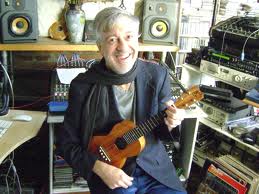
Leah Siegel sings "Oh Darling" with Roger on Ukulele In Part One of my conversation with Roger Greenawalt, I learned about the life of a record producer at Shabby Road Studios and how some producers work with artists. In the continuation, I learn more about Roger’s inspiration behind the annual Beatles Complete and his other title, the ukulele carrier.

“For three and a half years, I’ve been carrying this [the ukulele] everywhere,” Roger explains. “It’s an ongoing permanent art exhibit. This performance is forever. I also do it to constantly interact with people, and I sort of know the range of reactions.

“Today, for example, a woman jogged by and said “go on brother.” That was one reaction. A very common one I get is when a mother is with her kid, and she points me out to her child, but she doesn’t need to because children usually directly engage with me and follow me with their eyes. Then, there are those that pretend not to see or hear me.”

I asked Roger whether anybody ever approached him and asked to play his ukulele. He says:

“No, actually, the opposite happens. I’ll show you.

“Someone will come to me and say “wow that ukulele is so cool” and I will put it in their hands.” Roger hands me the ukulele to demonstrate. “I would tell you to put one finger right there and strum steadily.”

I placed my finger on the first string right on the third fret, and strummed as Roger sang an English lyrical improvisation of “Frere Jacques.”

“I’ve taught them a song they will always remember for the rest of their lives,” says Roger. “I’ve had people come back to me after I taught them the song, and they would say “I will always remember that first song.””

My personal experience interacting with Roger on the ukulele was exciting, especially when I realized playing the ukulele is really just playing a fragment of the guitar. According to Roger, many skilled guitar players express the same realization about the ukulele.

“That’s what I realized when I started playing,” he echoes.

I then asked Roger why chose the ukulele as a trademark instrument, and then why dedicated an annual music event to The Beatles.

“Multiple factors,” explains Roger. “A) People love the ukulele.

“I started playing the ukulele right after September 11th (2001) and like many people that year, I was in a lousy mood. Then, one day, my cousin who lives San Francisco – he is a book publisher and a talented amateur musician – invited me to visit. So, after the flights started up again, I took a plane to San Francisco.

“When I went to see him, I learned that he had just been in Hawaii cheering himself up from a break-up. He picked up the ukulele and started learning songs. It just made him happy; it’s this happiness machine. And, the appeal of the uke keeps getting bigger.

“B) There is the undying universal appeal about the Beatles.

“They have been a unique phenomenon throughout the years. The passing of their music from generation to generation has been frictionless. Kids continue to like their music and they keep getting bigger every year. They are the second best selling artist of the last decade after Eminem. So, these are both two good things.”

Roger continues, “Then, if there are 60 artists and they each have two friends, there is a good chance these two people will show up to watch them perform. So, there will be 60 different people in the show, and they will bring in an audience of 120.

“That’s why the event works.”

Yuzima jams with Roger at the Beatles Complete on Ukulele to "Hey Jude" Based on my experience, The Beatles Complete on ukulele does work in attracting a crowd. I remember the 2012 show, which fell on the first weekend in January. People packed the space in front of the stage, shoulder-to-shoulder. I remember singing to Yuzima’s rendition of “Hey Jude” with my sister as we stood among the crowds. To our right stood two Brooklyn bachelors sporting wind breakers and beanies, while to our left, a father was raising his toddler-aged son on his shoulders to see the musicians on stage.

However; I also do admit that outside circumstances, which are not related to music, also play a determining factor on whether the next show the following year will produce a greater turn out than the one prior. For example, this year’s show fell on a weekday, which probably prevented families from attending. In addition, it was also one of the coldest nights in January, a factor that might have discouraged many from coming out. Roger comments:

“If it was not the coldest night that day, the place would have been packed.”

Luckily, people, whether they are returning attendees, new comers to the area, first-timers, or tourists, will likely come to Brooklyn Bowl next January to hear the cheery sounds of the Beatles on Ukulele and hopefully remember it as an event that brightened their beginning of the New Year.

The same applies to many of the musicians that return the following year to perform a set. It gives them a great performance opportunity; a chance to jam with similar groups like them from the Williamsburg area; and a moment to make themselves known to a new group of Brooklynites.

As Roger prepares for next year’s Beatles Complete on Ukulele, he will also continue to work closely with artists looking to really make their big break on the New York City music scene. Roger talks about two musicians in particular.

“Lovely Liar,” he explains, “is a collaboration between me and Tatiana Pajkovic. She is tall, authoritarian, fabulous and tense. She has a Billy Holiday-kind of tone to her voice, and her style ranges from stately mid-twentieth century to French disco.”

Roger is also working with another act called Reno is Famous. Reno is a world class dancer who is a member of the Ballet Company of the Metropolitan Opera.

Roger describes her as “A very well-thought of modern dancer making her way to rock star.” He adds, “Her repertoire includes aggressive punk music ranging to electronic dystopia; a style that is much darker than Radio Head.

“This one’s really close to my heart. I’m making all the soundscapes [in her music] and it includes experimental elements of all my favorite things like strong acoustic ukulele and guitar riffs. It also includes reggae bass, funky drums, and hooks and groves…”

My interview with Roger has come back full circle to his work at The Shabby Road Studios.

In Part One, I learned of two very important pieces of advice that Roger has for aspiring professionals: musicians must always make room for business if they want economic success; and that the more an artist adapts, the faster his or her circumstances will change for the better. In Part Two, I learned about his inspiration behind playing the ukulele and the annual Beatles Complete.

Reviewing our conversation, I realize that Roger makes room in his studios for artists of all backgrounds. A musician can be inspired by a genre that is not widely heard in America, or have performance experience within a different art form other than popular music. If the artist is willing to commit to his or her craft, and willing to work with an experienced professional like Roger in making excellence in music; they will learn a great deal about how to work in the industry, and continue on their professional path with, hopefully, more confidence.

Roger Greenawalt on Music & Business Part 1: Running Shabby Road Studios

Roger Greenawalt at Shabby Road Studio. Courtesy of Originalhipster.net Last week, on one of the windiest evenings in January, I stopped by the Shabby Road Studios to talk with record producer Roger McEvoy Greenawalt. I asked him what a high-quality recording requires, and he says, “All you need is a good microphone, a mic pre-amp, and an audio digital converter like an M-Box going into a computer.
“That’s it; then knowing where to put the microphone, and a good musician playing a good part on a good instrument. Finally, a good mixer can make anything sound serviceable.”

As my conversation with Roger continued, I learned that while anybody can produce a record, a musician needs more than talent and ambition to become a professional.

My debut full-length interview for 2013 will be divided into two parts. In this article, part one, I talk with Roger about: the most important lessons he learned as a musician in his early years; the day-to-day in the life of a record producer at Shabby Road Studios; and the advice he has for young musicians looking to make it in music.

Early years with The Dark

During the start of his career in the early 1980’s, as a guitarist for the band The Dark, Roger learned the difference between a musician that was ready to take on the music industry, and one that was not. Roger explains:

“We [The Dark] were on Relatively Records at the same time as the Beastie Boys, when they were putting out their first record, “Cooky Puss.” And Megadeath was also on the label. We were at the right place at the right time. Our music, structurally, was cutting-edge, but not suicidally so.

“I think ultimately though, we had two weaknesses. The first was all my fault – I was the leader of the band and we did not develop an effective business team. Although we had some good PR instincts, we just couldn’t focus on them.

“Art lives in a system defined by commerce. Visionary entrepreneurs like David Geffen, for example, actually curated the culture. The artists that were closest to him defined the core of a dominant style and they acquired the best reputations. Think Neil Young and Joni Mitchell. Are they really the best of their era, or did they have the best PR and management?

“Secondly, our singer did not believe whole heartedly that he was the “Joseph Campbell” hero character. He would not inhabit the hero. He thought it was okay at the time to make fun of the rock star. Our singer was a virtuoso but he didn’t really believe he was a star. He made fun of it and didn’t really own it; so that gave people this view: “If he doesn’t believe it, then I don’t believe it either.””

Transitioning into the Recording Business

Roger eventually became The Dark’s ad hoc manager. Then, in 1983, the band parted ways.

Roger then describes the transitional period in his life from the guitarist in The Dark to learning the business of the recording studio.

“The Dark won a Battle of the Bands contest, and we won the time to do a record with Rico Ocasek at the Cars Recording Studio Syncro Sound, on Newberry Street in Boston. Then, I became the habitué at the studio and just insinuated myself there and made myself useful.”

Roger’s experiences at The Cars Recording Studio later took him to different recording experiences in the United States and abroad. Roger has only been living in Williamsburg, Brooklyn at Shabby Road Recording Studio for the past 13 years. Prior to this, he lived in Los Angeles; Kingston, Jamaica; and London. He briefly touches on what he experienced in each of these musical landscapes.

“During the time that I was in London, in the 90’s” Roger says, “the major label businesses were flushed with money; very different from now. I liked the energy of that city; it was similar to that in Los Angeles at the time. I still like the energy of LA now.

“When I lived in London, I was always learning a lot about new music. London is fantastic for music – their [London recording studios’] recordings are just more exquisite. They have more quickly evolving styles, they’re cutting edge. Since it rains there all the time, people stay indoors more when they record music.”

Working at Shabby Road: “…master the technical stuff and listen widely and voraciously.”

Living and working in different studios will definitely provide a developing music producer with plenty of experience. The more experienced the producer, the better they are at the craft. Roger states:

“To be a producer is to master the technical stuff: audio engineering; the physics of music – to understand that music is a subset of the physics of sound; and also the challenge to become an expert on as many musical instruments as possible; and listen humbly, widely and voraciously.”

During our interview, Roger exhibited to me exactly how the required skills of a music producer would translate into the everyday work of creating a record.

“My job is mixing and recording albums. I’m actually making loud speaker paintings.

“When we look at a classical musician, like Bach Concertos or especially Ravel, we figure out what to do with all the tones, frequencies and the ranges. Then, there is Nelson Riddle and George Martin and Max Martin to contend with. Time is the magic that music flows within. The rhythm of what’s coming out of the speakers, the display of all the different frequencies. What are the words being spoken/ rapped/ sung? You ask yourself ‘what do you do with all of that?’ ‘How do you disperse the energies to tickle the human brain and the nervous system just right?’ ‘Where do you draw the line between structure and surprise?’”

Roger on bass at the Shabby Road Studio. Image courtesy of Originalhipster.net Roger continues, “I really like playing reggae bass. I’ll give you a taste of what reggae bass is – the opposite energy-wise of the ukulele, which is a collection of high frequencies just floating and dancing above in the hi register. The voice is here, in the middle,” he shows me with a flat-hand positioned in front of his mouth, “and the ukulele is here,” he moves his hand above his head, “and the bass is down here,” he re-positions his hand below his chest. “So it’s great that the voice has all this space and the bass generations so much more energy without clouding the vocal.”
Roger plays me a line that is typical reggae bass. The line is written in a minor melody, and is easy to remember and repeat. He then picks up the ukulele and plays a few staccato minor chords. He plays these chords again in an arpeggio, and then changes them up again my turning these chords into major chords. Meanwhile, for every variation, he repeats the same minor bass line.

“There is a lot of color that can go over it [the bass line],” concludes Roger.

Whenever an artist comes to Shabby Road Recording studios, Roger applies a similar technical process to every client. The instrumentation and the goal for each recording session varies widely though.

“For musicians I haven’t worked with before, I ask them to send me a Spotify list of all their favorite stuff. I will listen to these songs with the artist and talk music. Then I will play them my favorite stuff and say “this is what I think is cool.” Then we would make a Venn diagram and see where our likes overlap.

“In the same moment, I will also try to tactically push a formal element so that this way, we are consciously doing something innovative without abandoning my two core values. The first: hook and second: groove. And crucially, the emphasis is on the singer. After that, everything is up for grabs: what instruments; what historical influence; what ensembles; tempos; and mood/feeling.”

Confident and Experienced Musicians are Interested in Learning

Artist Kiddeaux (Left) accompanied by Roger Greenawalt (Right) in the basement of Shabby Road Studio. Photo courtesy of maneatingseas.com  Roger’s job goes beyond providing the recording space and acting as master of the equipment.
“I don’t want to be anyone’s bitch,” he enumerates, “nor do I want to oppress anyone. I find that the more confident and experienced the person is, the easier it is for me to collaborate with them and the easier it is for them to listen and take advice.

“It’s painful to work with the inexperienced and insecure. They’re unable to put excellence outside their ego.

“I ask, “Can you be taught?” Because if they are interested in learning, then I am as well, and I see they want to be on a team that learns together.

“I don’t care about me and what I think, I care about the thing being excellent; and that takes a little bit of maturity.”

Of course, there are plenty of artists that know exactly what they want when they enter a recording studio; that is to put their song on a record. While Roger is open to this idea, he still expects more openness and commitment to the creative and collaborative process from the musicians that enter his orbit.

“If a musician has songs to record, I’ll be up to record their songs. I’m still into all of that, but I would rather start songs from scratch and create songs together.”

For The Young Musician: the benefits and challenges of the industry

Shabby Road Studios caters to musicians looking to get serious about their craft, and sometimes that means the artist must step outside of their normal routine and create new songs with producers. Based on what I learned from Roger, the musicians that are open and willing to accept this are the ones ready to take the first steps in pursuing the music industry. So what are the benefits and the challenges of taking on such a task today? Roger explains:

“There are multiple levels of rewards. The arts are good for people’s soul. Talented artists that work for themselves and are not working for any corrupt institution that oppresses people is a win/win for humanity.

“Aside from the grandiose and narcissistic personality; fame is necessary for economic survival in popular music. Fame is just part of the job. On a spiritual level, it doesn’t have to be who you are. There are a range of celebrities that are more-or-less well-adjusted. There is a range between Amy Winehouse and Tom Hanks.

“The challenges? Now, you have to be an artist, an entrepreneur, run your own small business, find your own scenes and drive people yourself. You have to be very good at that and adapt. The more you adapt, the faster things are going to change for the better for you.”

Recalling my past interviews with artists, each one encountered a specific obstacle. Sometimes it involved growing comfortable with performing in front of a large crowd, discovering a signature sound, or seeking the right ensemble. Each musician found a way to overcome their challenge and continued on their professional path.

What I didn’t realize until I met Roger is that economic success for a musician also depends on their ability and willingness to firstly, grow artistically and secondly, learn from a producer with extensive experience on the business side of music. Like Roger confirms:

“Being good at music is just not enough. We have to be good in business.”

What’s ahead?

Since I am talking to a music producer that has a ton of experience under his belt; my debut interview with Roger Greenawalt will continue in part two, which I plan to have up by the end of the month.

The Beatles Complete on Ukulele with Roger Greenawalt: A Breath of Fresh Air

The Beatles Complete on Ukulele at the Brooklyn Bowl is a musical collaboration between young singer-songwriters on the New York City music scene and lifelong instrumentalists that met for the purpose of celebrating the canonical music of one of the most world renowned British bands.

Image Music producer and ukulele player Roger McEvoy Greenawalt led this event for the fourth time. This year, the back-up band he played with was The Angry Buddhist East Band. On stage, from 8:00pm to 12:00am this past Wednesday, Roger was also joined by a number of musicians of different professional backgrounds.

The Brooklyn-based experimental singer-songwriter, Alyson Greenfield was the first artist to jam with Roger on a cover of “Glass Onion” and “I Will.” The electric violinist who has toured the world with Cyndi Lauper, appeared on Saturday Night Live and the Late show with Conan O’Brien, Deni Bonet helped Roger and the back-up band transform the upbeat “Please Please Me” into a folky minor-key serenade. Avi Wisnia worked with Roger to turn “She Loves You” into a slow and sensual cover that echoed the pop singer-songwriter’s signature Bossa Nova sound.

Additional artists that joined Roger that night included: Mike Rimbaud, who covered “Can’t Do That”; Olivia Mancini who performed a rendition of “I’m Looking Through You”; the ukulele female duo, Supercute that performed “Getting Better”; Leah Siegel who performed “Oh Darling”; the underground industrial rock musician, Yuzima who covered “Hey Jude”; Craig Greenberg who together with Joy Askew performed a rockin’ version of “While My Guitar Gently Weeps”; and many more.

One might call this event a breath of fresh air, especially if the individual looks to get away from the confines of mosh-pit concerts or the house DJs in New York City’s most expensive clubs. The Beatles Complete on Ukulele allows Brooklynites to enjoy music among a crowd of respectable musicians and audience members. On this note, I will talk about some of the reasons why this event is attractive, as well as reasons for why some people might be turned away. 

A Wide Range of Listeners

The meeting of musicians of all ages and different musical backgrounds attracts a crowd of people that come from different walks of life and span across a wide age range. Some audience members might have formed a friendship with the musician from past shows, and have come to this event to lend their support and see a familiar friendly face on stage. Some might have just come from work, looking to have good and clean musical fun.

The majority of the audience absorbed the atmosphere and performance vibe just in front of the stage. The bar in the back of the performance space, just at the right of the coat check, was occupied by individuals that had planned social meetings with several of their closest friends and acquaintances, and purposely wanted to keep the music in the background. However; this is not to say the music didn’t reach them at all in the foreground of their conversations.

As I waited at the bar for a Brooklyn Lager and a long flat bread pizza, I listened to Craig Greenberg and Joy Askew play “While My Guitar Gently Weeps” and applauded them. A British man in a long black blazer and shades to my right joined me in my applause and remarked “This band definitely rehearsed!” I responded with a nod of agreement.

Everyone enjoys themselves and the music 

I watched Yuzima lead the crowd in a sing-along to Paul McCartney’s “Hey Jude” – a moment that lifted everybody’s spirit and created a sense of community in the audience. Earlier in the program, Leah Siegel sang her rendition of “Oh Darling,” in which she gracefully choreographed a physical performance that communicated beautiful anguish. This performance could only make some of the feel like Leah was specifically singing to them.

 Whichever artist came up to the stage, Roger was always in the foreground interacting with the main act. This makes audience members, especially those who are new to the Beatles Complete, naturally think that Roger is a part of all these groups. As for those who are returning for a second time to watch this line-up, they will also feel like Roger is a part of every musical act. Roger’s complete sense of comfort and joy in performing with each consecutive performer might attribute to this visual affect. Some might even begin to wonder how he finds the energy to stay on for the entire four hour program.

Ticket holders get their money’s worth   

I applaud the musicians for overcoming the distractions from the bowling area adjacent to the main stage. Every musician that night performed with Roger and The Angry Buddhist East Band like they were at an intimate venue. Attendees can rest assured that they will get their money’s worth at the Beatles Complete.

On this note, I should mention the ticket is only $10.00. However; if you are very pleased with what you hear and see, you will probably feel compelled to enjoy some food and drink. Now, here is where I believe concert attendees will run into a petty and annoying detail: Brooklyn Bowl is an expensive place.

Price for food and drink a little bit high

The drinks are all over $6.00 and customers can only use credit cards for a minimum of a $10.00 purchase. Although this might be great for attendees that crave food; a dish as simple as a Margherita flatbread pizza is at least $10.00. This and a drink come to $20.00 per individual, and this is only bar food! In addition, the kitchen closes at 11:00pm – something that audience members must research in advance.

Although I can come to understand the kitchen has to close at some time; the price for food and drink is still a little bit high. However; I do say the price is definitely worth the great experience at The Beatles Complete.

Avoid the “Gypsy Cab” after the show

I must also warn concert attendees that if they wish to take a cab home, they must vigilantly seek a yellow cab service as opposed to the white or black Lincoln Town Cars that are used in the highly popular and dodgy “gypsy cab” scheme. The outside of Brooklyn Bowl will be lined with both real taxi cabs and false ones.

See who is active on the NYC Music Scene

In conclusion the positives of The Beatles Complete on Ukulele at Brooklyn Bowl weigh out the negatives. The greatest strength about this performance includes Roger Greenawalt’s love for the Beatles, ukulele and collaboration with great artists on the independent music scene.

I am happy to share some very muffled-sounding videos from Wednesday night’s performance right here on my Youtube channel. I apologize for the poor sound recording quality but I hope readers form a good idea about the experience they might have if they’re interested in coming out to Brooklyn Bowl either for next year’s Beatles Complete led by Roger or other musical occasions. And then, of course, there is always the bowling.

Finally, for those real music lovers out there; The Beatles Complete is a great opportunity to see who is active on the independent music scene of New York City. Most of the artists that performed with Roger on stage that night are very likely to have something new – an album, a tour, or exciting musical project – taking place in the New Year.

So, to those that came out to the Beatles Complete last Wednesday night, I hope they enjoyed themselves and the musical experience. For those who did not, I encourage them to learn more about the musicians, including Roger Greenawalt, and make a trip to Brooklyn Bowl for next year’s performance.

Sean Bones Interview: An artist on an Exploration… and he’s “Here Now”

I love living an hour away from Manhattan; it makes traveling to the city for band performances so easy. On Friday, August 3rd however, I was surprised to learn that a band I wanted to see, Sean Bones, was making a trip out to the suburban town along the north shore of Long Island, Huntington.

He performed an hour-long set on an outdoor stage in Heckscher Park. It was a great evening to enjoy music and an even better time to hang out after the show and personally invite Sean Bones to be the full-length interview feature for the Music Historian Blog, Hear; Don’t Listen.

“A charming take on the 3-minute pop song”

Anyone who listens to Sean’s music will hear a range of styles- from surf rock to folky psychedelia –all under the influence of Jamaican music. He explains, “I started to discover a lot of interesting older reggae. When I discovered rocksteady artists, like John Holt and Alton Ellis, I found that they really had a charming take on the 3-minute pop songs. And that eventually lead to more experimental dub music.”

Since I was unfamiliar with the term “dub” that often shows up in reggae music, I asked Sean to enumerate.

“Dub music began with Jamaican producers removing vocal tracks from singles and experimenting with the instrumentals. Producers like Lee Perry would break song down to just bass and drums, and sometimes add a layer of sound effects and delay.”

For Sean, reggae is a genre in which he can integrate his own musical experience with some of his favorite influences. In the album, RINGS which was released in 2009, he incorporated a Barrington Levy beat in the single “Dancehall.”

“He [Barrington Levy] is a reggae singer, and he was at the forefront when reggae started turning into dancehall,” explains Sean. “One of his albums, Poor Man’s Style inspired the song “Dancehall.”

Sean performed the single “Dancehall” for the Huntington audience at the end of his program. Most of the songs he played though are featured on his second release, Buzzards Boy.

 “I focused on making more of a deliberate statement”

The most obvious musical difference between the albums Buzzards Boys and RINGS is the pace in each song. Sean shares his experience recording these two different records.

“Production on both albums started with live band tracking. On RINGS I spent less time rearranging songs. On Buzzards Boy I took more time and focused on making more of a deliberate statement – something that was specific to a “Sean Bones” sound.

“The second album included a lot more layered recording than the first. I made the first record while I was in another band. When I created the second album, I wasn’t in a band anymore, and I acquired a bit of an audience as a solo artist. So, I focused on making an album that was specifically mine.

“Also, RINGS was very faced-paced, and I wanted to slow down Buzzards Boy.”

In addition, the word “Buzzards” is also “…a reference to the area I’m from – on Buzzards Bay,” adds Sean.

“Tell Me Again” is another song that struck a chord with me. At Heckscher Park, Sean described this track as “… a song from a colder place; no where tropical, more like the North Fork and beyond.” 

Several of Sean’s songs paint pictures of faraway areas and take listeners to places that are far away from the busy city – places of a nautical origin. Sean would say that many of his songs are about “getting away from Brooklyn, and coming to a nice place like this.”

The most enjoyable part of making music for Sean revolves around the ability and opportunity to create music with great musicians and experiment with sound engineering.

“I would like to appropriate some of what I learned from sound engineers and people that I’ve worked with”

“Recording at any time is the high point for me; as well as working with great musicians and in great recording studios.”

Sean is currently preparing to record more music in September and October of this year. He will focus more specifically on music that is fast-paced, like the tracks on his first major release RINGS. He is also preparing for a possible tour at the end of October. In the meantime though, he’s undertaking another exciting project.

“I’m building a studio in my basement, so I can make more of this record on my own” Sean explains, “it’s going to sound more home made.

“I would like to appropriate some of what I learned from engineers and people that I’ve worked with and make something a little cruder or maybe unclean. I’d like to maybe show that when there is a ‘learning-curve’ in making a homemade record, it can sound interesting in its own way.”

This ‘learning-curve’ is something that several artists have experimented with and revisited. I recall the White Stripes 2003 release Elephant where the band specifically played and recorded music with out-of-tune instruments.

Lately, I have also taken up listening to an independent group that wrote an album called Teenage Hate, a compilation of over 20 songs that sound like they were recorded in a small room with a tape recorder. On a more personal note, listening to this album sometimes reminds me of a time when I composed my own songs on guitar and used a hand-held Panasonic tape recorder to put them on a cassette tape. When I did this, I often used what little amplifying equipment I had in arms reach, like a karaoke microphone that I taped to a tripod.

Although I partook in this kind of music making as a high school student and in my early college years, I hadn’t written anything since then. Making music is not just a career; it is part of one’s life. This is especially true for Sean, who from early on was sure that music would always be a part of his life.

Starting as a supporting instrumentalist then developing “the core of the Sean Bones project”

“I started playing music in grade school. My Dad taught me the piano, and then he taught me the guitar at 12. I played with my friends from high school band well into my 20s, and we all eventually relocated to New York City for different reasons. After that, we went our separate avenues, or looked for new musical projects.”

The New Bedford, Massachusetts native had been a supporting instrumentalist up until he made RINGS in 2009. Once it was time to look for a new musical avenue, Sean became interested in developing his own sound and pursuing his own musical projects.

“The Sean Bones project allowed me to pursue a style of music that wasn’t being replicated a million times,” he explained, “and that was the reggae style from the 60s and 70s.”

Very well, Sean admits that reggae music is definitely a part of the popular music landscape, and “it shows up everywhere,” from the Beatles’ music, to songs by Sean Paul. However; several fans of popular reggae music might forget that this genre includes a wider range of artists beyond the Bob Marley phenomena. Reggae and its relatives like dancehall, rock steady and more always leave room for experimentation; and Sean Bones might have found that as he embarked on an exploration for his own sound.

 Wherever his curiosities take him musically, Sean is bound to gain attention from people in the arts and entertainment world. He has already made an appearance on an episode of HBO’s Girls acting in a fictional band named Questionable Goods alongside actor, Chris Abbott. In addition, NME.com recently put up the video for “Here Now” on their site.

As for New York City audiences, they can expect to see Bones perform with his band at The Glasslands Gallery in Brooklyn this August 29th. Tickets are currently on sale here. In the meantime, you can also view the latest video for Sean Bones’s single, also from Buzzards BoyHit Me Up” on Nowness.com.

3dCosby’s Daniel Harris Talks about Band’s Latest Album, Satan’s Secret and “Doing Family”

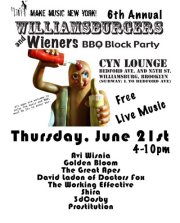
 On the hot and muggy Thursday, June 21st, I traveled to Williamsburg to visit the Cyn Lounge. Here, Avi Wisnia was hosting his annual BBQ Block Party. Although the heat persisted as 8:00pm rolled around and I was sweating through my work clothes, I was happy catch up with Avi to hear some of the bands in his line-up. One band I particularly enjoyed was 3dCosby.

The songs by this band that caught my attention included “Paint by Numbers” and the humorously-titled track, “Star F*cker.” Both songs are featured on their latest record, Satan’s Secret. All of 3dCosby’s tracks combine funk and jazz. Occasionally, they will add a special musical technique called polyphony – the playing of four different voices or melodies produced by the guitar, keyboard and bass all at the same moment.

During their performance, the front man of 3dCosby, Daniel Harris, invited audience members to dance to some of the instrumental pieces. The audience, me included, responded positively, and moved to the rhythms of their songs inside the small cemented outdoor space of the Cyn Lounge.

Daniel Harris on guitar and mic at the Cyn Lounge, June 21, 2012

Daniel admits that “it’s great to see people respond to it [our music].” However; Daniel and the member of 3dCosby who is perhaps closest to him, Matt Ross, see music making as more than just a means for having fun; it is how they “do family.” Over a telephone conversation, Daniel talked to Music Historian about the history of 3dCosby, the album, Satan’s Secret, and most importantly, the development of their style. I am happy to introduce 3dCosby as the full-length interview feature on Hear; Don’t Listen for the month of July.

Pre-beginnings of 3dCosby: Hillel

Anybody who listens to Daniel talk about 3dCosby can believe that this band is a family.

Daniel says, “Matt and I initially met when we both moved to Monroe, New York. Our Moms introduced us, and we were pretty much attached at the hip. We went to the same camp; we were in the same Jewish youth group” and they made music together from an early age. Daniel continues:

“We both grew up around music. Matt’s Dad was a professional musician who practiced saxophone and flute. My Dad taught me to use the turntable when I was 3 years old; and in the 4th grade, I started playing cello and Matt picked up trumpet. In the 5thgrade, I picked up guitar, and at that time, Matt and I would listen to songs on the radio and write our own lyrics.”

Daniel Harris and Matt Ross, courtesy of 3dCosby’s site on bandcamp.com

Daniel and Matt initially dabbled in the idea of forming a band. Then, once the two hit high school, the idea slowly turned into a reality.

“Matt and I wrote our first song at 14 years old called “Never End” inspired by the author, Michael Ende who wrote The Never Ending Story. We also started playing in bars, coffee houses and in people’s backyards at that age too.

“Our band was first called Hillel (named after Hillel Slovak of the Red Hot Chili Peppers), though we eventually changed the name to Ethan’s House of Pancakes. At the end of high school, I got a call from our friend Alan asking if I wanted to start a new band with him. “Can Matt be in the band?” I asked. Alan said “Totally,” then added, “We have a gig in two weeks at the House of Blues in Boston.”

Daniel admitted that playing the House of Blues was an epic opportunity for him and Family Junction at the time. The band stayed together for about 7 years. While they were in the process of recording a series of 5 EPs, Hillel separated. Daniel describes the break-up:

“We [all the band members] started taking on extra projects. Matt was working with other bands and I was working on solo stuff. We made the collective decision not to play anymore shows until the EPs were completed, which ostensibly was a diplomatic way for us to sadly agree that things had come to an end. In the Fall of 2008, I put out my first solo album, “Thirty-two bit isn’t really eight bits better” which you can check out on http://www.iamdanielharris.com.”

Luckily, the break-up of Hillel was not the end of the friendship between Daniel and Matt. These two would continue to make music together.

“This is just what we do – we’re brothers, and at the foundation of our relationship is music. It [music] keeps us together and it keeps us sane.”

“It All Made Sense”: A few jam sessions and songs later, a new group and record forms

Although Family Junction was over, Daniel and Matt decided to come together for a jam session in 2008. Daniel enumerates:

“After the band was already broken up, I drove to Matt’s house in New Paltz and decided to just jam. We soon started writing songs in his living room.

“We just wanted to see what would happen, and as we continued writing together, we soon had enough songs to make album. Just last winter, we decided to make a record which transformed into 3dCosby’s first album.”

3dCosby still remains just Daniel and Matt, and their friends that are invited to play during live performances. So far, the band gained tremendous recognition for their album, Satan’s Secret. The track “Paint by Numbers” became the band’s hit.

3dCosby’s album cover for “Satan’s Secret”

“This [“Paint by Numbers”] is a funny track. My younger brother wrote the lyrics, and it is about a guy named Colors, who only saw in numbers, and a girl named Numbers, who only saw in colors. It was originally an instrumental piece, but someone demanded we add lyrics. So, we gave Jesse, our bass player, my brother’s story, and asked him to write the lyrics.

“This song also makes fun a band we played with a few times. We still love them, and so we decided to tease them in “Paint by Numbers” because we feel one of the ways you show someone you love them is by teasing them.”

After the album was completed, Luke Sullivan, the musician who mastered Satan’s Secret suggested that 3dCosby send “Paint by Numbers” to Michael Marotta, a disc jockey who played songs by local artists in the Boston area on WFNX.

“Luke suggested we send the single to Michael. So we did, and he wrote back to us within 3 to 4 hours and agreed to spin it on the air. He also asked us to follow-up with him once the release date for the album came closer. Then, we were played on 4 to 5 difference station, and we made it to the top ranks on a few music charts like “The Deli New England.”

“The attention from the press was just flowing very naturally and it all made a lot of sense.”

3dCosby was “Satan’s Secret”

Daniel and Matt have constructed their own world of excitement by incorporating their own jokes into their songs. In addition, the dance beats and funky rhythms and dissonances that accompany the lyrics in 3dCosby’s songs invade the minds of attentive listeners and music lovers without creating any discomfort or pain. Daniel validates my thoughts as he explains the meaning behind the album title.

“When we were naming the album last year, this joke happened to come into our minds; then it became that 3dCosby was “Satan’s Secret.” We want to destroy you,” joked Daniel as he continued to make a reference to the Satan character in the 1999 South Park movie.

As Daniel and I continued to talk, I soon realized that we were starting to joke between ourselves. I reiterated back to Daniel my understanding of why 3dCosby thought that “Satan’s Secret” was a great name for their record. I said to him:

“Satan’s Secret is 3dCosby. They want to destroy you, and so do you. They will annihilate you in the best ways possible, and it will seem like you’re not being destroyed at all.”

Daniel responded, “That’s great, write that down.”

As our conversation continued, I saw the progress between the beginnings of 3dCosby to the band’s full-length, Satan’s Secret, which was released in February of this year,as the result of Daniel and Matt’s musical development, their friendship and the appreciation of different musical styles. One individual that Daniel credits for fostering his and Matt’s appreciation for music is their history teacher from junior and senior year of high school, Mr. Lee.

“He showed us a different dimension and put us on a specific path”

“When we graduated,” explains Daniel, “he gave me a copy of the book On the Road and two Frank Zappa albums. I didn’t listen to them until the year 2003. I was going to attend a protest in NYC against the war in Iraq, but ended up spending the weekend in Monroe, New York at Matt’s house.

“When we were there, we really wanted to listen to something we had never heard before, so I found one of the Frank Zappa albums Mr. Lee had given me and I remember listening to the first track titled “Inca Roads” off the album, One Size Fits All.We loved this track; we literally took it with us in the car and drove around Monroe for one hour listening to this song.

“This marked an important musical change in my life. This motivated me to get Frank Zappa’s albums, and through listening to them I was inspired me to revisit an album I already possessed by John Coltrane. Afterwards, I eventually fully understood jazz.

“So, if it wasn’t for Mr. Lee, we wouldn’t have learned to develop an understanding of jazz. He showed us a different dimension and put us on a specific path. That’s why, when we released Satan’s Secret, the initial idea was to make 3 copies of this CD: One for me; one for Matt; and one for Mr. Lee.”

“People…whether they’re musicians or not, they connect with the music” 

Although Daniel and Matt graduated high school over 10 years ago; have experimented with several different musical groups; and have each jumped from job-to-job in order to support themselves; the members of 3dCosby always remember the friends that have helped them and the communities that facilitated their growth and love for performing.

“This is what we want to be doing and we’re doing it our way,” says Daniel. “We’re gregarious; we have a strong sense of community and we love meeting new people. We also stay in touch with our friends from home. Matt still keeps in touch with the friends he’s known since he was a child.

“Through this album, and through music, is how we do family. When people see 3dCosby, and listen to the record, they get to know who we really are and they also see our profound dedication to music, as well as our humor and what music does for us as individuals. People get it. Whether they’re musicians or not, they connect with the music.”

3dCosby is currently working with a third party on a Fall tour for this year. They are booked to perform at Lit in New York City on September 22nd. In the meantime, the duo will continue to make music and perform for audiences everywhere they travel. For Daniel, playing music and doing music with Matt “means more than what any words can appropriately describe” – playing together is “a saving grace.”