Tinderbox Arts’ Showcase at CMJ: Reviewing Artists who have been on Music Historian

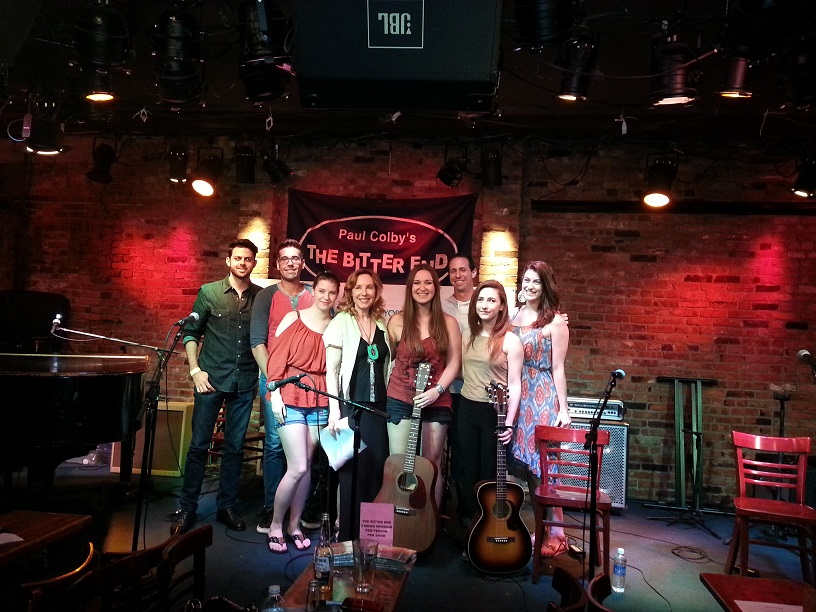
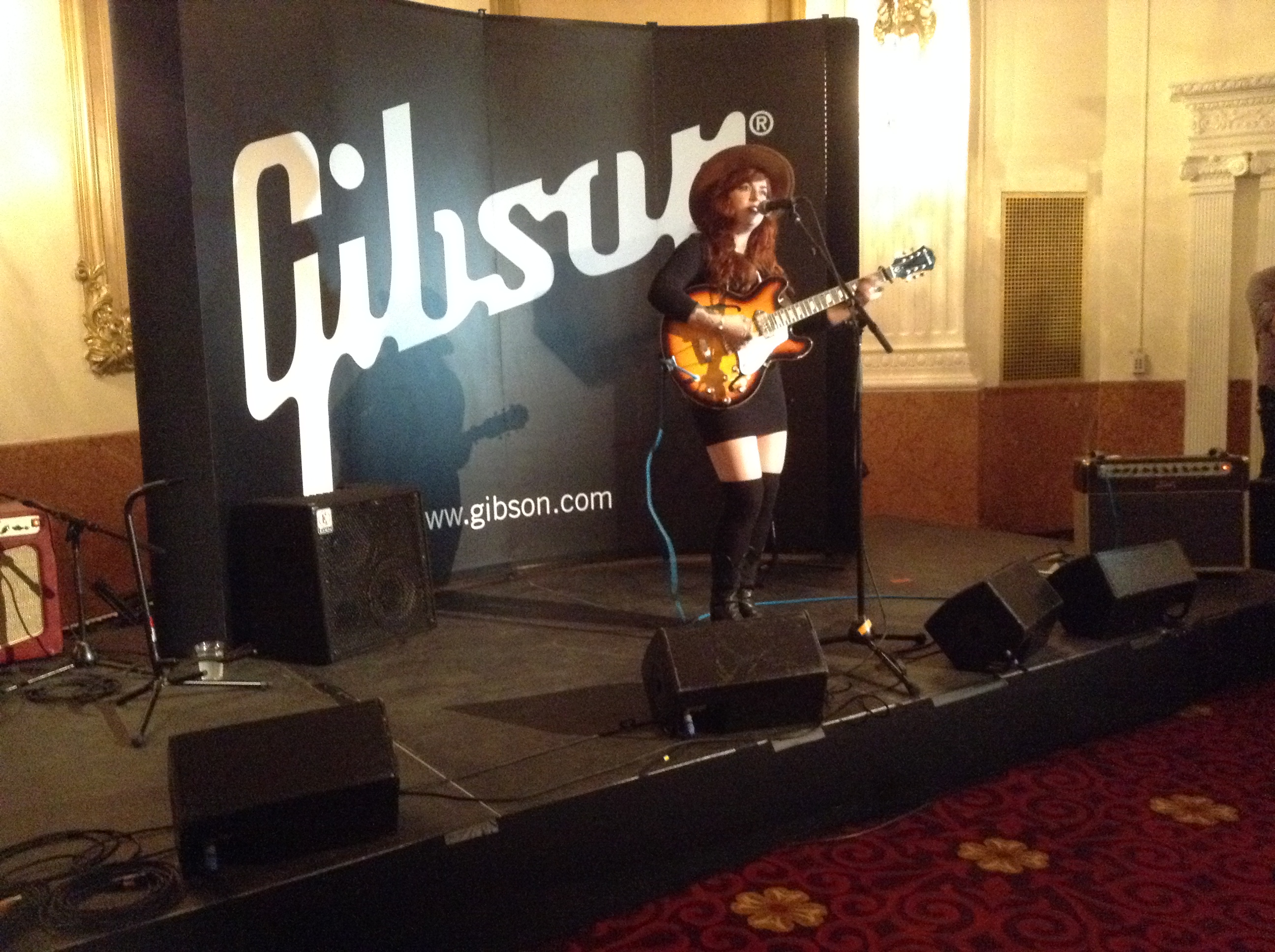
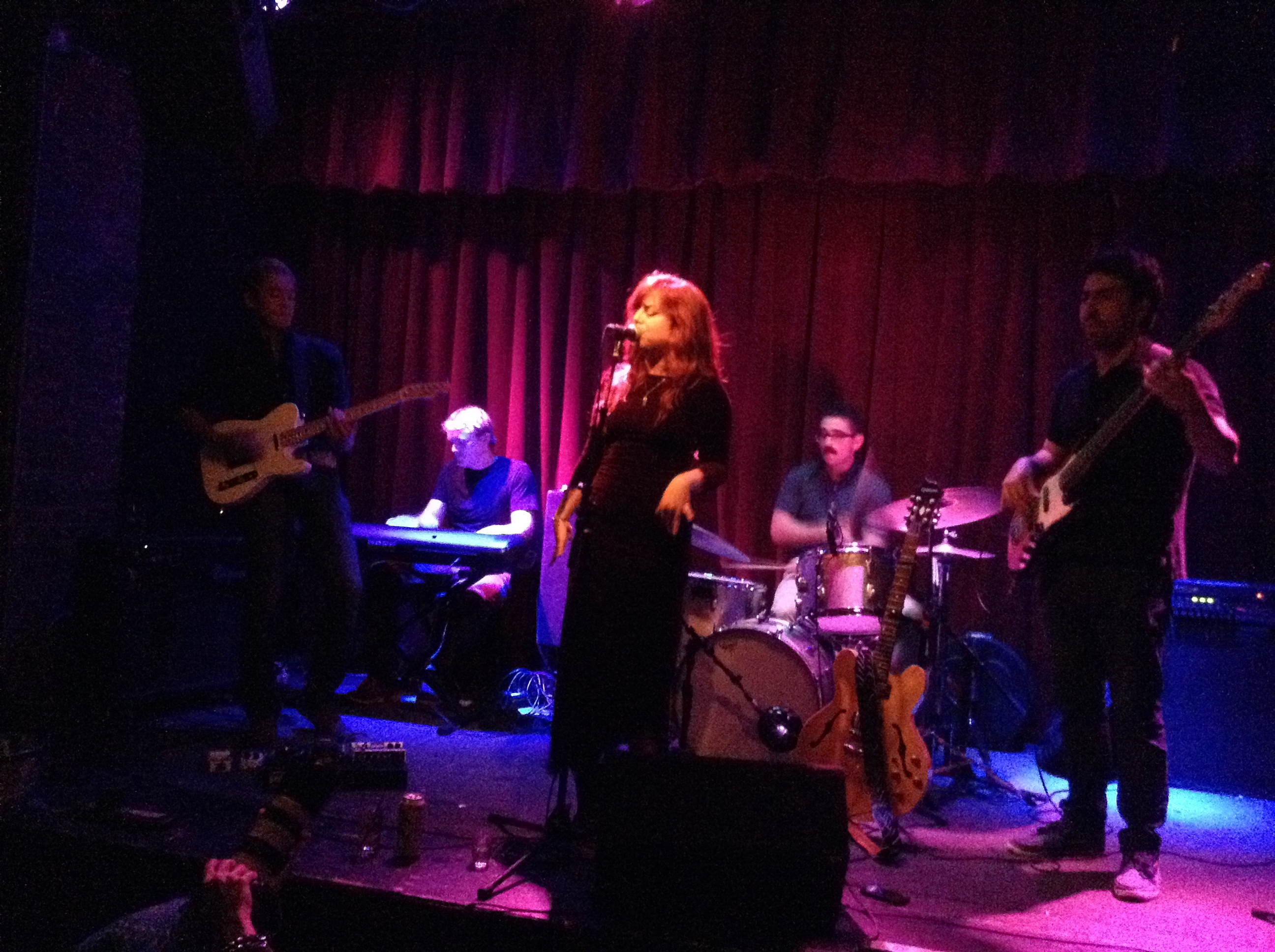
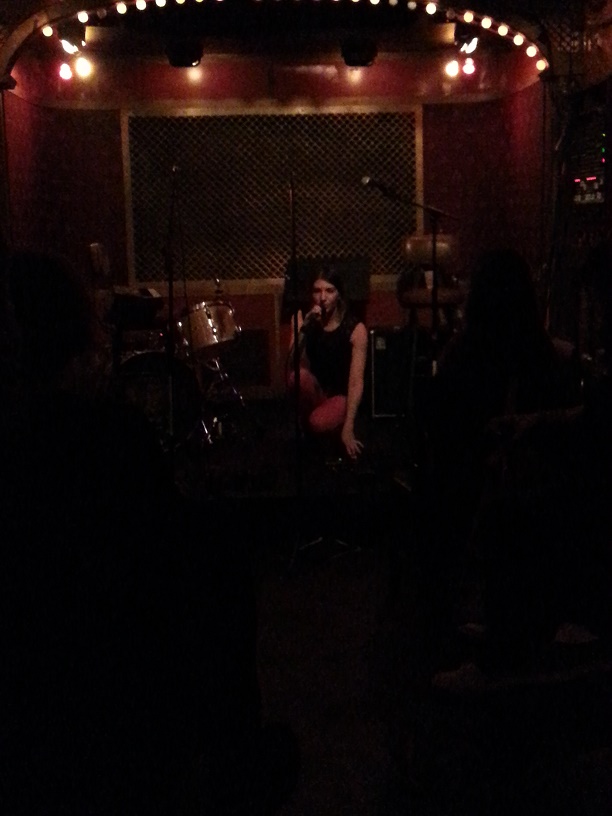
Alyson Greenfield performs solo during her set at Pete's Candy Store, 10/23/2014 as part of CMJ Last Thursday, I went to The Tinderbox Arts’ CMJ showcase at Pete’s Candy Store. This show was made possible with the help of The Catalyst Publicity Group, and hosted by Alyson Greenfield. The performance included a line-up of five bands – most of which have been interviewed by the Music Historian – that performed between 9pm and 12am the next day. This showcase was a great replacement for the Tinderbox Music Festival Alyson had hosted in the past.

Before I get into reviewing the show from last week, I want to share a little history about the Tinderbox Music Festival. In 2010, Alyson learned there was a large community of female musicians who desired to be part of a new women’s music event, specifically reflecting the current landscape of emerging talent (tinderboxmusicfestival.com/story). The festival continued annually for four years. In 2012, CocoRosie headlined the festival. Then in 2013, Deerhoof, the art-pop band headlined the fourth and last Tinderbox Music Festival.

During the four years of this large festival, Alyson established Tinderbox Arts, a company that focuses on booking shows for artists, public relations and consultation, and the former official producer of this large event. This year, she has decided that all of her company’s efforts would focus onto showcases that bring together both male and female artists who are on the firm’s roster – Todd Carter a.k.a. The Looking, Janna Pelle, Alyson, Fiona Silver, and Sylvana Joyce + The Moment.

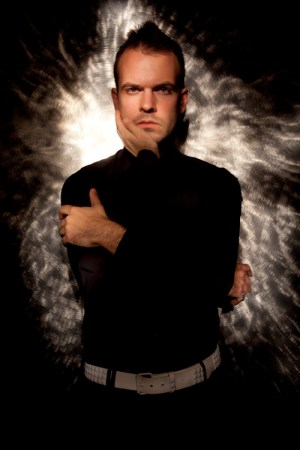
Todd Carter a.k.a The Looking opened the set with songs from his 2013 release Songs for a Traveler. These songs included “Blue-River,” and “Old Man River.” Then, he sang a cover of the avant-garde songwriter from the 1970’s Hugo Largo’s “Second Skin.” As the guitarist plays the opening chords on his tin-like sounding Strat guitar, Todd takes time to feel the driving harmonic rhythm. Very silently calculates the volume at which he should project his voice during the sudden skin-crawling crescendo within the chorus. Todd was very precise in his vocal execution, as was his entire three-piece band on their instruments – electric guitar, drums and piano.

The Looking’s most notable skills include their ability to make music sound just right – not too loud nor soft – in any performance space. Further, if you like art music that is void of automated technology and involves instruments of classic rock, please check out this band the next time you want to head out on the town. The Looking as part of Tinderbox Arts showcase at Pete's Candy Store, 10/23/2014
Janna Pelle followed The Looking as the second act. Her ensemble included a drummer, whose set had snares, an electric bassist and a piano played by Janna. The most memorable number in her set is from her 2012 album, Shameless Self-Promotion, titled “Accessory.” This track feels like Tori Amos and Fiona Apple if they were upbeat and fearless about admitting their need for sex. The lyrics in the chorus are You are my favorite accessory/ you look so good on me/ there ain’t no other piece of jewelry/ that does what you do to me.

In terms of melody, the song does not finish on the tonic, but with a half-cadence; giving the feeling this light-hearted physical affair our songstress is having will not finish anytime soon. Our heroine might take a break, but she will not put her needs on the back burner anytime soon. Or so I hope.

In addition to songs about sex, “City Life” is one song that talks about the confusion of The Big Apple. In the chorus, Janna sings Where, where, where do I go?/ So many directions/ I don’t know where to go. The song opens with a driving cymbal and snare in the rhythm section as the bass plays a syncopated and jazzy line. On the keyboard, Janna holds out the chords for whole notes across her measures.
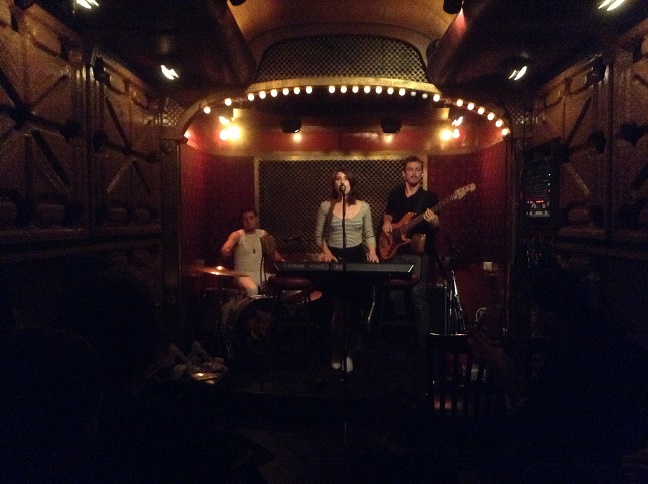
Janna Pelle's set at Pete's Candy Store, as part of Tinderbox Arts showcase for CMJ, 10/23/2014 During Jana’s performance, Sylvana Joyce sat down next to me to say “hello.” As Janna takes the listener further within her song, Sylvana starts to harmonize with the remainder of the chorus, I guess I’ll have to figure this out on my own. This lyric, without any pun intended, serves as a mantra for several artists.

Between performances, I also had time to mingle with other active musicians. I was introduced to a young composer who works full-time writing children’s music professionally for an app development firm. This composer has toured all over Australia with his old band, completed his Masters in Composition at NYU debt-free, and opened his own studio in Brooklyn. I would not be shocked if he had to figure out his way in the business independently too.

I then talked with Alyson about the company she manages while she continues paving her career path. Watching her performance at the line-up, Alyson exhibits how she consistently paves her way in music. I first interviewed Alyson in 2012. She was premiering the music video for her cover of LL Cool Jay’s “Mama Said Knock You Out.” At that time, she had already recorded “Understand the Sky,” which was on her album Tuscaloosa – a record that compiled acoustic guitar. In this album, her songs addressed the toils of women taking on the music business and living with the societal stereotypes often placed on them. In addition, synth-themed songs acted as meditations regarding the experiences we don’t immediately acknowledge, like human nature.

In her most recent performances from 2014, Alyson has kept her synth-work, put the acoustic guitar aside temporarily, and made room for hip-hop. Her collaboration with beatboxer Shane Maux in the song “Uncharted Places,” and other tracks – including one where the two rap about the industrial development in Brooklyn – serves as valid proof of this bold stylistic move.

This slideshow requires JavaScript.

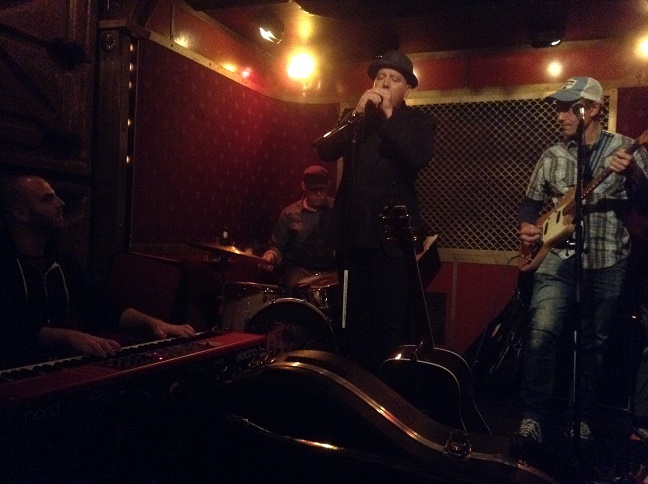
Turning to Fiona Silver’s set, I must say her music sounded a lot better at Pete’s Candy Store than it did at the Knitting Factory. I accredit this a lot to the great sound system and the engineering, a small space, and finally, the performance skills of the songstress and her band. Fiona brought with her an electric guitarist who played a Les Paul – a perfect accompaniment to the moments Fiona pulled out her strat and ukulele. Additional players involved a drummer and bassist.

The beauty of photographing Fiona and her band up close is that I could get a better shot of her, the Elvis mic she brought and better capture her incredible stage presence. Fiona’s style of blues-singing has always been described as smoky. That night, I heard a few new tracks that brought out more fiery vocals and melodies than the firm and gentle “Sweet Escape” and “Sand Castle.” Songs like “Coming to Get You,” does not exhibit the light strumming of a uke, but a guitar melody with a metal slide. Her last song for the set, “Long Gone” resembled something more of rockabilly and surf rock.

This slideshow requires JavaScript.

These irresistible tracks got the audience to request one more song. In honor of the night that would quickly draw to a close though, the songstress left the spotlight open for the next scheduled act.

Sylvana Joyce + The Moment were the second to the last act. They opened with their latest single, “Rosie” – a song which marries classical and heavy metal music together, and repeats several beautiful minor cadences. Further, their sound is that of rock, cabaret, and classical with an Eastern European flair. Think Klezmer and Romanian folk.

The music by this band spiced up the response of the crowd. Sylvana and her crew drew in young fans who, in that cramped performance space, busted out dance moves appropriate for a punk rock concert. When I listened to the band’s next song “Chin, Chin,” the rhythm in the chorus made me want to get up and dance the sarba (pronounced Suh-R-Baa). This dance is similar to the hora but with a lot more staccato-like step and bouncing.

Sylvana Joyce + The Moment rock CMJ show, 10/23/2014 Sylvana Joyce + The Moment’s music combines both American and Romanian style. Depending on where you come from, your ear will pick up one element more quickly than the other. In order to fully understand this music, one must not think about why these different elements would work well together in the first place, but instead physically feel how these components work together to make one union. With songs which are 5 minutes long, at least, there will be plenty of time to absorb the experience of this band.

Shayna Leigh closed the night with an unplugged performance. She played with an acoustic guitarist. By the time she got up, it was already 12:30 AM, on October 24th. Although I couldn’t review her performance the way I reviewed the previous bands, I can tell she is a talented songwriter. Her original song “Crash” felt composed like a pop song. I could clearly hear a verse, pre-chorus, chorus, verse, pre-chorus, chorus, and then, a section that might have been built on a deceptive cadence (think the dominant chord, or the 5, going to the supermediant, the 6).

When a show runs that late, I will say; it is not only audience members who become tired. The artists – especially those with day jobs – also become a little too overwhelmed. Some of the audience members told Shayna, while she was taking a breather between songs that her water bottle looked like a vodka bottle. She responds, “I wish it was, I really do. But I’m not that type of person.”

It was during Shayna’s set I noticed more verbal interaction between the audience and the artist. After a long and busy day, this can be quite refreshing. Sometimes listening to music live is not all about the music; it is about the absence of structure and the presence of personable experiences within performers while they put on a show.

My experience at the Tinderbox Arts CMJ showcase this year felt like a reunion filled with music, catching up, interaction and listening. Even in a large and robust places like New York City, there are moments when we can break down barriers and get close to the artists.

Music Historian’s thoughtful interviews with independent artists show just how the musical landscape is evolving. Looking to the future, I hope to work and help the public get closer to these talented musicians through my blog. I just have to take things one step at a time. Happy Birthday, MH!

Works Cited

Greenfield, A. (2014). Story. Tinderbox Music Festival. (About). Retrieved from http://tinderboxmusicfestival.com/story/

Yuzima’s Insta-Album, BASH: The Pop-Up Album That Unites Anti-Homophobia & Mysticism with Punk

Yuzima Philips, Press Photo, for the BASH, the insta-album released on Oct. 7, 2014 What do you call a collection of songs, created to represent a specific theme, which are then released as an automatic response to a quickly changing world? Yuzima, the indie luminary who graced the Music Historian with his 2013 industrial-themed LP, THE MACHINE, calls it an insta-album. Since this release is very spurring of the moment and surprising, I thought an interview article of the same spontaneity with a New York City musician that has gained my artistic respect was very appropriate.

During the creation of THE MACHINE, many additional musical ideas hit Yuzima, especially during one influential visit to New Orleans. The artist also thought about what was happening in the world at that time, specifically the issue of homophobia. All of these experiences funneled down into one creation, the three song album titled BASH, which Yuzima will release digitally on October 7th.

The self-titled track on the Insta-Album opens with a heavy U2 influence in the vocals. Then there is the musical component within the guitar and drums that I have not yet heard within an indie song – polyrhythms. In this musical element, and in the case of “Bash,” the electric guitar plays the melody with syncopation and many rests. The drums work to fill in the silent spaces of this guitar melody.

Listeners taking in “Bash” will hear the intricate relationship between the instruments. Further, they will feel the physical space created by the echoes – which are recited with crescendos and decrescendos – Yuzima creates in the chorus. This chorus quickly follows a verse that contains the following lyrics, we are different yet the same, straight and we are gay. Naturally, I wondered whether the next two songs on BASH would carry the same type of instrumental feel.

“That seems to be a touchstone for me – a little bit inspired by U2 and then transformed into my thing,” explains Yuzima. “Madame Laveau has a bigness to it… I drag in synths. I think of art like the cosmos; U2, The Beatles sent out creative energy and folks like me are transmuting it, and sending it back.”

In regards to the lyrics mentioned above, Yuzima claims he was “on the fence about that lyric.”

“I thought it might be too straightforward, but I made the artistic decision that the message still needed to be said and heard. So I kept it. I don’t believe in race, in ‘black people and white people.’ I think we have interests that either unite or divide us, and that [theme] was a big part of my last record.” BASH, cover art, a pop-album by Yuzima, to be released on Oct. 7, 2014

On the subjects of interests that either unite or divide us, gay rights and the issues of homophobia comes to mind. When I was a child, I received plenty of homophobic slurs from my peers. While this eventually disappeared for me – mostly because these slurs came from bullies or classmates who were very immature and insecure with their own sexuality – for many, unfortunately, homophobic bashing does not stop in adulthood.

Yuzima claims that his pop-up album delivers a theme of anti-homophobia. The musician explains, “Homophobia is awful and cruel. At the same time, it’s insanely uncool. When folks engage in hate, it makes them look way out of touch. That’s where music comes in – artists are the purveyors of cool. By putting homophobia on blast in a punk tune… we assert ourselves.”

BASH also has a rebel post-punk theme. Meanwhile, “Madame Laveau,” is a progressive reggae-ish rock number inspired by the New Orleans voodoo legend, and “Light Love” is a spiritual pop number. Yuzima’s trip to New Orleans inspired him to creatively marry this rock ‘n’ roll genre with the wild jazz and voodoo energy of the Louisiana city.

“I loved New Orleans. You don’t know jazz until you go there. I’m always heavily influenced by places I visit. I’ve written songs about Miami, Venice Beach and New York City – where I live.

“Part of the reason I went [to New Orleans] was to inhale the scene – to be touched by the magic. The moment I touched own, I wandered the streets and [entered] a store called Marie Laveau’s House of Voodoo Readings. It was one of those transforming moments where I came out a different person and I had to write a song about it. The concept of the Insta-Album is to get that inspiration out – not have it sit around for half a year. I came back to NYC, started writing, recording and voila!”

Prior to embarking on his trip, Yuzima knew there was something down in this city he wanted to experience – voodoo. I wondered what interested him in this mystic practice. He says:

“I love the idea of something that has not been adulterated by the modern world. It’s stronger than technology. Old voodoo ceremonies seem to connect us to the spirit world and the old world [in a time] when everything didn’t have an [immediate] answer. Also, there is a hidden power in music, which voodoo kind of exemplifies.”

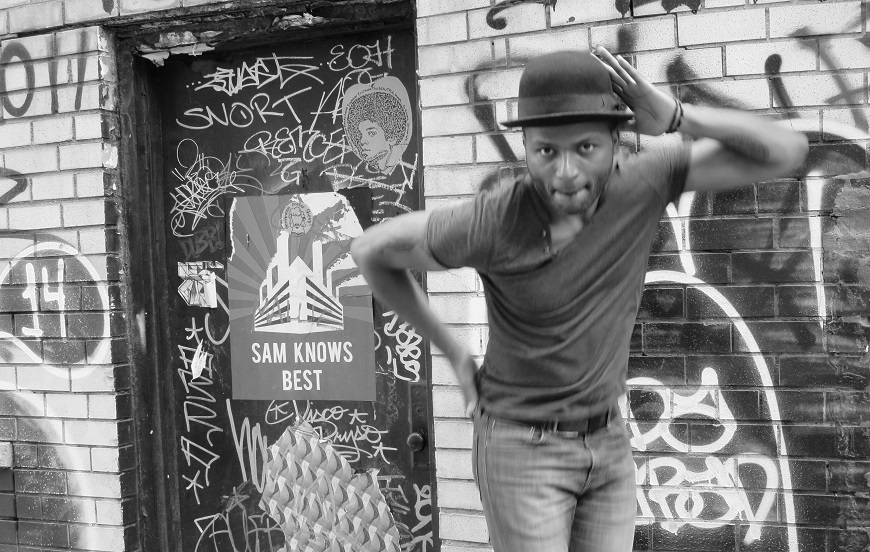
Yuzima poses for photo shoot, for his insta-album, BASH, to be released digitally on October 7th So, Yuzima parallels multiple themes or ideas that perhaps don’t belong together, like the purity of mysticism next to the unrefined and grimy feel of punk music. Meanwhile, the coupling of rebellion against homophobia and a spiritual trip inside Marie Laveau’s House of Voodoo Readings seems almost impossible. Come October 7th; listeners will have a chance to understand how Yuzima’s signature new age punk will connect these juxtapositions into a musical relationship that will be just as intricate and exciting as his single “Bash.”

My last question to the artist was, “why come up with this new album format? Is it for more effective marketing for a longer album coming down the line, or does it excite fans more?” Yuzima answers:

“It might be…but artists today can’t just rely on the past formats. Bands innovated before us, it’s our job to carry the torch and innovate for today.”

Yuzima also claims he plans to release two more insta-albums. Yet, one might ask themselves, why not just wait to release 10 songs in a full-length album? The answer, based on what Yuzima tells me might reside in the fact that letting a musical idea or message sit for too long will eventually lose its level of pure artistry. Further, an artist might fall in the trap of overproducing a song.

All artists will greatly benefit from the traditional process of focusing solely on a full-length or an EP. This insta-album is a new way of releasing music, especially since it can allow musicians to focus more on their art. Most importantly, this can serve as a trial and error period to see how fans receive an artist’s new musical idea. Could Yuzima be onto something? Maybe.

“When others say “no”, find a way to “yes”: Tina Shafer of the Songwriter’s Circle and her advice for today’s musicians

TIna at Young Performers Night 2014, at The Bitter End night club Many artists we have come to know experienced their first big break at the right place and the right time. This is especially true for Billy Porter, a former pupil of songwriter/ vocal teacher and founder of The New York Songwriter’s Circle, Tina Shafer.

“When I worked with Billy Porter – who won a Tony 2013 for his performance in the hit Broadway Musical “Kinky Boots” – he was an unknown singer with one of the most amazing voices I had ever heard. In the late 90’s he got a record deal with my help on the A&M label.   He later went on to perform “Love is On the Way” a song I co-wrote for him that became the Center piece song in Bette Midler’s film “The First Wives Club”.   Later that year, Celine Dion cut “Love is on the Way” and it ended up on her album “Let’s Talk About Love”.  The Album sold over 33 million copies worldwide because it also contained the song “My Heart Will Go On” from the blockbuster movie “Titanic.”

The songstress, who I had the pleasure of meeting in-person at a performance at the New York Songwriter’s Circle held at Bitter End last month, also talked about another former vocal student named Lana Del Ray.  Those who follow Lana know her break was very different from Billy Porter’s.

“Lana, when she was studying with me,” recounts Tina, “wrote the song “Video Games” and most of the attention she first received was through online bullying.   She is very beautiful and an easy “hate Target”. As people started listening to her they then started actually liking her music.  There was a whole backlash of people that starting standing up for her.  It became a viral phenomenon.

But then, where do you go from there? How do you keep your fan base and the customer in mind?”

Music Historian has welcomed advice on how to make it in the music industry from current and former record producers, music publishers, A&R representatives. Now, I welcome advice from Tina Shafer, who is a vocal teacher, singer-songwriter and the founder of the New York Songwriter’s Circle that helps provide a welcoming community to those who work in the beautiful, yet sometimes, lonely and cutthroat world of songwriting. I welcome Tina Shafer to my blog.

Before I get into what Tina advises to current and aspiring musicians and songwriting professionals, I want to share her story about how she became involved in songwriter and began with The New York Songwriter’s Circle.  Music served as the background to Tina’s life. Her mother was a composer, and she brought Tina up in a house where there was always music. At the age of 4, Tina started to learn music in an experimental class for young children at a conservatory in Cleveland. Tina explains:

“They [the teachers] were trying to prove they could teach difficult theory and composition to young kids.  This is similar to the way they teach languages now to young kids.

“The first time I really decided to become a songwriter was when I listened to my first Joni Mitchell record. I was in the 10th grade. From there on, I decided to pursue music and songwriting.”

Just as she finished high school, Tina made the move to New York City, by herself, where she did not know anybody. She performed in clubs, including the Bitter End, and picked up any gig she could do. After 10 years in the city, she obtained her first publishing deal as a songwriter with Warner Chappell and started working with some big names. In addition to Billy Porter, she has written for Celine Dion, Donna Summer, Phoebe Snow, and performed with John Oates (Hall Of Fame), Suzanne Vega, Marc Cohn, The Hooters, The Spin Doctors, Gavin DeGraw, to name a few.

The New York Songwriter’s Circle officially started in 1991 held the first Monday of every month at the Historical Bitter End located in New York City’s West Village.   Tina originally took over the circle as a temp for the original founder. The woman who was initially in charge left to Nashville for a trip and decided to not return. In 2016, The Circle will celebrate 25 years of facilitating rising talent. I then wondered how the business model worked. 

“The New York Songwriter’s Circle is a platform for great talent and up and coming writer/performers but her own company “Tina Shafer Inc.,” I work as an executive producer, developing talent, and putting together  the best creative package to represent that talent.  This often includes, putting together all the musicians, writers, and producers, making an LP and finding the proper promotion.  This is known as “Content packaging”.”

The last component of her business model; marketing, is perhaps most crucial. According to Professor Ana Valenzuela, a faculty member at Baruch College, 75% of a plan for any type of business involves marketing. The other 25% are finances. Marketing enables entrepreneurs to understand who they are as a business, which customers they serve, and what makes the customers return to use the product or service.

Based on what I learned at the New Music Seminar earlier this summer, the same holds true for musicians. They must make music for their audiences. On the same token however, the music industry has changed dramatically in the last 10 years, making artists perhaps more vulnerable.

“When Vanessa Carlton – another Grammy nominated artist and student of Tina’s appeared at The New York  Songwriter’s Circle before making it big – (in 2002), some of these new artists received $400,000 advances  on their first record,” said Tina. She adds that in those days, record labels fostered artists’ development, now, labels do not want to pay for this. On the other hand though, Tina, just like Daylle Deanna Schwartz, asserts an artist does not need a record deal. She explains:

“All you [the artist] need is a great booking agent and advisor. Then you tour, make money from that, and create a record on your own. In a way, this is good, but it costs money to have a booker, a website, you have to pay for so much.

“Now, you have to be self-propelled. Ed Sheeran, for example, was couch surfing and writing with everyone and anyone he could when he started out, then got some air time. Then, he started touring with Taylor Swift.”

While so much has changed in the music industry, Tina reassures songwriters that even when record labels stopped paying for artistic development, Napster started satisfying customers who could get content for FREE, and self-recording and digitization has become more prominent; the only thing that has not changed is the need for great content. In other words, excellent records, songs, playing and performances. We are slowly catching up to the ways of the internet and trying to find avenues to get payment for content.

However, like everybody working in music, I heard a lot of ‘no.’ Even while I was in college, many of my colleagues who were vocalists were told they would have the hardest times finding work after graduation. Now, I find myself talking with a Tina Shafer, who is a conservatory-trained vocalist and guitarist who managed to make her dreams of being a singer-songwriter come true. Naturally, I wanted to know whether she had any advice for someone who is currently in college or in the music industry and receives a lot of discouragement.

“Anyone who goes into the arts will almost always hear that they are not going to make it,” says Tina. “You have to find a way to say, “that is not going to be me”. You have to recognize your strengths.  You may be an ensemble player, you may be a soloist, there are many avenues of music to explore”. “When people said “no”, it gave me [the chance] to find a way to say ‘yes.’”

Tina carries these encouraging words to her sons. Her oldest, Ari Zizzo who is 18 and becoming a well-known teen songwriter.  He has so far, opened up for artists like Mumford and Sons and this summer will open for Emblem3 and Demi Lavato at the Pop Tarts Concerts in Chicago.

Thomas, her youngest who is 16, is a sophisticated writer who hopes to become a film critic. The boys’ father is also a music producer. (Peter Zizzo)

Tina Shafer at the Songwriters Circle on July 7, 2014, The Bitter End In addition, Tina applies this lesson to The New York Songwriter’s Circle. While her company also works to help artists create content, Tina confirms that musicians must push themselves to connect with their own fan base, communicate with their customers directly, and get out into the performance spaces. In addition, good music will not change, and a great song has a way of rising to the top.

One might bump into a cynic who discourages them from continuing with the music industry, but remember this – while music is an undervalued industry, music consumption will double within ten years. Thanks to digital technology, the artist, who I believe can now become more personally involved in the marketing and distribution, has the chance to ultimately get closer to the consumer via social media. Therefore, the consumer can have a better relationship with the product. This gives way to great branding opportunities exist for today’s musicians. Also, musicians trying to fund a record through KickStarter.com help create business while increasing communication with their supporters and customers. Finally, digital vehicles like iTunes and Spotify can immediately deliver music to buyers. Fantastic customer service, right?

If you are a musician and worry about making money, your best option is to focus on the customer. A returning customer, whether it is a loyalist who will come to your shows or always buy a new record, will bring you the most financial return. Lastly, I can attest, that customers return for the good music. So don’t stop doing what you’re doing. Tina didn’t stop. If you happen to be a singer-songwriter looking for some help, check out The New York Songwriter’s Circle www.songwriters-circle.com

You can also check out Tina Shafer directly Tinashafer.net.

The Allegory, History and Humanism in Sylvana Joyce + The Moment’s Gypsy Rock

Sylvana Joyce + The Moment (l-r): Peter Bellomo, Sean-David Cunningham, Nick Salgo, Sylvana Joyce, Christopher Smith “Comrade” by Sylvana Joyce + The Moment, a track from their 2012 debut, For You, greets listeners with a Doina, the freestyle violin playing found in Klezmer music. Further, in the song, the Habanera rhythm – and yes, I do mean the one from the song that made Georges Bizet’s Opera Carmen an internationally recognized hit – will tempt a listeners’ curiosity. Let the track play further, and you will be led to a driving gypsy-like folk dance.

I started listening to Sylvana’s music after I saw her and her violinist, Sean Cunningham open for Todd Carter’s performance at the Cutting Room back in June. I covered her performance and we communicated back and forth. I mentioned how moved I was by her story of how the Romanian folklorist musician, George Sbarcea, was her grandfather. I then invited her to read some of my father’s story. We learned that both of our parents had nearly identical stories about how they left Romania during one of the worst eras of communism in Eastern Europe.

Naturally, I wanted to learn more about her background. More importantly, I was interested specifically in how she would describe her style of music, which she titled Gypsy Rock.

“It’s an interesting question. Gypsies around the world get a terrible rap. In fact, there are still rumors in the states that all Romanians are gypsies,” explained Sylvana.

“Yes!” I respond. “What do you say when someone claims “Oh, you’re Romanian, you must be a gypsy?”

She says, “Being a gypsy is an idea. It’s the idea that your home is not a place, it’s a feeling, and it’s a relationship you have with a person or an ether. I feel because our style is so diverse, we are a nomadic tribe wandering the world of genre. We fall in love with everything we come across, and we make it ours. I believe Gypsy Rock reflects the sentiment of wandering and finding our own version of an eclectic assortment of genres.

“We are all very passionate about what we do,” Sylvana claims as she focuses on the band. “We are all conservatory trained. We have all fallen in love with music and married music. I think, in the end, that is the most important thing that comes through and helps us connect with others.”

Like many, I readily observe how music can connect the artist with the public. What interest me the most is finding an artist who can describe the experience through his or her own point of view. I welcome Sylvana Joyce to do just that right here on Music Historian.

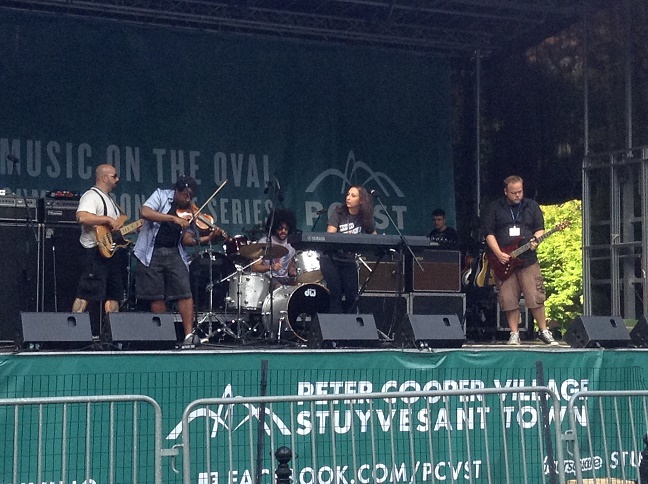
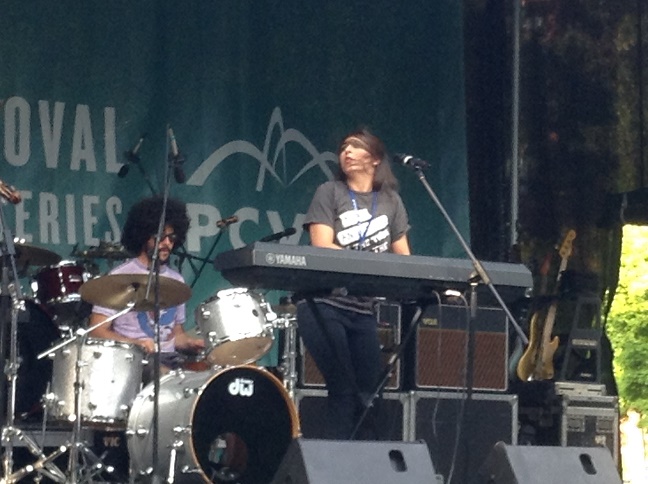
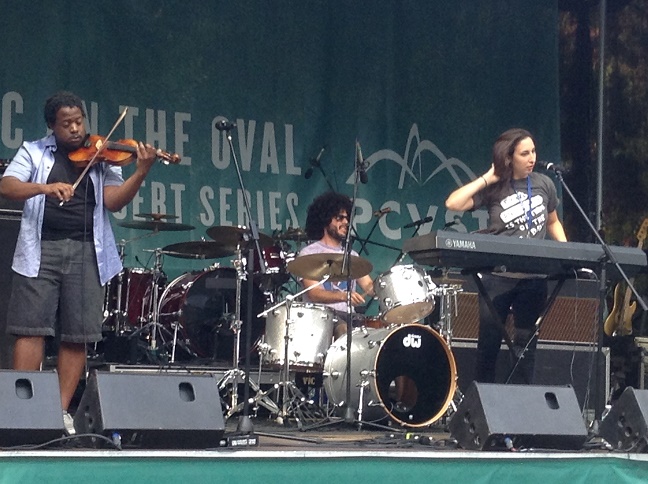
My talk with Sylvana about her music started in a model apartment within the Stuyvesant Town/ Cooper Village complex somewhere between Alphabet City and FDR Drive. Following Sylvana Joyce + The Movement’s hour-long set at the Oval, we were escorted to the apartment complex. When Sylvana, her guest, per diem bassist in The Moment, and I arrived at the apartment, we all had a look around the place and commented on the excellent space. Sylvana and I then headed to the small kitchen for a beer and then proceeded to the dining room table a few feet away to conduct our interview.

Sylvana, the singer, songwriter and pianist claims that she grew up in New York City, where she has gotten to know some of her band members from playing in a conservatory setting with them as a child. As a city-native, the bold and energetic artist reminds me how New York can be a tough scene for musicians.

“[While] I feel it’s easy to get lost in New York City, we don’t find that in smaller towns. That’s kind of been our goal – to find community-based places, play there, and go from there. One of our strengths is that we can perform to any kind of crowd.”

Although community-based places are sometimes overlooked by new music enthusiasts, these spaces enable the performer and audience members to have a better listening experience. For the musician, the sound system and the listening experience beats that of a brownstone pub. In addition, the listener can enjoy a pleasant, spacious spot on a clean lawn, sitting on a blanket with friends and breathe in an open space while experiencing the music.

Aside from discovering their love for giving community-based concerts, Sylvana Joyce + The Moment quickly learned that industry players have an interest in their music. In just six months of the band’s inception, Sylvana Joyce + The Moment were winning international competitions, and even gained a week long coverage from MTV about the band, which included a new recording of their single, “The Break.” The music video can be viewed here.

“MTV was a complete shock to me,” explained the artist. “I sent my music [to an acquaintance at the headquarters], it was this demo we recorded in somebody’s apartment. Someone [the person who listened to the song] just fell in love it with, so we were really excited.”

“That is one step though,” Sylvana continued. “You have a long way to go. We’ve been a band for four years… we’ve been moving up the ranks… it’s been a learning experience for me. I feel good.”

The group’s single, “The Break,” which has received the most attention successfully straddles the musical world of the 2 to 3-minute rock song, and the complex Eastern European-fused cabaret music. I then had two questions for Sylvana: What did she enjoy so much about Romanian folk music? Are the subjects within her songs inspired by real-life, fantasy, or the escaping into fantasy as a way to deal with real life?

As I asked the first question, I brought up George Sbarcea again. Sylvana laughed, “Oh my God, I have not heard his last name said correctly in forever!”

She continues, “Something that is really interesting… a lot of Eastern European folk music is minor. Romanian music is upbeat and major. It [might include] a few interesting minor melodies, but it has a very major and happy-sounding basis.

“We are almost putting a certain genre of music… rock ‘n’ roll on a pedestal. I want the next generation of musicians to start thinking outside the box a little bit. I may be involved in projects that put together rock bands of completely crazy assortments of instruments. I want anyone who plays any instrument to feel like they can be in a rock band because it’s true!

“I hope I can contribute in my own way, both as a performer and instructor. I’m happy I am going to teach music while playing. I think being an example and giving back is important in life.”

In addition to serving as a tool that can help artists reciprocate to the communities that fostered the musical development all each band member; songwriting has also become a form of therapy for Sylvana. Sylvana and drummer, Nick Salgo

“I kind of had a tough childhood. My father left when I was young, and my mom struggled to make ends meet. It [songwriting] was a way of expressing all of those difficult, sometimes ineffable situations. What I couldn’t put into words, the music would take over.

“I’ve actually been writing music since I was a little kid… around the age of 4 or 5, just as silly and imaginative play. I just got very interested in the fact that musicians would put thought into what words went well with the music. I thought the marriage of the two was very interesting.

“I only shared my music with my closest friends, but I would usually feel so embarrassed that I did, I would regret it later, and then have nightmares. When I put a band together 4 years ago, that’s when I started to take it seriously, and I thought I could do something with it, and when I was the crowd respond, I then said to myself, it was a possibility.”

Songwriting serves as a form of therapy for many musicians. A listener most quickly detects this in the lyrics, especially if they directly speak of a delicate situation that one hears of commonly. However, many artists will not address a story involving an issue or a personal problem directly. Instead, they might create an allegory or an allusion. Sylvana accomplishes this in “Comrade.”

“All the songs I have written have some application to my life, but then I will always put in a little bit of allegory and allusion. “Comrade” is loosely based on the story of MacBeth, and how he was so power hungry. He wanted to be adored [so much] that he didn’t listen to reason, became swayed and seduced by magic, and skipped the process of gaining power with integrity. He chose the quick route [to power] and then lost the ability to choose his own fate.”

As Sylvana helped me recall the Shakespearian story which I read many years ago, I was then reminded of the character Morgan from a recent flop-of-a-series about King Arthur produced by Starz called Camelot. I explained to Sylvana that like MacBeth, Morgan – who is Arthur’s half-sister – is so hungry for the throne, she depends on black magic to help her devise a plan that will kill her half-brother. The anti-heroine though has difficulty controlling her powers and depends on the help of her mentor, a nun who has been banished from her own convent. The nun reminds her that the best way to gain power is through earning the trust of her people, the commoners. Adding an adjacent story seemed to interest Sylvana. She then went on to apply another recent (non-fictional) story to the song “Comrade.” This story is about a malicious historical figure many Romanians know too well, Romania’s last communist dictator, Nicolai Ceausescu.

“You know,” Sylvana begins, “Comrade” also reminds me of the stories my mom told me about Ceausescu. Ceausescu’s right hand, his entourage, would try to shield him from the truth of what his regime really created in the country. When he would visit the places of peasant’s, his entourage would arrive early and put nice things in people’s homes to make it seem like they were not living in squalor.

“I feel like, as responsible as he was for his fate, he just wanted to be loved, and this kind of fueled his decision making and it ended in a tragic way. He was such a purist, and idealist that it all went horribly wrong. So, “Comrade” for me, the song, is about bringing something humanist to that fatal flaw of wanting to be loved and going to lengths, and how this desperation distorts everything.”

The lyrics within the chorus of “Comrade” are – Could it be/ that you’ve been made a fool/ by you, yourself?/Turn back now/ it’s better for your pride/ to bruise than lose your soul. This is followed by the second verse, Memories, of all the people who made fun of you/ would creep into your consciousness/ and keep you up at night/ now they have become/ the people who will work for you/ they are on their knees smiling/ and reciting popular poetry/ through their teeth.

Aside from “The Break,” most of Sylvana Joyce + The Moment’s songs are not the 2 to 3-minute tracks that many artists try to reproduce in the rock genre. While some bands have written great songs within this play-length, I have read comments from a handful of listeners who stream this type of rock music for free on Youtube, who often say, they want the songs to be longer. Sylvana’s music helps fulfill that wish with her 6 to 8-minute tracks, and “Comrade” serves as an example. Further, this length allows for so many different compositional movements, that it almost seems to be an eclectic circus of styles and genres facilitated by a classical music backdrop. I wondered whether Sylvana finds herself traveling throughout different genres in one song.

“I grew up listening to classical music, not rock music. That came later in life, and also through the band introducing me. I think that classical influence, especially with Sean and I having played chamber music as kids, comes into play as we are creating the music together,” explains Sylvana.

Now that we have landed on the subject of creating music, I had to ask Sylvana the following question, “When you come in with a song, do you present a basic idea, and then all of this improvisation happens, which eventually turns into a solid song?”

“It is that way for many songs,” she begins. “Sometimes, I have specific parts that I write for players, but [really] many influences come together to create something really special.

“This act can lend itself to being very folk-based. The harder rock sound, [produced by] Chris’s guitar playing, is influenced a lot by metal. Then, Pete’s bass playing is very funk influenced. Our drummer, he went to school for contemporary jazz. Sometimes, I want to reign it in, but other times, I want to let it loose and make room for something eclectic.”

Sylvana claims the entire group contributes the final sound within all the songs. “I will come up with a script of the song, let’s say, and we’ll have our own characters which we play in our performances – a grand opening of its own kind, like a movie, play or story.”

She then adds, “I think something special about the group, is that I found musicians who I trust creatively.” This sense of security is critical to all musicians, and any ensemble working creatively together. Further, one must have trust especially if they want to be successful in their future endeavors. Sylvana Joyce + The Moment currently have a few immediate projects. One includes a new record, which does not yet have a title.

“I think us as a recording band, and live artists are two different experiences. I’m trying to converge that into one cohesive sound in this upcoming record,” claims Sylvana.

An additional creative endeavor that will serve more as a Public Relations tool is Sylvana Joyce + The Moment’s appearance in a South Korean indie film, produced by an independent agency TreeFilms. Sylvana talks more about how the film and how the band became involved.

“The violinist of the band, Sean, performs in train stations every other day. A filmmaker visiting from South Korea one day noticed him, and Sean invited him to come see our set at the Brooklyn Bowl later that night. [This happened a few months ago]. He [the filmmaker] was so taken by our theatrics and music that he wanted to make a movie about us.

“In the film, Sean is a musician who is dealing with the death of a friend. I am the friend he loses, and I am actually a ghost. The story in the film is about loss and grief, and how a musician deals with it. I show up wherever he [Sean’s character] goes. He [The director] actually just finished filming.”

At this period in our interview, we have come back to another allegory. This film has a fictional subject, but the theme can be applied to a situation very many experience – loss. Then, there is also the topic of fear, the kind that is brought about by a corrupt political idealist with a desperate wish – wanting to be adored by the masses, but not loving yourself first – like “Comrade” might suggest. Aside from the allegories and allusions, Sylvana also hopes to help people overcome fear through music. She explains:

“I feel that music is one of the most powerful antidotes to fear. It reminds us that we cannot always worry about [fear]. I also feel like success for me will come when I have given everything I can do creatively.” In my view, I believe Sylvana will feel successful when she knows her music will impact somebody positively.

Based on what I see from this artist, the wider the performance space, the better. Sylvana can make her theatrics, dramatic character and boldness visible to all, which is why this band works well in a community-based space. In addition, the absence of walls makes it easy for that sound to travel and bring in passing audience members at their own volition.

On the subject of performances, the band will have a concert, celebrating the release of their new single, “Rosie.” The show will be on August 24th at Rockwood Music Hall at 8pm.

In addition to unrestricted physical space for her shows, as a songwriter, Sylvana exercises little control over others, yet enough control of herself. She embraces freedom enough to welcome to new ideas and accept other players’ roles within her music. For the community of classical, Eastern European, traditional Romanian and Gypsy music lovers, and fans of eclecticism; Sylvana Joyce + The Moment is a force to be reckoned with.

The Desert Sharks’ Hook-Drenched Rock ‘n’ Roll Tunes: My Interview with Stephanie Gunther

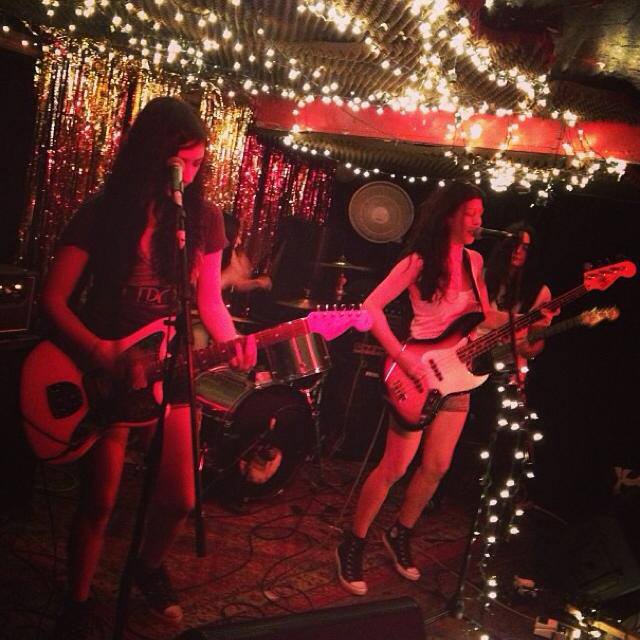
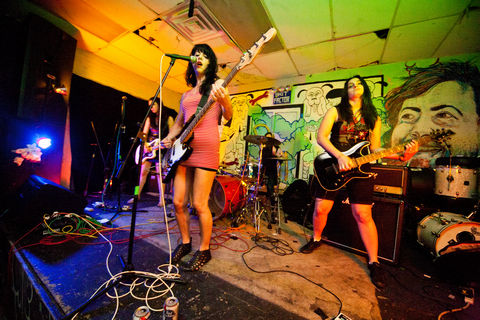
Desert-Sharks_CakeShop When I touched base with Stephanie Gunther, the vocalist and bassist from the Garage Rock Band, Desert Sharks, I felt excited to talk with a rock ‘n’ roll band that puts so much vulnerability into their songs. “Tequila Shark” was the track that attracted me to this Brooklyn-based all-women group, with a grimy bass line, and tinny sounding guitar which seems to echo, creating a space within the music for Stephanie’s beautiful alto voice. In the second verse, she sings the lyrics, I had a dream/ we had just met/ you showed me through your hallways/ and asked me would I stay. Fast forward to the chorus she sings It’s all mine/ your love’s in my mind, and then these lyrics repeats one more time.

When I asked her about the lyrics, Stephanie said, “I was exploring how we can go to such depths of dreaming up scenarios in our mind about someone we pine over. You can have all these fantasies of what it would be like to be together, how every detail would go down, where you would go, how you would interact, how much in love you would be.

“You can literally picture it and sometimes start to feel the emotions as if it were real, like you are having this secret mental affair with someone and they have no clue. I wrote, “Tequila Shark” about two dreams I had about two separate people, and that went along with those ideas.”

The most attractive aspect about the lyrics involved the vulnerability and honesty of the storyteller. In addition, there is very little mystery and interpretation of the meaning. Desert Sharks will remind rock enthusiasts that female bands continue to push past the gender stereotypes, and can do so with grace, and create opportunities for themselves independently in hopes to get recognized by a label. All of these are reasons for players in the music industry to pay attention to this group who were also in the Artists on the Verge class of 2014 at the New Music Seminar. It is my pleasure to feature Desert Sharks on Music Historian.

Stephanie says that when the band first started, people immediately doubted Desert Sharks.

“We’d get comments from people who first saw us on stage that they didn’t expect us to be any good, due to being female. Then, they’d say we blew them away. Now, it’s less about gender and more about our set, who we reminded them of and how they felt during our show. We’ve met some really awesome and supportive people at our shows. That’s one of the best parts about playing,” says Stephanie.

While some stereotypes are easy to disprove, including the one that says women can’t play instruments, women still have to work perhaps twice as hard as a man to make it in the business. Luckily, Desert Sharks don’t let challenges slow them down. Instead, they look to create opportunities to help them get closer to their ultimate goals – making a living with music.

“We’d love to work with someone on a full-length. The biggest task is getting heard. Our focus is on writing, playing shows, recording and touring,” explains Stephanie.

At the moment, Desert Sharks have an EP and vinyl they released in early 2013 which was recorded at Converse Rubber Tracks Studio, post-produced by Adam Reich, and pressed through Double Dare Ya Records, titled Sister Cousins. Just a few weeks ago, they released their 2014 EP on Manimal Records, Template Hair – an occasion that was marked with a show at Shea Stadium in late June. The promotion for their latest record will continue with a tour in August. Sister Cousins vinyl and Template Hair cassettes are available for purchase on Desert Sharks’ bandcamp.

In the short time they have been together (since 2011), Desert Sharks have played with bands they look up to, recorded and worked with a few labels, and toured. This four-piece group continuously set their sights on greater projects like working on a full-length with somebody in the future, touring out to the Midwest, where Stephanie is from, and getting signed. In order to reach these benchmarks, the group continues to dedicate their time to as Stephanie would say “making our music better and better.”

“We’re constantly writing new material and are anxious to get it recorded and out there for people to hear,” Stephanie adds. Desert Sharks Press Photo

Like I learned at the New Music Seminar in the panel The A&R Movement: Where is Music Headed? good music rises and makes its way to several listeners and to A&R representatives. I also learned that there is an opportunity for guitar-driven genres to make a comeback as well, which presents an opportunity for Desert Sharks. Songs like “Tequila Shark” can act like one of the Desert Sharks’ strong songs.

Aside from the fact that garage rock – according to Stephanie – can be “sexy, heavy, sweet or dancy,” “Tequila Shark” has an impressive compositional structure of A, B, A, B, C, as opposed to A, A,’ B or A, B. In my opinion, the more varied the sections within the song, the more interesting and exciting the track is to the listener. In addition, the lyrical content, which is straightforward and honest, lingers somewhere between vulnerable and impermeable. I asked Stephanie whether the realistic scenarios behind these lyrics focused on past romantic relationships, friendships, struggles or anything else.

“I’d say yes to all of those things,” begins Stephanie. “A lot of it is from my own life experiences, some of it, like our newest single “crazycrazy” is from someone else’s point of view put into my own words.

“When we start writing a song, I’m never quite sure what I’m going to write. I write at home a lot and put notes in my phone of phrases that pop into my head. Once we put together a song musically, I start to actually feel out the vibe. [I ask] ‘Does this song sound happy to me, does it sound sad?’ The hardest step for me usually is deciding the subject matter. Once I know what I want to write about, I can shape the words to fit the melody.”

While Stephanie loves Garage Rock, and agrees that this style influences Desert Sharks’ music, she admits that describing the group’s style of music is never easy.

“Garage and surf [rock] definitely influence our music, but I’d say we’re also heavily influenced by metal, punk, goth, pop, and more. Describing your style of music is the worst thing ever, especially when every band is a mishmash of influences. You end up [saying something] like, ‘Oh, we’re like The Ramones meets Dolly Parton meets Sabbath meets the Spice Girls.’ People get hung up on trying to label it and it gets hard to navigate. You want to say ‘just listen and see for yourself.’ Choose your own adventure and draw your own conclusions. It’s all rock ‘n’ roll in the end.”

An additional challenge to being in a rock band is making decisions with a group. The ladies within Desert Sharks “all share strong opinions,” says Stephanie.

“It usually takes a long time to come to a decision. Figuring out a [band] name was no easy task. We wrote “Tequila Shark,” and afterwards, some of us said ‘that’s a cool name, should we just call the band that?’ Desert had been a word on a list of words we dug, so we stuck desert and sharks together. It was the first name we came up with that we all didn’t hate.”

Since 2011, this band has built an excellent resume. The greatest strength they have developed as a group is their willingness to be flexible while they maintain strong attitudes. Their talent for writing a lot, and having a wide selection of songs is also beneficial for any A&R representative looking to sign a female Garage Rock group. From starting off with a Craigslist ad and arriving at Shea Stadium, Desert Sharks have made a healthy journey.

“We met through Craigslist,” recalled Stephanie. “The stars were aligned for that one. Rebecca [Rose, the drummer], Sunny [Veniero, the guitarist] and I met up initially with another girl and wrote a song together. We were sort of just jamming and playing around with ideas.

“The other girl had prior commitments to another band, so she left. We put out an ad, and Stefania [Rovera, the additional guitarist] answered. It was the missing puzzle piece. Once she joined we started writing a ton and felt like we wanted to start playing shows.”

Desert Sharks Bkyln Vegan There are plenty of rock ‘n’ roll listeners out there who want to hear this type of music and Desert Sharks might be at the right place in time to get recognized. People still line up to see independent Garage Rock bands in the United States. As for guitar-driven music, based on what I listened to at the New Music Seminar and what I saw at the Governors Ball Music Festival, there still exists an audience for The Strokes and Jack White.

Regarding my final question for Stephanie, I wanted to know what she thought of the motto “Rock is Dead.” She explained in two words “rock ‘n’ roll reincarnation.” Based on my interpretation, this means rock ‘n’ roll is alive and well, just in another form.

Female bands continue to make a comeback in rock ‘n’ roll, and like the Desert Sharks, they dedicate their time to writing songs, making records and performing in both small and large venues. These sharks are coming up to the surface with their hook-drenched tunes and ready to enter new territory – the wild music industry. The greatest strength of this group is their ability to carry listeners within the strong currents of their 2-3 minute tracks, a talent which – based on my listening experience – has been difficult to replicate on today’s music scene.

The Blackfoot Gypsies: Modern Southern Rock That Helps You Release Internalized Feelings

 When I listened to the song by the Nashville-based band, The Blackfoot Gypsies called “Don’t know about you,” I immediately felt the timbre within the singer’s voice resembled that of Bob Dylan from the ‘60’s. In addition, I felt splashes of rock ‘n’ roll, blues, Garage Rock, and Americana. As far as the rest of the song is concerned, I heard very little country. I initially found this curious because I thought Nashville was the capital of country music. Thankfully, the band told me this is not the case.

“I think it is more of a touristy thing that Nashville is only for country music,” explains the bass player in the band, Dylan Whitlow. “Where we live in Nashville, there are mostly rock ‘n’ roll bands.”

The group’s harmonica player, Ollie Dogg adds, “It used to be that way, but I always played the blues.” As I talked with this group at the dimmed Delancey lounge on the Lower East Side, I soon learned that only two members of the Blackfoot Gypsies are Nashville-natives.

The group began as a duo in 2010 with drummer Zack Murphy and Guitarist and vocalist Matthew Paige. Zack had just moved back to Nashville after spending six years in Knoxville, and Matt had recently moved from his hometown around Portland, Oregon. Both young men were new to the music scene and somehow, they found each other and started playing. Then, in 2012, Dylan, who relocated from Gettysburg, Pennsylvania met with Matt after seeing the duo at a show. The final addition to the band is Ollie Dogg, who was introduced to the group by his cousin at a Marathon Party. Now, all members live together in the same house.

Research this band’s Facebook page, and you will see a charming photo of the band right outside of their beautiful home. Dig deeper onto the “about” section of their page and you will find something that if it doesn’t grab your attention, it certainly grabbed mine – Band Interest: “Spreading the terrifying joys of realism.” I asked Matt to talk to me a little more about this.

“Being a real band is almost a challenge,” he begins. “Being a real person and entertainer is very difficult. Touring as a real band and seeing how terrifying it really is, it makes people say “oh man these guys are real; [they’re] people playing music because they like it.””

Zack chimes in, “to make money without compromising ourselves or our art.”

“To be able to earn money, be silly and entertain, and somehow keep a leveled head about yourself,” concludes Matt.

Just a few minutes into my chat with this band, I have already learned that something besides country music is happening in Nashville, and the realism this group speaks of might actually go beyond the lyrical content within their songs. For the remainder of my conversation with this group, I wanted to learn more about the band that described themselves as “The amplifier for your heart and soul, your love and your hate, your on and off, your push and pull… there is no room for thinking… Only feeling (Blackfoot Gypsies, Facebook, 2014).” It’s my pleasure to welcome the Blackfoot Gypsies to Music Historian.

When the group says “there is no room for thinking… Only feeling,” within their music, they emphasize the need for listeners to lose themselves in a song – a human aspect that is left out of today’s modern music. Further, the feelings Zack and Matt wish to evoke through their music are visceral. Matt elaborates:

“They are the ones you can’t control, and the ones that you want to hate, but you can’t. We’re not necessarily trying to prove anybody wrong [about themselves] but mostly trying to tear down the walls of the preconceived notions people usually create about who they are and what they like.

“When they come to the show, [for example], I’ve watched guys try to be straight, square and cool in front of girls, and then they turn into these ape monkeys because something happened [inside of them]. It is in the music, it is in the energy, and sometimes, it gets so fast and perpetual that you lose yourself.

“We lose ourselves all the time, that’s our job and getting other people welcomed into that. This is the type of feeling we try to harvest in people. That is the human aspect so often left out of music nowadays. That’s real.”

I could tell this band wanted to convey something to the listener within the first song on their 2012 LP On the Loose, titled “Don’t Know About You.” In the opening verse, only the guitar accompanied the voice. The lyrics are – I wandered out last night/ looking out for your home/ knowing you like to roam/ without your telephone/ But you don’t know because/ I never said a thing. Then when the chorus came, later in the song, the one element that grabbed my attention was how the down beat in the drums, the harmonic rhythm in the guitar, and the voice came in synch, emphasizing the lyrics I don’t know about you, but I feel like makin’ love.

These compositional elements attract the listeners’ attention and make for a memorable melody. Then, there are other songs on the record that have sadder lyrical content, like “Stone Throwin’ Angels.” One of the verses in the song is You’ve got three kids in the yard/ and watch you come and warm your bed/ and a fugitive conscious that goes unsaid… I asked the band members about the meaning behind these lyrics.

“That one is mainly about a friend of mine who was once a musician and could have followed the dream, but then he had kids and a wife, and I watched it not happen,” explains Matt.

While this song is based on a true story, Matt claims that if it holds any relevance at all, the fun part is making up the rest, in a way, that applies to the songwriter.

“We are just doing real life, even if it’s just something stupid,” he continues. “We were just jamming on a song called “I’m on Fire.” It was really hot in our room one night, all of the amps were turned on, and I thought to myself, ‘what am I going to sing?’ “I’m on fire!” There it is, a song, and it’s real.”

I decided then and there that I would share a story about when I took a trip to West Virginia for the Appalachia Service Project. “I was 15 years old, and I went to Logan County as a volunteer with a church to fix homes for those in need,” I said to the Blackfoot Gypsies. “One day in July, I was doing roof work and I thought to myself, it was scorching up there.”

Then Zack asked me where I was from and somehow, I mentioned that I grew up in a Romanian-speaking household. I promise, I’m not babbling. This information will become helpful as the article continues.

At the moment, The Blackfoot Gypsies currently self-distribute their LP and it is available for download and 12” vinyl. Zack describes the process of being your own musician and entrepreneur as rewarding.

“It’s nice to have help in getting everything done, but when you all of the work yourself, you get all the rewards for yourself. Do you really want to pay someone else money that will not be used for you? Would you rather have that money yourself? You don’t have to pay anybody back. It feels good.”

This made me wonder – since the Blackfoot Gypsies are currently unsigned – whether the group is currently on the hunt for a record deal. According to Zack, the band is looking for the “Right record deal.” Matt adds, “It’s not really like we’re hunting, it is more like they’re hunting.”

“It’s so much like dating someone – ridiculous. It’s through a friend of a friend that saw you at a show… and now they’re bringing their friend’s lawyer to check you out. Then, there is a meeting and contract, and ‘Oh my God,’” he continues.

While this method of networking with labels proves to be more efficient, the group should be ready to ask a handful of questions. I asked the members whether they had been careful when speaking with lawyers. Zack reassures, “We usually consult our friend who is a lawyer. We ask him questions in order to decipher what we should ask [the label representatives].”

As the group keeps experts within the music legal field close, they simultaneously stay atop of their long-term goal for the future, which Zack claims is “being the next big thing.”

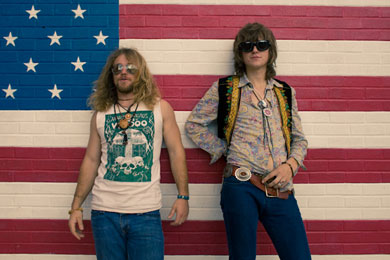
Matt_and_Zack_BFG “Anyone who says they don’t want to be famous for what they are doing are probably lying,” he expresses. “So, why are you doing it? You want to be unsuccessful with it, do you want nobody to hear your music?”

I agreed with Zack. I then asked Matt to share his thoughts, and he expressed something similar, but with a little more hint of sass. (Remember that information I shared with the members regarding my ethnic heritage? It will be useful now.)

“One of the greatest bands that ever lived. We’ll be 90 years old and still doing it, God willing none of these guys gets hit by a bus, or overdoses or falls in love and runs to Romania. That could be bad!”

“It’s only bad if you don’t have a plan,” I politely and diplomatically replied. “But, if you know someone who can help you get established…”

“Romania is fine, I’ve got nothing against it,” said Matt jokingly.

Regarding the Blackfoot Gypsies’ immediate future, the group is currently focusing on a few projects. The first, a new LP titled Handle It, which they plan to release at the beginning of August. The second, a Gypsy Camp Tour set to start in July, which Zack claims will be amazing. Matt, Dylan and Zack say the band is coming to do a show in New York City on July 11th, at the Bowery Electric, as part of a two-week camping excursion, romping around the middle of America.

Basically, The Blackfoot Gypsies will perform at venues everybody recognizes. Instead of heading to a motel after the show though, the group will set up a tent somewhere. Given the lack of camping grounds in cities like this one and Chicago, the band already established they will sleep under a roof for these particular shows.

“It is part of the adventure,” explains Matt. “We are shooting for the gypsy concept but sometimes that does not always work out. We will sleep under a roof when we come to New York City or Chicago.

“We also encourage artists to come out and sell their jewelry, pictures and art. You can buy things, and you can trade. Why restrict it to just us? Have other people come out.”

The group sees the Gypsy Camp Tour as more of a recreational pursuit than an entrepreneurial endeavor. They did it for the first time last year, and it was “a blur of great memories.”

While the band definitely does find time for fun, they expect to get paid for the performances they put on. After all, performing is still work. The camping is their downtime. In addition, while performing and touring presents its benefits, including the constant changing of scenery, meeting new people, and keeping oneself busy; there are also challenges, even for musicians who don’t mind “roughing it.”

“All of the driving in all of the conditions possible, and making a dollar stretch longer than it should, the show we perform determines whether it is worth it or not. It happened to be worth it almost every time,” says Matt. “The challenge is, you can’t predict when you lose. Sometimes you lose, but when you win, you really win.”

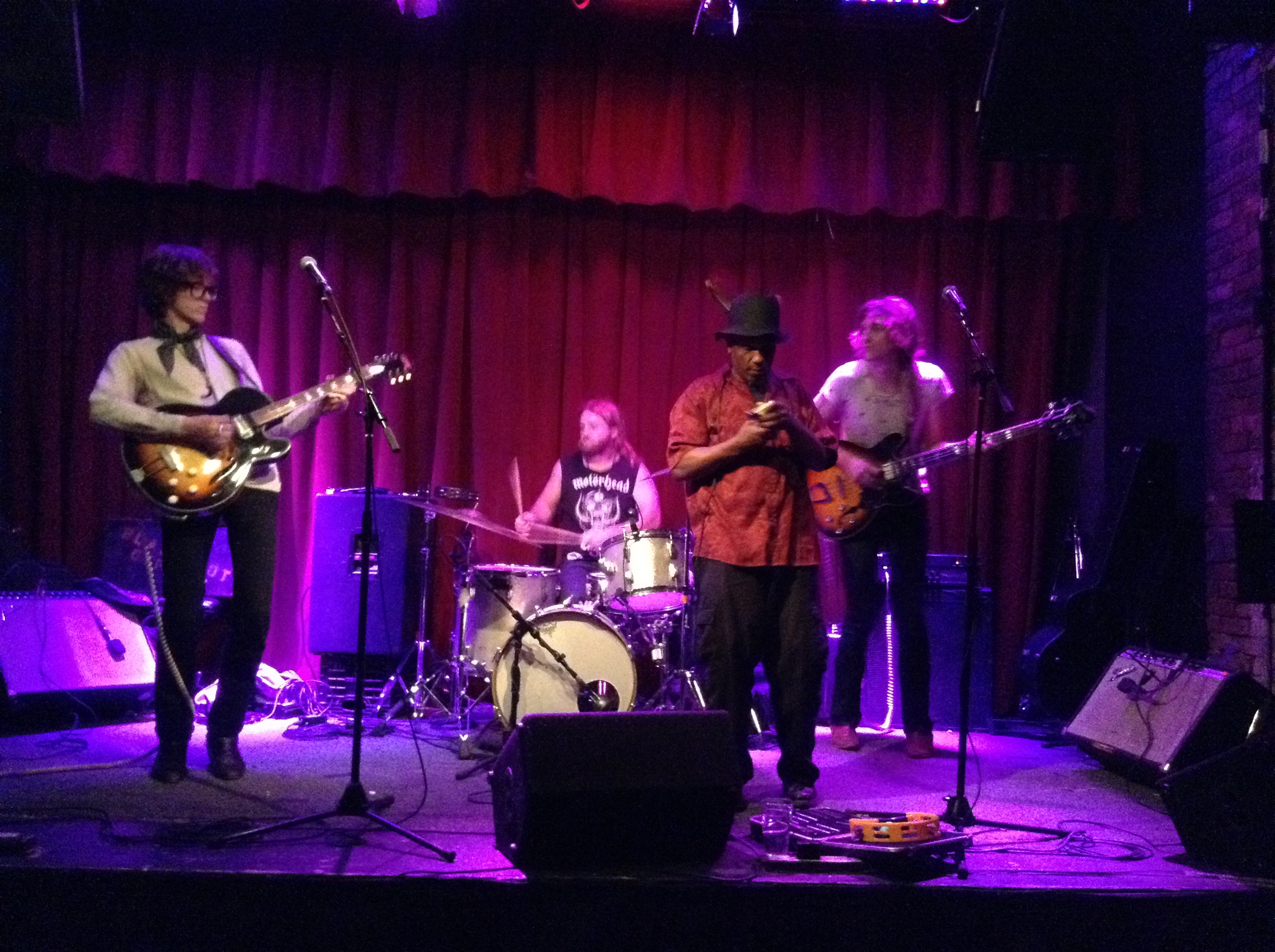
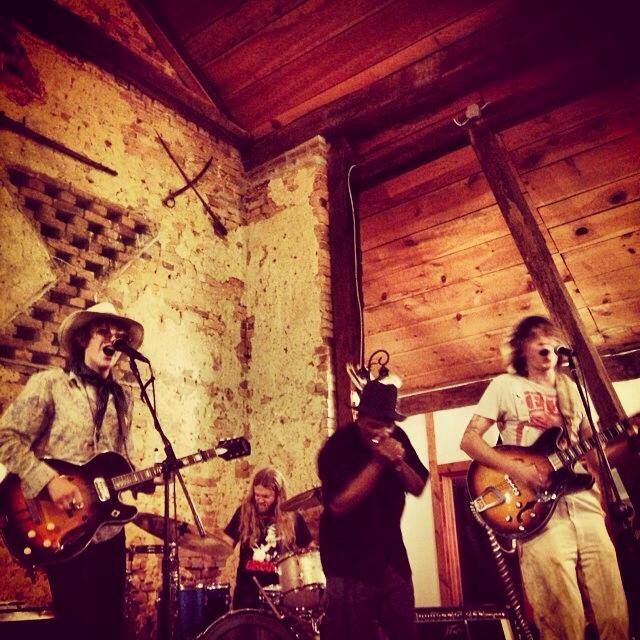
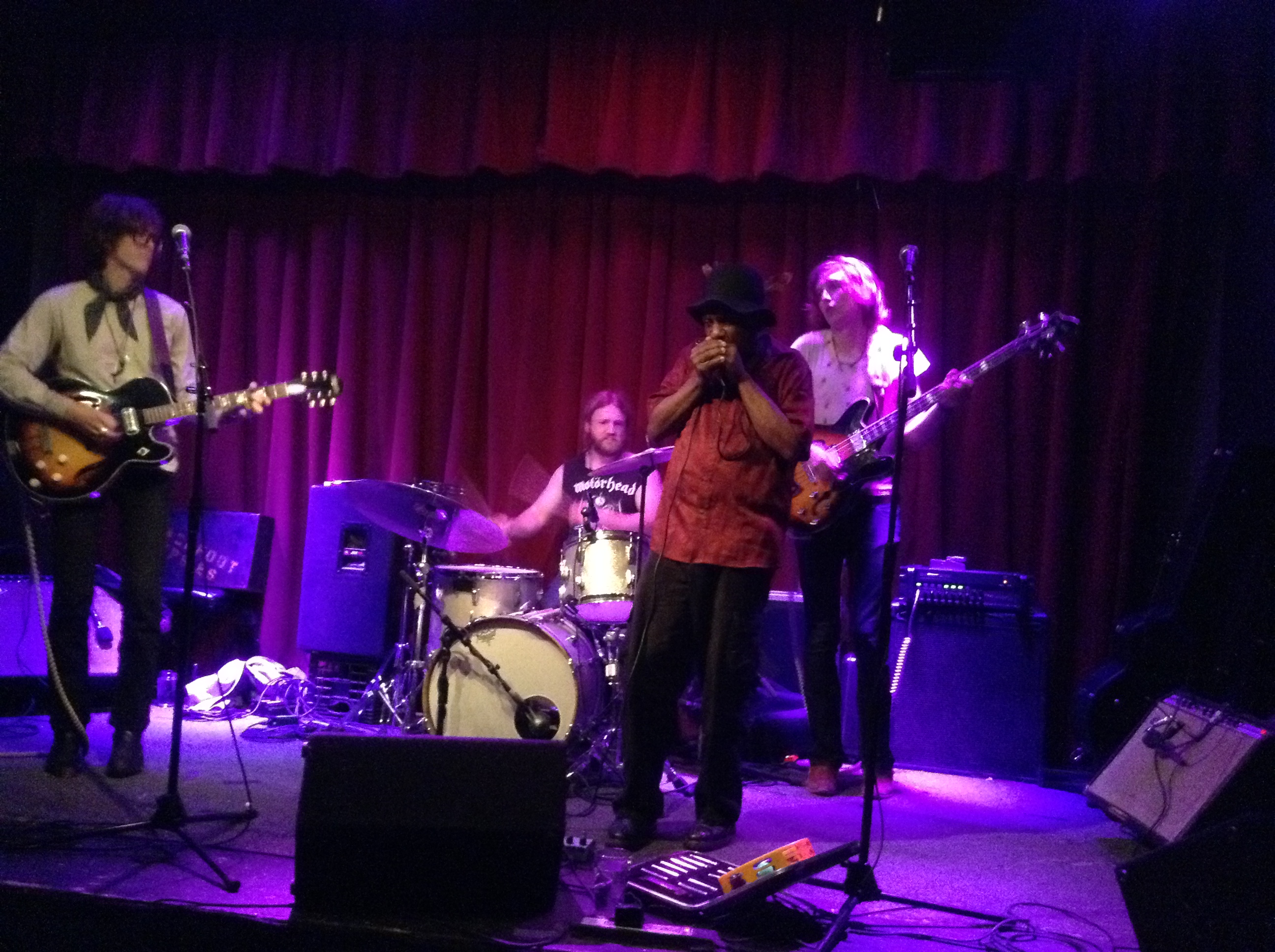
I saw a performance by the Blackfoot Gypsies at Spike Hill in Brooklyn. The energy that filled the audience, the amazing and full-bodied harmonica playing by Ollie Dogg that drew in the attention of the whole crowd, and the well-rehearsed set from the rest of the band assured me this group is really searching for winning moments. These moments don’t only come from performances, they will also come from the right record deal that will benefit both The Blackfoot Gypsies and the label helping distribute and promote the band’s music to audiences in all corners of the U.S.

Lovers of Americana looking for the perfect music that will help them temporarily lose themselves and feel both the good and bad, beautiful and ugly, positive and negative emotions all at once need to check out this band. They can download their album through their Bandcamp website, or go to a live show, which can have its perks. The Blackfoot Gypsies like to bring a close-knit line-up with them, enabling listeners to get a taste of other Nashville-based independent musicians who have a similar sound.

Meanwhile, label representatives should continue pursuing this group, especially since, as Nashville-based artist Kim Logan would say, “Americana has taken hold, and as vinyl makes a comeback,” more artists will be performing rock ‘n’ roll (as cited in “Plugging into Modern Southern Rock,” 2014, para. 33).

As I conclude this interview article, I want briefly to share the inspiration behind the band name.

“I had another band before this one,” said Matt, “and we all sat around trying to think of a name that was cool and close to home, like the Blackfoot Indian tribe. And gypsies are cool, I like them. They wander around nomadic style, you know, like Romanians.”

“Not all Romanians are gypsies,” I explained.

“Yes they are,” he responds.

Perhaps The Blackfoot Gypsies don’t play themselves up as a mysterious rock band, but who needs mystery all the time? Let the music take over every now and then, and help you release some of the feelings you have internalized for a while. Try it. You might actually find it enjoyable.

Works Cited

Blackfoot Gypsies (n.d.). In Facebook [Fan page]. Retrieved June 9, 2014, from https://www.facebook.com/blackfootgypsies/info

Trutescu, P. (2014, June 18). Plugging into Modern Southern Rock: My Interview with Kim Logan. [Blog post]. Retrieved from https://musichistorian.net/2014/06/24/plugging-into-modern-southern-rock-my-interview-with-kim-logan/

The Dirty Gems Make Great Music for a Growing Audience

The Dirty Gems_Press Pic Better Whether it is to laugh, cry, or dance, the New York City-based pop-rock-soul band, The Dirty Gems want to make you feel something. One of the keyboardists in the band, Mills claims “Often times, people have a hard time placing us into a specific genre because of how diverse our influences are, but as we continue making music, we have no doubt our own unique style will find its audience.”

The Dirty Gems began as a trio in 2007 with singer Raycee, bassist Ulises, and keyboardist Cam. They were members of a small jazz combo during their attendance at Hofstra University. Later, drummer Jack joined the group and they transitioned into a cover band called Pump Yo Brakes. They began to write original songs after graduating in 2010. The four-piece group  furthered their music endeavor, and this led to the addition of songwriter Mills, and guitarist Gary. They returned to Hofstra for a Battle of the Bands in the Fall of 2011, which also happened to be the band’s first public performance.

“The incredible response we got at the Battle of the Bands was definitely a turning point where we thought, “Hey, maybe we have something here!” explained Mills.

The group won the Battle of the Bands, a moment which quickly led The Dirty Gems to open for artists such as Big Boi, rapper from the Hip-Hop duo Outkast, indie rock band from Seattle, Minus the Bear and New York City rock band, London Souls.

While this start-up band had tremendous success, the kind that might prompt an artist to pursue a record deal aggressively, The Dirty Gems choose to stay atop of their first priority – making great music for a growing audience. I am happy to welcome Mills from The Dirty Gems to a full-length feature interview right here on Music Historian.

Although one can argue that a band like The Dirty Gems should first focus on getting signed, Mills emphasizes that a successful group focuses both on their art and entrepreneurship.

“The music industry has changed so much that now, being signed to a label may not necessarily be the end-goal for a band like us, at least at first,” says Mills. “We look to continue growing our audience and making great music, and if that involves being signed to a label, then so be it. The distribution model [though] has changed so much due to the internet. If you have a Bandcamp page, good marketing strategy, and great music, you are already your own record label.”

As I recall a panel I listened to at the New Music Seminar called The A&R Movement: Where is Music Headed? A&R representatives at the panel assert that now, more than ever, musicians need to create a marketing plan and build themselves a fan base. Record labels want to see that the artist has pulled themselves up a lot. In regards to the music, A&R reps will positively affirm that good music rises to the top, and somehow, the labels will find that artist.

That is one “check” from the industry representatives. However, the same industry players who offered the advice above will also have their opinions and criticisms for The Dirty Gems. For example, at another panel I attended, which included some of the same A&R reps from the panel I mentioned above (please reference my review of the New Music Seminar for more information) called Music XRAY Presents: A&R Live – Music Critique and Sound Selector Sessions, one of the panelists commented on the band’s newest track “Insomniac.” The person giving the critique said:

“While the vocals were good and I liked the guitar in the forefront, I don’t see a lot of hit potential. Strengthen the verse a little bit.”

I wondered how Mills handled criticism like this from industry players and his response has been humble.

“The panels have been incredibly insightful and informative,” he says. “We already have meetings set up from the connections we’ve made at the New Music Seminar, which has provided us an excellent experience. We are honored to be one of the Top 100 Artists on the Verge with several artists and we know and respect from the community of up-and-coming musicians around us.”

Additional experiences this band has favored includes representing Queens in the WNYC/WQXR Battle of the Boroughs at The Green Space; the KahBang Music & Arts Festival in Bangor, Maine; The Mountain Jam in Hunter, New York; and opening for Wynonna & The Big Noise at Alive @ Five in Stamford, Connecticut. The best experiences for The Dirty Gems though is really any show where they have been able to move someone with their music.

 There must be something great in The Dirty Gems’ music for the fans who travel from their office on a hot night last Tuesday, June 10th to see this band perform in the darkened lounge called The Delancey located on the Lower East Side. It’s incredibly comforting see how people come together as couples or in groups, and they have an age range from 25-44, and 45+ and all of them crowd in a space in front of the stage, a space that is small and tight, and provides room only for standing.

In short, there was a great turn out for The Dirty Gems that night, and even the performance organizer for The Delancey, who was also part of the New Music Seminar staff, James Birkenholz, mentioned a handful of customers quickly filled up the performance space for their show.

On The Dirty Gems’ Twitter page, fans have Tweeted “Watching The Dirty Gems kill it at the Delancey for the New Music Seminar showcase, great job.” A few days later, the President of Imagine Music LLC Tweeted, “The Dirty Gems is the best new band I have seen for some time. Look and listen here” and concluded his message with a link to their Bandcamp website.

So, what is it about this band’s music that makes their fans Tweet and comment about their performances and more? Simply put, their music has a personality. Mills explains:

“We call it [our music] pop-rock-soul. Our influences are diverse and we, as individuals, listen to all different kinds of music. We have just 2 EP’s out, our self-titled debut from 2011 and Vuja De released in 2013. With our most recent EP, that sound has started to coalesce into something uniquely our own.”

The popular single from Vuja De “Easy on Me” includes a very lucid and consistent vocal melody, with a slow tempo, sung by Raycee – a melody that is in a major key, and includes accidentals, almost making it sound like she is singing in both major and minor. In addition, the lyrics are simple and beautiful – I would fight all the mighty seas/ just to have you next to me/ cause you make it easy/ I would run across all the most dangerous miles/ Just to feel you smile/ because you make it easy.

Although the above lyrics are just to the verse, this enables Raycee to add many bends and trills in her singing, a style of singing that is very closely associated with the soul genre. The rock in this music is heard within the few tin-like and rough notes by the guitar. The pop lies within the driving rhythm of the drums.

In addition, the modulations and the entire composition of “Easy on Me” suggest the group created the music before the lyrics. I asked Mills about his thoughts, and he said:

“The basis of a great song is always an excellent melody. “Easy on Me” began with the chorus, and the verse melody, with the rest of the song, came from there. The modulations you’re referring to in the bridge came after the rest of the song was written. The constant beat that goes through the song has a lulling effect and we wanted to have an element that was surprising enough to make you really listen to the lyrics.”

In my opinion, The Dirty Gems accomplished this successfully with their Vuja De single. As for the single they presented to the Music Xray panel at the New Music Seminar, “Insomniac,” I felt a minor melody within the song, and the guitar, while still having the tin-like sounds, were now a little cleaner and crisper, and it played like an additional voice in a call-and-response manner with Raycee. Have a listen to the live version of the song here:

http://soundcloud.com/thedirtygems/insomniac

In addition the amalgam of musical influences that make their sound too diverse to fit one category; part of The Dirty Gems’ musical personality comes from Raycee’s voice, which right now, I cannot match to that of any singer I have previously heard.

Like many independent artists today, The Dirty Gems play music that is on the fringe of multiple genres. In addition, the band has incorporated their quirky sense of humor into their music videos, enabling them to create a funny and warm brand personality. See the videos for “Easy on Me” and “Your Name Here.”

Music videos, self-distributing music online and performing in the Battle of the Bands, opening for bigger artists and playing live as part of festivals and conferences, help The Dirty Gems spread their music to potential new fans and returning fans. The band just released “Insomniac” as their new single. They also plan to spend the summer in the studio writing and recording their next project – a third EP which will include “Insomniac” as a single. Afterwards, the group hopes to play in CMJ 2014 this fall at then SXSW in 2015.

The Dirty Gems_NMS_Press Photo As I stated in the beginning, The Dirty Gems act as their own entrepreneurs and artists. In today’s music industry, that is very expected. However, being your own artist and manager has its complications, because these are two separate roles played simultaneously by a single person or group. Thankfully, the musicians within this group don’t get lost in the hustle of all the business. Instead, they make it a priority to focus the most on those who matter the most to their business, their listeners.

“Out in the “real world,” your triumphs and failures are on stage for paying customers,” explains Mills. “College was an opportunity to play in the “sandbox” and learn from peers in a closed environment. At this point, we’ve been out of college for long enough to feel more like the “real world” is the sandbox, but that only motivates us more.”

Mills might be expressing that the real world of the music business is more experimental and less-structured than we are lead to believe. School offers a lot of structure and direction. In the business world though, whether it is in music or any other field, only you can give yourself the right type of structure that will work for you and all you must accomplish.

The Dirty Gems have found and secured a structure of doing business that works for them, a roadmap for their own songwriting, and the support of fans who positively receive their music. Whether or not this will provide sufficient reason for their right producer to connect with The Dirty Gems is tough to tell. Nevertheless, the group has an excellent foundation, and great discipline and practices. Like every band looking to make money with their music, these gems might just need a little refining. Aside from that, all the essential pieces for a successful business are in place.

Plugging into Modern Southern Rock: My Interview with Kim Logan

 Behind the full-bodied and slightly sweet vocals of Southern Rock singer-songwriter, Kim Logan, is a fiery woman who know what she wants and what she is about. Lyrics like I’m a real good catch and I know it… from “Voodoo Man,” And I’ll give you three, but no more, turns across the floor/ But then it’s your turn, boy you better learn to be a gentleman, from the chorus within “Gentleman,” and finally, I ain’t someone’s other half/ I don’t like you baby, but I’m like you baby/ I think I love you but I don’t know if I should/ because there’s already one of me in the neighborhood from the song titled “Neighborhood,” which you won’t find on her first full-length record, but on the landing page of Kim’s website, will get the message across to any listener.

Although she recently turned 23, Kim has had a long road of musical development and plenty of real-life experiences which she transforms into great songs. In addition, she has an attitude about music today that matches the female empowered persona portrayed in her tracks.

“In the music industry today… It takes at least twice the work for a woman to accomplish half as much as a man. I really want to break that ceiling, and someone who has inspired me with lyrics, statements and actions has been Lady Gaga. What really disturbs me is Classic Rock and Southern Rock does not have somebody like that,” says the young musician. “I want to be the new millennium woman, the Lady Gaga of southern music, telling women and all creative spirits that it [the music industry] doesn’t have to be gender divided anymore.”

I agree with Kim on the subject of women in the industry. Daylle Deanna Schwartz, New York City’s first white female rapper will tell you that in the ‘80’s, women used their bodies to get ahead in the industry. Look back at the history of the American industry in your own personal time, and you will see women were only given two masks to wear – the emotional exhibitionist who was a sex object, or the unsentimental, bitter and passive-aggressive woman. Both of these facades are one-dimensional and superficial and sadly, female musicians are still expected to put on these faces today.

On a brighter note, there are female artists in country music that did not play either of these roles during the pinnacle of their careers, and led and continue to lead by a more positive example. One woman that comes to mind is Dolly Parton. I asked Kim about her thoughts on this, and while she agrees Ms. Parton continues to positively speak up for women’s and gay rights, her prominent years were the 60’s, 70’s and 80’s. The Southern Rock scene needs a fresh young face, and Kim hopes to be one of those new faces.

Yes, Kim is a very ambitious young woman. So I listen to her story of how she got into the industry, the positive experiences she had along the way, and what she wishes to make of them. In doing so, I begin to understand what fuels this passionate musician’s ambition, and why she chooses Southern and Classic Rock to tell her stories to the public. I am happy to welcome Kim to Music Historian.

Kim credits her mother and father for their support in her long road to becoming a singer songwriter.

“I always wanted to sing and my Mom worked in pubic relations and events for some really amazing people in the 90’s like singer songwriter Charlie Daniels, Southern Rock bands [like] Molly Hatchet and the Marshall Tucker band.

“I developed a special bond with Doug Gray, the guitarist from the Marshall Tucker band, and when I was about 9 years old, I was talking to him during one event weekend and he said I should go out on stage with Charlie Daniels at the end of the show and sing with him during a jam. Doug and Charlie jammed together after the show.

“I believe we sang “Amazing Grace” and Doug kicked my ass out on stage. Singing with Charlie and Doug is when I got the [rock ‘n’ roll] bug. I went to my Dad and told him I wanted to sing professionally, and I think my Mom had already realized that. My parents said “you’re going to do it right,” so they put me in classical and vocal training and the opera program in Sarasota, Florida for about a decade. This started when I was turning 9, and I did this all through high school.”

During this time, Kim also picked up the guitar. Her motivation was to accompany herself in her singing and songwriting.

“My parents got me a guitar and my father told me I wasn’t allowed to play electric guitar until I made my fingers bleed on my acoustic guitar, which he was right about,” says Kim. “I don’t know where I would be without a guitar in writing. I can’t do without it in the writing process, I want to have control over the writing process.”

Throughout high school, Kim also participated in additional musical activities such as playing in punk bands, party bands, blues and classic rock bands. Whether it was opera or songwriting, she was always singing.

Kim’s strong classical education helped her get into the Berklee College of Music in Boston for vocal performance. However, her desire to play honky tonk and rock ‘n’ roll made it difficult for the young artist blend into the Boston music scene.

“I think, at the turn of the millennium, everybody just got so crazy with music technology and music school, and students at Berklee had all of this new equipment available to them, they were held up in their dorm rooms tracking themselves and playing shows for other students,” expresses Kim. “It was also that weird blog [phase] that happened at the same time… and for the first 10 years of the new millennium, I think everyone was a little too innovative and saturated with music technology to get out to a show and plug their amplifiers into a wall and play. I wanted to play, not sit in a classroom anymore.”

So, the artist moved to Nashville to perform, record and tour. “Nashville is very centralized,” she explains. “I have been able to hit the entire deep south, including Texas, and then come back up to New England, and Chicago. I very briefly studied at Belmont, but that was more of an afterthought because my schedule for years has not been conducive to a classroom environment.”

Thankfully, Berklee College reached out to Kim while she was pursuing her career and Nashville, and she is now completing her music degree online. She hopes to obtain her degree from Berklee soon. Although Kim has been in and out of school, she never stopped educating herself in the history of American genres. Through self-education, she learned to appreciate some of her songwriting heroes and favorite musical styles. She explains:

“It really comes down to the fact that I am obsessed with Music History. Before I was in college, I sought to learn the history of the genres in contemporary music myself. I would just dive into everything from the 1860’s civil war tunes to jazz and the blues.

“What really lit my fire was the father and son team of John and Alan Lomax, who went to the Appalachians and the deep southern terrains and did their field recordings. When I learned about that, and the Great Depression, and where everything after that comes from, it helped me understand the songs of Jack White and heroes of mine who, have also gone back and learned the same things. I felt like I was going back and strutting the same path, learning the same things in order to create my own contributions.

“My potpourri of different stylistic attempts comes from a deep love of other genres of music and re-creation of southern and grace, and different types of music. This lets me stretch my muscles in songwriting and vocal performance. That’s sort of my life’s work there.”

 Pick up Kim’s self-titled debut and you will hear how she flexes her songwriting muscles. “Black Magic Boy,” a Southern Rock song with a grimy tin-like effect in the guitar will leave you feeling like you transcended into a barroom in a southern part of the U.S., perhaps New Orleans. Listen to “Devil Makes Three” and the pitch bending produced by the steel-peddle and the major melody within the tune makes one feel like they are driving through a small sunny town in the Midwest. Then, there is the blues-infused track “Gentleman” which includes soulful vocals that back-up Kim in the chorus.

Aside from her style of writing, Kim continues to display her love for music history in the Vinyl production of her debut record. I asked what attracted her to recording with analog equipment, as opposed to staying strictly with digital.

“It is a science that non-compressed music and sounds, which have not been diluted digitally, are much warmer, more open and richer,” explains Kim. “I recorded the album at a converted church, and I pressed the record at United.

“I am passionate about vinyl records, no matter who represents me or what management I am under. We want that instant gratification and that quick satisfaction of logging onto Spotify and hearing something from somebody’s iPhone or their party. When you are at a live show though, you are listening to real live music, and you want to take home a vinyl of that record so that you can listen to it and understand the artist’s brain, and why they felt it was necessary to create that thing.

“It’s plain and simple, but that is the best method of listening to what a musician has to convey and say.

“I do think analog and digital can go hand-in-hand, they both can be complementary.”

I remember reading articles in Brooklyn-based publications, like Brooklyn Magazine and I heard that the vinyl is making a comeback in some music communities. I thought back to when I had researched Kim Logan before I contacted her for an interview. Specifically, I recall feeling surprised when I learned about some of the other artists on the Artists on the Verge roster for the New Music Seminar, who also make Southern Rock music – The Blackfoot Gypsies, Jamestown Revival, and Carolina Story. I thought to myself ‘something is happening within the Southern and Classic Rock community somewhere in this country that is getting industry players here in New York City excited.’ In regards to Kim, I wanted to know what made her passionate about classic rock, and the other form of classical music that attracts her, opera.

“It really is the timelessness in a piece of artwork. Each movement, whether it was classical, romantic or experimental in opera, were associated with distinct feelings. It was both a genre and community.

“I feel that way about classic rock and I feel that way about the blues, classic country, and the new wave of classic country that is currently happening. You have a community of artists who are trying to achieve a certain standard while enjoying art as much as possible.”

As I got to know more about Kim, talking with her in the very crowded and active second floor lobby of the New Yorker Hotel, I wondered about her personal observations of the music communities throughout the U.S. What did she think about the scenes throughout the different places she has lived?

“The scenes are going to be completely different in almost every city in America. Everything springs from the ground up. There are very different kinds of people in New Orleans, Atlanta, Nashville and Chicago.

“I think Nashville and Brooklyn have become my favorites. I spent a lot of time in the Boston and Brooklyn scenes trying to connect with some of the bands, who came from indie pop music. There were many blog-driven Pitchfork bands with whom I did not connect. I was happy to take my act to Nashville where I not only played with large bands, but also became a fan of the bands.

“As Americana has taken hold, and as retro recordings make a comeback, like vinyl, it feels good for musicians playing rock ‘n’ roll, country and soul.”

While this young artist works towards greater goals like being a positive role model in the Southern and Classic Rock genres; like every savvy business person, she is always setting little goals along the way. Kim self-produced her debut. At this time, she gets ready to make a second record with producer, Dave Cobb.

“I am excited to work with this guy because I think it will provide the perfect combination for what I want to hear on my record, and what I want everyone else to hear. I am returning to the studio in the late summer and I am aiming for a Fall release.

“I think I am going to tour on it, and start the whole cycle over again. I think I have beaten this last record almost to death, and it’s time to get some new material.”

At the moment, Kim is currently unsigned. If any producers or A&R agents in New York City plan to attend CMJ in October, I encourage you to check out one of Kim’s shows.  If you are an industry player in Nashville, watch out. She is playing several shows throughout the summer.

Between her move to Nashville in 2010, and the release of her debut in 2013, and her appearance at the New Music Seminar, so much has changed for Kim, and the development of her career continues.

“I have put out records in March of 2013 after I had gone down to the SXSW Festival and I did not have merchandise nor any recordings, and I scrambled to release this record so that I could take it on the road. Then, I got an article in the Nashville-based Native Magazine, and it all kind of tail-balled in the last year and a half.

“I’ve been on the road, and I have been working my ass off, and the iron happens to be hot. Absolutely everything has changed, and I’ve checked a lot off my list since then. I’m really grateful, and I want to go to as many places as possible and bring the best records there. It will only get busier.”

Music history lit this young artist’s fire. Plugging-in to a performance space with other musicians and making something happen helps feed that passion. Whether listeners are attracted to her country songs, driving rock ‘n’ roll riffs, or blues-infused choruses, they are bound to hear the voice of a woman who delivers stories about her real life experiences through clever lyrics, thoughtfully written compositions, and warmly recorded sounds.

She might be a combination of a music nerd and a young woman who reveres the Southern and Classic Rock legends who were big in the 60’s through the 80’s, and in the early millennium. Regardless, Kim Logan has found her voice within this genre, and she flexes it freely. She comes to the city as much as possible to bring her sound to Southern and Classic Rock lovers here in New York City, Nashville and just about any city she can reach. Kim says, “I want to get people excited about it, and I want people to put money, time and energy into real music, with real instruments.”

Experimental Classical Music Exists in a World of Art: My Conversation with Ian Fiedorek, composer of Fallout Symphony

Ian Fiedorek Experimentation with classical music quietly lingers around the New York City music scene. Singer songwriter Ian Fiedorek, and the composer the project Fallout Symphony states the following about experimental culture and instrumental music in the city, “I don’t think too many people are thinking in terms of the classical structure, the four-movement structure … but there’s an incredible wealth of experimentation happening in New York generally. By nature, categorizing or pigeonholing this music can be difficult, as it should be.”
Ian recently completed the shooting of a music video for Fallout Symphony’s second movement “Jim Crow”, with the help of film directors Nasa Hadizadeh and Robert Dume of Cultured Productions. This fashion-charged short film which captures the avant-garde beauty of the song. The themes of paranoia and overcoming bigotry addressed in the lyrics – “I’m your guardian angel now, tearing this all down to timeless/ There’s an ancient bigotry that’s always set in drunken stone/ I will stop their hateful words tonight” – are emotionally conveyed in the music and video.

Watching this beautiful video, I could not help but raise the following question – why experiment with images that, while aesthetically pleasing to the eye, do not capture the historical aspect of the song’s title?

Ian answers my questions and also talks to me about this experimentation, and touches on the following for this type of musical among today’s listeners. It is my pleasure to welcome Ian to a full-length interview feature for the month of December, right here on Music Historian’s Hear, Let’s Listen.

Musical Background

Ian began studying classical piano at 7 years old and grew up a pop/rock aficionado. He appreciated classical music for its long-form structures and physical challenges, two attributes that attracted him intellectually. As a mode of expression, he states “nothing was as viscerally impacting as picking up a guitar at age 13 and writing songs. Fallout Symphony is something of an amalgam of these two components of my musical upbringing.”

After studying music at NYU and Cal State Los Angeles, Ian entered the NYC music scene as a guitarist for Harlem Shakes. Then, in 2012, he continued as a solo artist. Ian does not see these life events as transitions, but as “lateral movements between projects.” He explains: “Studying music was beneficial, but it was mostly an excuse to devote my time to making music. Performing in Harlem Shakes and other bands while working on my own material is all part of an intuitive progression in my view. I never thought in terms of ‘going solo,’ I always viewed myself as a singer, songwriter and composer who dabbled in a couple of different projects on the side.”

Harlem Shakes and Fallout Symphony differ immensely from a musical perspective. One is an indie rock band that is very performance-centric, mobile and public. The other is a 30-piece orchestra that is restricted to recording music in a studio, Ian spends hours after rehearsal mixing and editing.

Fallout Symphony is a far more insular experience than Harlem Shakes or other bands I’ve been in – there’s a moment in the timeline of production where it’s very collaborative, but generally, it’s you alone in a studio putting together the most detailed and thorough score possible, then later, the clearest final mix.”

Fallout Symphony

Creating a band is easy, and many of them emerge spontaneously in NYC. One might agree that the cultural scene in large urban and cosmopolitan areas are often saturated with the typical pop-rock band, the guitarist, drummer, bassist, a keyboardist, and a lead singer. Very rarely do we hear about symphonic groups emerging on the popular music scene. When I asked Ian about what classical musicians are doing on today’s musical scene, he responded, “I haven’t met many artists experimenting in this particular way [the classical structure].”

Ian describes Fallout Symphony as an ambitious, kaleidoscopic effort, and bold musical vision; one which mixes symphonic elements with vocals and a lengthy lyric sheet – something unusual in classically influenced music. I asked Ian about his greatest influences:

Igor Stravinsky’s The Rite of Spring was an influence on me – his use of non-linear musical cues and motifs was a large reason I structured Fallout Symphony to be through-composed, in many ways quite unstructured. Only a few of my motifs loop around and appear again. Mainly, the entire 40-minute duration is all new sections. I relied on the lyrics to be the glue of continuity, helping the piece cohere.”

The song and video for “Jim Crow” Ian Fiedorek in his music video for "Jim Crow"

As I thought about what Ian meant by continuity, I recalled how the lyrics “Now I know I dress like Jim Crow,” sung after “I am your guardian angel now…” contrasted each other. I wondered whether Ian did this on purpose.

“The lyric is,” Ian explains, “’Now I know why you dress like Jim Crow’ – as in, you are in ‘tattered rags.’ They have brought you to a breaking point, you are a non-entity to ‘them’… These lyrics are all of a piece I would say, or at least are intended to be so. It is about overcoming the bigotry, whether tangible or ethereal, foisted upon the “you” character in the story.”

According to Ian, if we had to identify the “you” character of the story in “Jim Crow” by watching the music video, “you” would come in the form of a tall and brunette young woman with deep set eyes. One moment, she gracefully models the most beautiful 1930’s inspired clothing, the next moment curled up in the corners of a dark room appearing frightened and confused or reaching out to touch an invisible figure.

When the video’s main character is dressed in her glamorous garb, she is often sitting down on a couch in a foyer with a piano. At this piano sits Ian, playing. In other shots, he stands behind the young woman. Both characters in the video have their own inner story stirring simultaneously. This is visually represented during the first two minutes and 30 seconds of the song in which two different coherent musical ideas are played at the same time. Although these two characters visually appear together in certain scenes, they never interact with one another, at any time within the video.

Screen shot of the music video for Fallout Symphony's second movement "Jim Crow"“Certainly, having the two characters never interact was intentional – authorial intent perhaps is not particularly germane – but I believe the male character,” who is Ian, “is something of a figment, a specter, in her [the main character’s] troubled mind.”
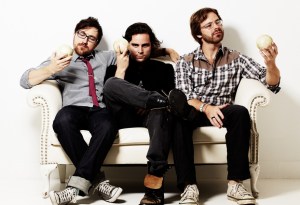

Then, there is the main theme of the music, a theme that talks about the inescapable oppression cast by society. In this case, Jim Crow is relevant to this theme; but I did not feel the music video reflected this theme at all. I inquired about the artistic inspiration and the intention.

“We did not want the video to be too ‘on-the-nose,’” explains Ian. “We felt, instead of literally translating a narrative of overcoming bigotry, it would be more effective to let the lyrics do that heavy lifting, and instead create a more general narrative for the video about conquering one’s own ailments and mental spooks.”

The video for “Jim Crow” was shot in one day, on a budget that Ian describes, was lower than what the final product presents. He credits co-directors Nasa and Robert for “wringing the sponge of all its possibilities.” In addition, Ian believes the video “came to fruition in the way any good piece of art does – with some really good planning and some very happy accidents.”

Ian asserts, “I believe the video as an entertaining piece of work in its own right, complements and contextualizing the music to be heard from new angles, with heretofore undiscovered wrinkles.”

The audience looking for this musical and visual experimentation

The making of Ian’s video was supported by the donations of fans and people interested in Ian’s music – a type of support that allowed Cultured Productions to put the finishing touches on both music and artwork, and the replication of the Fallout Symphony CD. When I asked Ian about receiving this support, he responded, “It is fantastic. Art exists for the community, and to have that community support its creation is a blessing.”

Through the video for “Jim Crow,” Fallout Symphony exhibits that postmodernist classical music through the help of visual imagery makes a greater emotional impact on listeners. Ian helps listeners understand that music exists within a world of art, surrealism, culture and most importantly, a community that wants to hear experimental classical music.

It is my pleasure to share with readers this beautiful video. Thank you Ian and Nasa.

Apollo Run’s “Here Be Dragons” Saga: Bass player Jeff Kerestes Shares the story from start to finish

Apollo Run (Left to right: Jeff Kerestes, John McGrew and Graham Fisk)

The most successful bands establish a memorable sound, the one that encourages listeners to return to performances and purchase the group’s music. In the process, artists might find that the music they create does not fit a label. Jeff Kerestes, a professional bassist of the Brooklyn-based band Apollo Run, briefly explains this experience.

“When we changed the band’s name to Apollo Run we did not know how to categorize the music. It was all new to us, the three part harmonies, the bass, the drums… We were wondering “what’s here?” Let’s explore it.”

It was at this moment the band decided to name this phase of their musical development “Here Be Dragons.”

“In the old maps,” explains Jeff, referring to maps of the globe dating as far back as the 1500’s, “signs that read “here be dragons” were drawn to represent uncharted territories. The music was uncharted territory for us.”

In Music Historian’s full-length band interview for May, Jeff talks about how Apollo Run’s “Here Be Dragons” exploration started; where the course has taken them; the possible conclusions of their journey; and what awaits the band in the near future. It is my pleasure to welcome Jeff to Hear; Don’t Listen.

The Beginning: John McGrew and the Sit Backs

One night in 2007, the Arizona-native with a jazz degree from Arizona State University, was celebrating his one year anniversary of living in New York City. Through the husband of a friend, Jeff learned of a band that was looking for a bass player – John McGrew and the Sit Backs. Jeff joined this group in December of that year. Here, he met singer John McGrew and drummer Graham Fisk.

“John and Graham hit it off right away,” recalls Jeff. “The band also had another bass player, a guitarist and keyboard player.

“In this group, all the songs were fully-written by John and the members of the band would play these songs and perform under the moniker John McGrew and the Sit Backs. At that time, John was working a day job just to pay the band. In New York, there is almost nobody that will play another person’s song for free.

“Eventually though, paying the band became expensive, and John decided to leave his day job and do music full-time. Since John McGrew and the Sit Backs was the best experience I had at the time, I decided to stay, and so did Graham.

“Afterwards, John decided he wanted to change the name of the band because all three of us would be writing songs, not just him. We were ready to create a new sound.”

At this point, it was 2009, and John, Jeff and Graham decided they wanted to bring a new approach to music making – one in which all three members could use their ability and talent to the fullest and tie it together into a series of songs.

The Middle: Developing Ideas and Completing Songs Together Apollo Run at the Bowery Electric, April 5th, 2013

“One of the most exciting parts about Apollo Run is that we all write, and we will bring different ideas to each other.

“For example, John and Graham were both in a Cappella groups in their college years. Sometimes, John will have a great a Cappella line, and we’ll develop a song from there or, he will come to us with a song that is almost finished, and we’ll complete it together.

“Graham also writes songs on piano, and sometimes he will come in with a song that he has not finished, and we will hone out the rest of the parts – the vocal harmonies, the bass line, drums and the key board.”

Jeff enumerates on this example through a few stories about some of the songs on “Here Be Dragons” vol. III.

“One of the songs on our last record, “Sirens,” we wrote while we were on tour. I was playing chords on a ukulele during the car ride. In this time, we created the hooks of the song. Then, when we halted for rest stops, we would refine the lyrics and the vocal lines.

“For “Desire,” Graham came in with a partially developed idea for the song. We composed fifty to sixty percent of it in the studio. By the time we finished the other songs for the third volume; we had to complete “Desire.”

“This was one instance in which we were putting too much thought into how a song is “supposed to sound.” When this happens, it becomes very difficult to complete the song. Once we played the song several times through though, it came out right. We played [“Desire”] until it felt right.”

Naming the Band: “Many names can put you in a box and we did not want that”

Prior to recording any of the “Here Be Dragons” records, the band applied the same intuitive effort behind finding the band’s new name.

“Naming the band was difficult,” recalled Jeff. “We really wanted our music to dictate the name and not the other way around. For example, when you hear the name Led Zeppelin or Pearl Jam, you think about the music of the band, not their name. The words don’t mean much on their own until you define them with music.”

“We did not feel we could categorize our sound,” adds Jeff. “Many names can put you in a box, and we wanted to avoid that.”

Listeners will have a difficult time putting Apollo Run’s music neatly in a category. One might feel that the opening piano melodies to “Autumn Song” that paid homage to art songs from the Romantic period; or that the doo-wop-feel of “That’s How it Felt” belongs more to pop; or that the “Devil in Disguise” makes a slight nod to the swing-jazz genre.

The eclectic sounds of each “Here Be Dragons” album might also make listeners wonder what made the band chose the name Apollo Run. For this simple reason: it felt right.

According to Jeff, all the members liked the mythology behind the Greco-Roman God Apollo, who ruled music, poetry, and light. In addition, John who is also an astronomy enthusiast repeated the phrase “Apollo Run” to himself several times. The more he heard it, the more confident and comfortable he felt with the name.

The Music: “You never know where your inspiration is going to come from…”

(Left to Right) John and Graham at the Bowery Electric As my conversation with Jeff continued, I became curious about what influenced the lyrics behind their songs. I learned that for these three musicians, “influence comes from everywhere.”
“You never know where your inspiration is going to come from; it can be from literature to what’s going on politically. A couple of our songs are inspired the book series The Game of Thrones. Sometimes John will come to us and say, “I wrote a new song, it is inspired by The Game of Thrones,” says Jeff jokingly.

Then, some of the inspirations for Apollo Run’s songs come simply from gazing up at a clear night sky.

“Our song “Stars” is basically John’s take on what he hears from looking at the stars. As they twinkle back and forth, John hears they are singing “oh-way-oh,”” explains Jeff.

Apollo Run plays on romantic imagery while celebrating the union of many musical ideas. In addition, fans’ responses to the band’s music have been supportive and unusually phenomenal.

This brings me to what might be the beginning of the end to a great expedition, a possible musical theater production of “Here Be Dragons.”

The End: A Theatrical Reception?

During the summers, John, who has a background in musical theater, works at a drama camp in Oakland, Maine called Acting Manitou. Every year, John helps students put on a play. According to Jeff, “the kids really liked Apollo Run’s music” and they wanted to make a play using the band’s songs.

“Last year, the kids asked whether they could put on a play using Apollo Run’s music, and they did,” enumerates Jeff. “Graham and I went to perform the music for the production. The result was amazing.

“The play takes place in a dystopia. In the story,  a ruler is overthrown and then another ruler takes over. The replacement, however, turns out to be much worse than the initial leader. During this story, there is a love story taking place between two characters. The play references the many faults and issues within our society.”

“After the experience, we decided to bring the play down to New York City and invited Broadway actors for a reading.”

At the moment, the musical has only developed to a reading of the play by professional actors. John says “I do not know where it will go from there.”

Beyond the Saga: A Fourth Album with a New Focus

If the “Here Be Dragons” saga does not end with a big bang, then fans can look forward to a fourth album in the near future. Jeff says the band is in the process of creating a new record that will focus on this idea: now that the territory has been explored, it is no longer uncharted.

“We are currently in the writing stage,” he explains. “The songs are very exciting right now.

“The album’s title will depend on the shapes the songs will take.”

Apollo Run (left to right): John McGrew, Graham Fisk, and Jeff Kerestes In the meantime, the band continues to receive a positive reception from fans all over the country. Jeff recalls Apollo Run’s first national tour from November, which was to promote their third volume and first full-length album “Here Be Dragons” vol. III, as a career milestone for the group.

“That was pretty big for us,” enumerates Jeff. “We started on the west coast in San Francisco, then drove all over the country for a month. We traveled to my hometown in Arizona, then to San Diego, and several other places before concluding the tour in Maine.

“Our fans traveled great distances to come see us perform, and it was rewarding to see them enjoy our music.

“We love what we’re doing and taking that everywhere with us is great.”

Jeff also invites fans to watch Apollo Run’s music videos for the following songs on “Here Be Dragons” vol. III that just premiered today on their website – “Devil in Disguise,” “Bending the Light,” and “Act IV.”

Apollo Run reminds listeners that while establishing a solid sound is a necessary component for a successful band, creating music is not about fitting neatly into a category. Reflecting on my interview with Jeff, I realize that a band’s potential relies on their ability to explore new musical territory despite the uncertainties or possible dangers. Apollo Run’s exploration helped them arrive to the destination they sought – a definition of their sound. In addition, their expedition contributed greatly to their artistic development. The result is the complete “Here Be Dragons” trilogy.

What awaits Apollo Run fans after the HBD saga remains a mystery, but it is one that listeners will look forward to discovering. One thing is certain. The band will apply the same virtuosity, dedication and meticulousness to each song and its various components. As Jeff says, “Many bands are known for doing one thing really well in their music. We work to making everything sound well.”