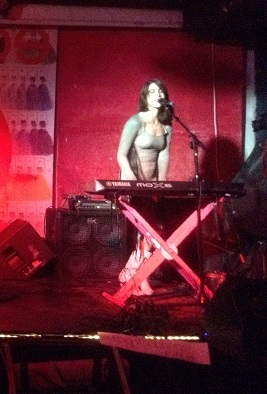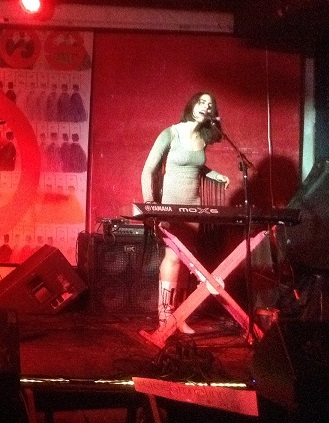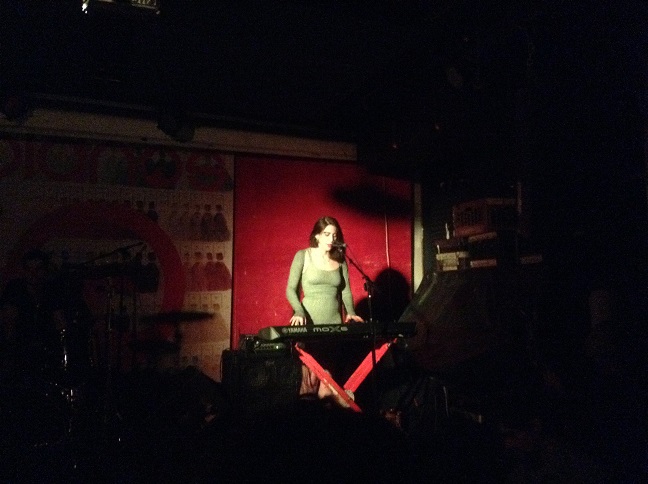
Connecting the Dots (Part 2): Leah Speckhard talks Female Empowerment and Coming-of-Age on her second EP, Sleepwalker

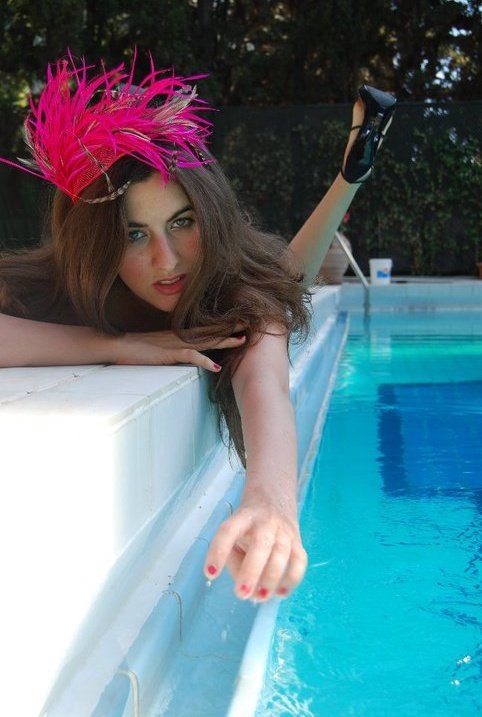
Leah Speckhard, Press Photo Although Leah changed her mind about her university major, she always made sure to remember music and make that a part of her life. The singer-songwriter reflected on the transition between recording of her first album Pour Your Heart Out Like Water, and her newest one, Sleepwalker.

“I recorded my first album in Greece. When I signed with the label, Legend Records, they had me record a full album, which they put out with full press coverage. But the follow up coincided with the downturn, and  the album came out during the whole economic crash.

“The record label was very supportive of the album and me as an artist, but everybody was tightening their pockets. I saw that it wouldn’t be easy for a new artist to break through in this environment.”

While Leah felt satisfied with the completion of her first record, she also admitted that it did not build up into what she expected. In addition, the young artist realized the market for Greek music showed a greater affinity for club music, which did not suit her lyrics-driven songs. Leah asserts, “I felt it did not make sense to keep pushing in Greece, so I decided to come to New York to see if I could make it happen here.”

Leah describes her first experience as a recording artist as invaluable. When she made her first EP, Leah listened to a lot of folk music, and she was relatively inexperienced at recording. She says:

“In Greece, the label was very supportive of me, but I did not understand how the whole process of making an album would play out.. I am a fairly assertive person in general, but in the studio, in that element, I did not feel that assertive. I had a hard time articulating what I wanted the arrangements to sound like.

“In the second record, I felt more involved in the process – which I think is just part of the indie experience versus the label experience. I worked with a producer in Brooklyn and within a different environment. You just naturally have more control over things.

“Many artists I talked to have a similar experience with their first album. You don’t know how to assert yourself and sometimes, you feel that you shouldn’t, because the label is paying for everything and they bring in people with a lot more experience to work on the music, too. The record was also the label’s investment, and I wanted to be respectful of that.”

“On Sleepwalker, I was more sure of what I wanted, and I’d evolved as an artist. I also worked with someone younger, so the collaboration felt easier and more intimate. I knew I was working with someone who believed in me and who brought a lot to the table – we co-wrote most of the songs, and he listened to me about what I wanted production-wise and we really vibed as far as finding a direction that reflected who I am as a person and the dance influence that I liked.”

A great lesson Leah learned was to be assertive on the second album. She would agree that learning assertiveness without acting rude, and finding that fine line, is also a process of growing up creatively, personally and professionally.

“When I was younger,” Leah recalled, “I wanted to be easygoing. I did not want to come across as difficult, but now I realize, you must be to a certain extent if you want your creative vision to come to life. You don’t have to be rude, but you have to be straightforward if something is not the way you want it, and that can be very awkward and uncomfortable. While I love to hear suggestions from other co-writers or producers, as an artist I have to be the ultimate decision-maker and ask myself “Is this what I want my sound to be or not?””

As an indie artist, Leah funded this album herself. Some people might think that an artist paying for their album defeats the purpose of making money with music. Leah says that having her music pay for itself would be a dream. At the moment though, she tries to separate money from music.

“I know some people to think about the connection between them [money and music] when they make music their full-time job. I realized that apart from the money piece of it, I want music to be a big part of my life. I try not to focus specifically on the money because it is really more about the emotions and the feelings for me.

“I try to organize my goals more around questions like  “Do I want to play for bigger audiences, make a music video, or get the music out?” To put it out, you want to have the audience.

“There are so many emerging artists now. To charge people right off the bat for your songs seems foolish – very few people will want to pay $10 or $15 for your album when they can get everything for free on Spotify. I know as a consumer, I am the same way. I’d rather pay to go see a concert, so as an artist, I try to keep that in mind. I think people have grown unaccustomed to paying for recorded music. It’s more about the audience now. I feel like my investment will pay itself off someday with a bigger audience, which is more important to me.”

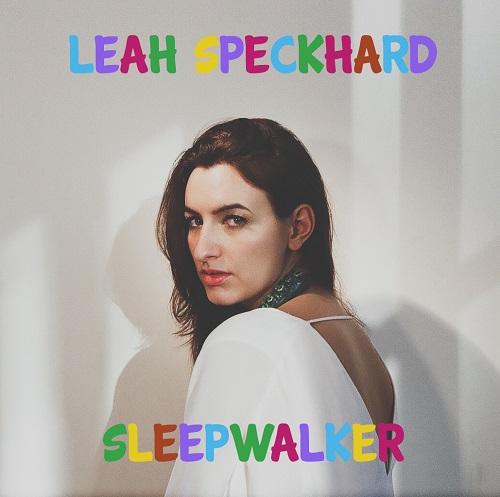
Listening to Leah talk about her music and her experiences, I realize that growing up for twenty-something’s is not reflected so much how frequently they change their minds until they make a decision most people find logical. Maturing comes from the valuable lessons twenty-something-year-olds learn within their development and apply that to make better choices in the future. I then wondered whether Leah had a song on her album that reflected a coming-of-age theme. She talked about another song on Sleepwalker called “Time Machine.” Leah Speckhard Album Cover

“I was delving into relationship issues with my songs – examining all of the heartbreaks, trying to figure out what was happening, and getting into all of this philosophical questioning about what really mattered to me. In looking at my emotions more closely, I realized that a lot of my fears circled around  getting older, and I put that into my song “Time Machine”.

“I started having this strong urge to be young again and have all of this time again to do things over. Aside from the social pressure to have a “real job” and career, there is also pressure to be young from wanting to be part of an industry that emphasizes youth and beauty. I started feeling like I needed to make choices, and fast. With so many options, though I was blessed to have them, I felt overwhelmed. In “Time Machine,” I thought, “I just want to go back in time and be young and not have to make any of these decisions.”

Leah is not afraid to expose her feelings in her songs – though they may come across as hyperbolic sometimes, she thinks hat many people can relate to strong feelings like this popping up from time to time. If you are wondering whether to listen to Leah’s music, this is definitely one reason; but it is not the only reason. In today’s popular music, there is a disconnection about the definition of female empowerment. Major performing artists talk about being female within their pop tunes without emphasizing empowerment.

Leah addresses female empowerment by expressing the injustice, the dissatisfaction with it, and then taking responsibility for entering that disappointing situation in the first place all within her music. “Loser”, a bonus song on her website www.LeahSpeckhard.com, is the track that beautifully introduces this concept. As for the rest of the songs, listeners will have to attend the launch of Sleepwalker on February 23 at 8:30 pm at The Bowery Electric, which she will do in partnership with Tinderbox Arts PR.


Connecting the Dots (Part 1): Leah Speckhard talks Female Empowerment and Coming-of-Age on her second EP, Sleepwalker

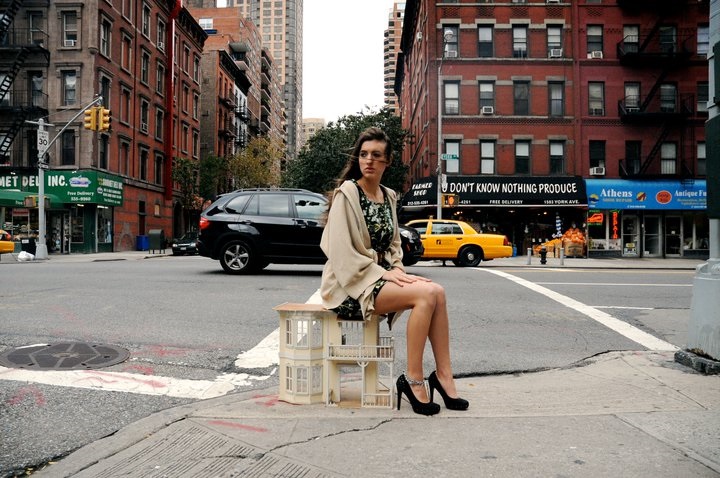
Leah Speckhard, Press PhotoIn her song, “Loser,” Leah Speckhard, sings, Why don’t you call me up, tell me my family’s dead/ tell me my best friend hates me, and always has/ burn my house to the ground, as you watch me cry/ this is what you know best, how to say goodbye. The catchy chorus carries the same dramatic tone, yet applies a more truthful resolution – I never really wanted you/ and all the things you made me do/ make you a loser/ and me a fool. Last Friday night, I sat down with the artist at the Moroccan restaurant, Marrakesh to ask her more about this song.

“The funny part for me, is that I wrote those songs in all seriousness,” explains Leah. “Then I would sing them for my friends and they would laugh hysterically. They said, “You’re so crazy.” I think that when I write, it helps that I am a bit melodramatic. My emotions are magnified when I have a moment where I think, “I don’t like that this [situation] happened, or I really don’t like this interaction.” It tends to be a little over the top, yet I think I started to embrace that instead of tone it down. This is part of my personality sometimes, and this is a fun way to release emotions – a lot like therapy.”

Aside from the obvious exaggerated context, the song is indeed funny, the melody is upbeat, and the rhythm has a nice dance feel. This song would be great on the show Girls; I said to her. Then, I silently recalled the press release of Leah’s upcoming album Sleepwalker. In addition to “Loser,” Leah also wrote a song that will also appear on this record called “Gaslighting,” which builds on a commonly-used feministic term. Additional songs, like “Time Machine” touch on coming-of-age in a global community. Naturally, with so many themes circulating in this artist’s music, and the release of new album coming up; I welcome Leah as the featured artist for January on the Music Historian to connect the dots on all the themes in her songs.

I have heard A&R Representatives from labels say that in dance music, lyrics are typically superficial and simple. “Loser” is an example of a song that is suitable for dancing yet does not fit in a club, and includes lyrics with depth, regardless of their dramatized context. Leah furthers her efforts by taking the message of female empowerment to new grounds.

“I think that some women allow themselves to be manipulated as a result of having a good and trusting nature, and unfortunately that can translate into playing a stereotypical fool. I saw that within myself at least. I thought “Yeah, maybe it was foolish to trust this person, but that person is also a loser for wanting to manipulate me in this way.” The song “Loser” stemmed from a reaction to that, and thinking “something needs to change.”

“Part of my process was to try and understand how I gave people permission to treat me this way, to examine whether it happened more than just once or twice. If it becomes a pattern, then you have a responsibility to stop that and stand up to that. I hope that some of that message comes through my songs,” says the artist.

Leah then talks about another important song on her album, “Gaslighting.” The term, Gaslighting expresses a practice in which men tried to convince women they were crazy. The term is based on an old film of the same name, in which a man arranges to have gaslights flicker noticeably while a woman is in the same room. When the woman comments on it, the man tries to convince her she is imagining the flickering of the lights in the room and is for this reason going crazy. Leah Speckhard Album Cover

“The song “Gaslighting,” is probably the most important and one of my favorite because it comes with a real message: Gaslighting should stop for me and all women,” explains Leah. “It bothered my sense of justice to see those things happen to me and my friends when I was younger. I have many amazing female friends, and I’ve seen many of them manipulated over the years. I too have been to a certain extent. I don’t want this for anyone, even men if they are experiencing this. While my songs come from a victim’s perspective, I want to be a little more empowering and say, “We can do something about this.”

Further in our conversation, I learned that in Leah’s life, she cared about a sense of justice not only in relationships, but also in a broader global sense. Leah is also the daughter of a U.S. diplomat and grew up in the suburbs outside Washington, D.C. until the age of 12 when her father was assigned to Belarus. While Belarus had a president, the leadership in the government was similar to a dictatorship.

“I moved to Belarus, and lived there for a few years in a compound where all of the ambassadors stayed. Everybody lived next to the president. He became very paranoid and believed people were spying on him. He blocked water, electricity and heat to the houses, and told residents they had to move for nonsensical reasons. All of the embassies invested money in those houses, so they told him that they had backup generators, and the residents were okay to stay. Then finally, he just said, “Get out.” This action violated an international treaty regarding diplomats, so my family moved back to the U.S. for a year until it was resolved. Living in Belarus really made me aware that we shouldn’t take rule of law for granted.”

After Belarus, Leah and her family moved to Belgium. Leah spent the remainder of her teenage years in Belgium completing high school. Afterward, she decided to pursue a degree in Vocal Performance at James Madison University in the U.S.

“I first became interested in music as a kid, because my family would always sing songs when they got together. My parents are originally from Wisconsin and my grandparents have a lake house there. All the generations would gather when we went there and sing around a campfire, and I loved those experiences. My Dad also sang to us every night before bed, and plays guitar. Music was always around me.

“My parents put me in piano lessons when I was a kid too. I can’t say I loved it; I always gravitated towards the singing and the writing more. I sang in a choir and the select choir in high school. I realized I wanted to do something more serious when I went to college and did voice as my major. However, at James Madison, the vocal coaching was geared towards opera singing, and I realized that I really wanted to write and sing current music. I learned that for me, music was more about expressing myself and sharing my ideas. So I ended up changing majors and working on my music on the side.”

After that revelation, Leah returned to Belgium and decided to change her major to International Relations. She explains:

“Although I grew up in Northern Virginia right outside of Washington, D.C., I lived in a city. James Madison University, while a great fit for some, wasn’t right for me – it was in a very rural area, and I wasn’t used to that. Apart from deciding not to major in music anymore, I also thought the location did not make sense for me. So, I moved back to Brussels and completed a dual accredited American and European degree.

“After college, I graduated and looked for my first job in Belgium. During this time, my family moved to Greece, and they told me, “Why not look in Greece? We miss you, and we’d love to have you around.” So, I found a job at a shipping company in Greece, and moved there.

“On the side, I worked on my music the whole time. I played around Greece, and some people heard my music and they wanted to introduce me to a record label. That’s how I started.”

Standby for Part 2 of my interview with Leah, in which she talks more about recording her first album in Greece, and coming-of-age on her second EP, Sleepwalker.

Arlen Roth’s Slide Guitar Legacy: Everything from Robert Johnson, to The Blues Brothers, to Teaching Students and Major Artists

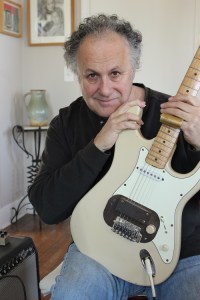
Arlen Roth, Head Shot Since the age of 17, guitarist Arlen Roth has been influencing the scene of rock music, film, and television with his slide guitar, dobro, guitar and pedal steel guitar-performing skills. His most recent album, The Slide Guitar Summit, brings together many great musicians Arlen admires, like Cindy Cashdollar, Sonny Landreth, Lee Roy Parnell, Jack Pearson, and Tom Hambridge and many more for a large concert and jam in Nashville. At the moment, magazines like Guitar Player and Vintage Guitar have planned interviews with the musician regarding his new work. Most importantly, somebody who knows Arlen personally and lives in my hometown within Huntington spoke highly of his new record. Arlen’s friend Billy said:

“The album I feel will be important to musicians interested in the bottleneck and slide formats. I don’t think any recordings have ever put the “cream of the crop” together in this way and just let them challenge and play off of each other.”

Arlen tells me, over a telephone conversation, “I was talking to a friend of mine, and I said “What should I do for this next project, what’s going on?” Simultaneously, we both said, “What about a slide guitar summit project?” Now, I am known as a guitar player, in general, who has influenced and taught many, but Slide guitar has always been a big part of what I do. In fact, there is a book about slide guitar I wrote when I was 19 years old. It is still the biggest slide guitar book in the world. This was 40 or so years ago. I don’t want to date myself too much, but that’s always been a big thing of mine – specializing in the slide guitar. I am sure you are aware of what slide guitar entails and what it means, and how different it is from other guitar playing, but it has also become the voice of American music these days.”

Slide guitar is a technique of guitar playing where the player presses down on the strings while wearing a piece of bar, brass or glass cylinder on one of their fingers. Arlen adds:

“In the old days, it used to be called Bottleneck guitar because players would take a piece of actual bottleneck and put it on their pinky or third finger, or whichever finger suited them. I prefer a heavy piece of brass. You can also alter the tuning of the guitar to an open chord – EBEG#BE for example – as opposed to standard tuning. There are some great standard tuning slide guitar players, but I prefer the open chords. This started to be common back in the ‘20’s with Delta Blue players like Robert Johnson and Son House.”
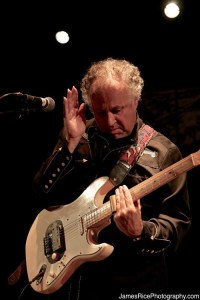
Arlen Playing Slide Guitar

If you listen to Q.1043, WBAB, or any rock station within and around New York City and the Tri-state area, you have heard slide guitar. Whether you listened to, The Red Hot Chili Peppers’ song “My Friends,” The Black Crows’ “She Talks to Angels” (in which the guitar is tuned to the open chord), or the instrumental version of Sam Cooke’s “A Change is Gonna Come” (recreated by Arlen Roth), you heard slide guitar. Yes, I am thrilled that the first official interview article on the Music Historian for 2015 covers a guitar playing technique that has captivated all types of audiences. Rest assured; however, Arlen Roth will not pay a simple ode to the beauty and joy of playing guitar. Arlen shares his story about how he was at the forefront of bringing slide guitar into television and film. Most importantly, he talks about the importance of passing his passion of guitar to his students, family, colleagues and musicians who are gaining a new appreciation for American roots music. It is my pleasure to welcome Arlen to the Music Historian.

“When I was writing my slide guitar book at 19, I remember asking myself, “How do I know all of this stuff?” I have not even had time to learn it, but at that point, I had already been playing for nine years. I was deeply involved in the blues and in country music. So, at that time, I was the only person in New York City who was playing pedal steel guitar, dobro, and Hawaiian guitar, just because I loved that sound. I used to tune into the far off radio stations and listen to country music in Upstate New York. Whether I was listening to it from Pennsylvania or Wheeling, West Virginia or the famous WSM from Nashville. I picked up all of those stations, and I would pick up and fall in love with those sounds.

“When you say, you’re the Music Historian; that’s what we all are. We all fall in love with something like the Blues or Country, and we want to keep getting deeper and deeper into it, and it does not take very long. I can remember at 15 or 16 saying, “I love Mike Bloomfield, now I love B.B. King, now I love Buddy Guy, now I love Son House, now I love Robert Johnson.” Being so young and voracious for this material, and so you are learning ten-fold, and the speed at which you pick it all up can be amazing.”

This slideshow requires JavaScript.

Arlen was 21 in 1974. In addition to writing his book about the slide guitar (also titled Slide Guitar), he went on tour with the Bee Gees across Canada. In 1975, he toured with John Prine, then between 1976 and 1978, he performed on an episode of Saturday Night Live with Art Garfunkel, taught guitar and recorded his first solo album. In 1983, he would tour with Simon and Garfunkel. However, Arlen assures that his road to success was not always rosy.

“I was in the opening act for the Bee Gees,” recalls Arlen. “They loved my steel guitar playing, so they would have me play on their song [Arlen sings] “I’m a-Goin’ back to Massachusetts.” This is like the real original Bee Gees, before they got into R&B and disco.

“We were touring Canada, and we had just done an album with a $100,000 budget. While we were on tour, we discovered the album was being shelved. It was not going to come out. Some of these things in the music business, you never know how much delay there is. The Slide Guitar Summit, I recorded two years ago. Almost, three years ago. Sometimes, that’s how long it takes to get things together.”
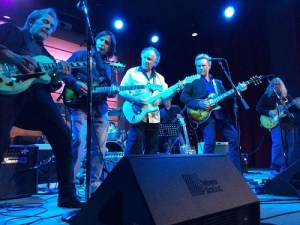
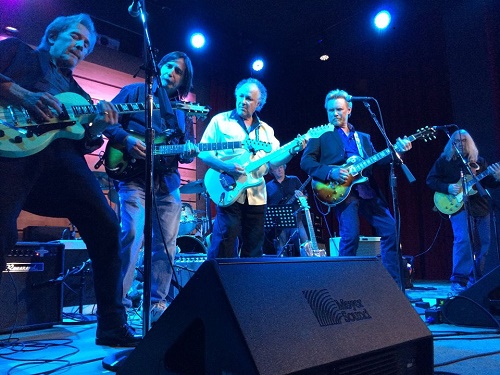
Arlen (middle) with (l-r) Sonny Landrith, Jack Pearson,  Lee Roy Parnell performing in Nashville to promote The Slide Guitar Summit, Jan. 2015

Aside from delays within record productions; Arlen also experienced plenty of challenges on large global tours, this time with Simon and Garfunkel.

“In 1983, I was teaching Paul Simon. I would also help and give him some pointers in some of his songs. Then, they asked me to do the world tour, the big Simon and Garfunkel tour. It was exciting to be on a tour that big, playing for 40,000 to 100,000 people a night.

“When you do a tour like that, the music connects with people, but more as part of an event. You are on the big screen, and one little move you make, gets 20,000 people to yell. It’s a whole different thing. I like it more when you are closer to the audience, and you have a closer rapport with the crowd.”

“True,” I said. “When you are on a global tour, you want to make a bigger event to get more money to pay back more of the expenses (operational). I’ve also noticed across the world, that in some countries, especially in Europe, music is made more for entertainment, and large events like that.”

“Yeah, it’s unbelievable,” responded Arlen. “It seems like they have festivals all the time, and these huge gatherings of people. I remember doing some of them with Simon and Garfunkel, and when the crowd got violent, there were riots and people getting hit over the head.

“We were playing “Scarborough Fair” and people are hitting each other over the head with bottles of Evian. Paul, when he saw that yelled, “Stop doing that. We will stop playing if you don’t stop hitting that guy!” People were getting crushed, running on stage and pulling your clothes; it was kind of scary.

“I also remember being in Boston, and [the crowd] getting unruly. People were hitting us in the face with glow sticks. I saw my niece in the front row, and she looked so worried because she was getting pushed from behind. Once the crowd starts pushing, they don’t stop. So, in the bigger events, try to be as safe as possible. But still, it’s exciting to be part of something on that scale.”

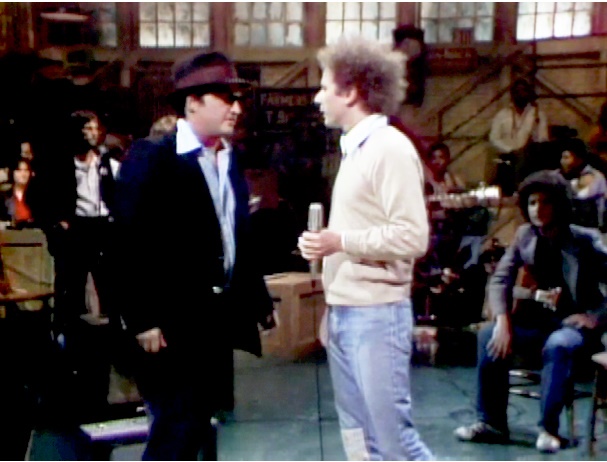
As I thought about having thousands of people watching every move a musician makes on stage, I recall reading about another major event in Arlen’s career where he performed for a large audience. This time, his guitar playing had caught the attention two actors on the set of Saturday Night Live – Dan Aykroyd and John Belushi. A jam warm-up session that night with Arlen transformed into the beginning of The Blues Brothers.

“That night in 1978, [on the set of Saturday Night Live] there was no “Blues Brothers” yet. Belushi comes up to me, puts on a hat and sunglasses and says, “Look, we are going to warm up the crowd. We’re going to put on these blues outfits, and we are going to be these blues guys.” We just warmed up the crowd with a song, which happens to be on this new album, “Rocket 88,” which I also did with Johnny Winter on the new album. John Belush (Left), SNL Host (Middle), and Arlen Roth (right) on the set of SNL, 1978
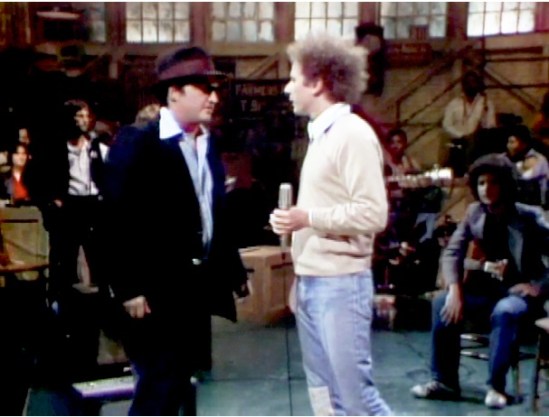
“What happens at Saturday Night Live, is you start on Wednesday, and by the time you hit Friday, you do the show over, and over. You have a rehearsal, then a dress rehearsal, then a live show. By the time you do it, you don’t even care anymore. You don’t even know it’s live, you are like blind. They keep cutting routines, changing them, and I remember I was backstage with Belushi.

“I wrote out the words for him, and he was very much an actor saying, “Quick, give me the information right now.” Then I remember Andy Kaufman was there, and everything was amazing. Then, we hit the stage and warmed up the crowd with “Rocket 88.” In fact, later that night, after the show, we all went to this bar afterward – because the party never ended with Saturday Night Live – and we were jamming and playing the blues. That’s what turned into the Blues Brothers.”

According to outside sources, The Blues Brothers became a musical sketch on SNL, then filming of the movie started in 1979 and then premiered in June of 1980. While it earned just under $5 Million on its opening weekend, it went on to gross $115.2 Million in theaters worldwide before its release on home video. The film has become a cult classic (en.wikipedia, 2015).

By the 1980’s, Arlen had taught Paul Simon, toured the world, and contributed to the beginning of The Blues Brothers. In 1986, his influence would later grab the interest of director Walter Hill, who had just started filming the film about the legendary Robert Johnson titled Crossroads. Walter invited Arlen on the set to be an authenticator for the film, to play much of the guitar in the movie and to coach Ralph Macchio on his playing, and the guitarist made sure to deliver.

“What happened in a scene – which included Robert Johnson in 1937 recording in a hotel room in San Antonio – I said, “Hey look, the guy has tuning pegs on his guitar from the 1980’s.” They [the pegs] were bright chrome, and I told them, “No, you can’t have that.” Walter had to shut everything down just because I said that. I told him, “We’ve got to get the right guitar. If I am hired here to make sure that all the guitar scenes go down right, even if the guitar is wrong. I am going to point it out.”

“The actor who came in said, “Oh, don’t worry, I’ve got it covered.” He didn’t have anything covered. He did not understand that the guitar had to be the right one for the era of the scene. So, we shot another scene instead and then, the following day; we shot the authentic and correct Robert Johnson session.

“Walter would sometimes let me sit in the director’s chair and direct the scene. He already had his camera angles set right and said, “Arlen, this whole scene is about the music, and I don’t know anything about it, and you do. So, I’m going to go in my trailer, and you be the director.” I thought, “Wow! Here I am in the middle of a Mississippi cotton field sitting in the director’s chair saying “cut.”” Everybody was looking at me like I was the director now. They did not even miss a beat. I personally think Walter did that to give me a little thrill.”

While Arlen acted as a director for a popular film, performed on television, and taught famous performers, he did not stray away from his life as a performer and a music teacher. He did not depend on these once-in-a-lifetime opportunities for his living. Arlen claims that teaching and showing an artist’s innermost passion is what he is all about.

“Many years ago, I was one of the first people to ever document famous musicians teaching. I had started a company with my late wife Deborah called Hot Licks. We formed it in 1979, and it was as far back as 1973 that I knew I would start it one day. In ’79, I started recording my teaching on audio cassettes. I then found other peers of mine – guitar players, piano players, drummers, whoever might be – anyone who would be willing to do something like this. It was a very new idea – it was not something many players embraced – the concept of laying it out on the line and saying “This is what I am about.” I am self-taught, I never took lessons, I don’t read music, I only learned in real life, in front of real people!

“I thought audio recorded lessons was a great way for people to learn because, and till this day, I still encourage my students to tape their lessons. I teach privately, and I always tell them [students], please tape it [the lessons] because you will lose everything, you will miss a lot of what we say. One day, a student said to me, “I miss those lessons on tape.” That student moved out to Colorado, and I said, “Aha! Lessons on tape. That’s what I will do someday when I need to start another business.

“Music is up and down. I was touring off and on, in between teaching and recording. When I got to the point of doing [one of the earlier albums] Toolin’ Around, I had many folks who had done videos for me, like Brian Setzer, Albert Lee, Danny Gatton – who was a big fan and friend of mine – Duke Robillard, Jerry Douglas, the incredible dobro player who performs with Allison Krauss, played on the album with me. This [album] stretched from 1989 to 1992, and it came out with 8 or 9 artists on it with me.”
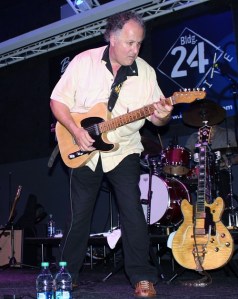
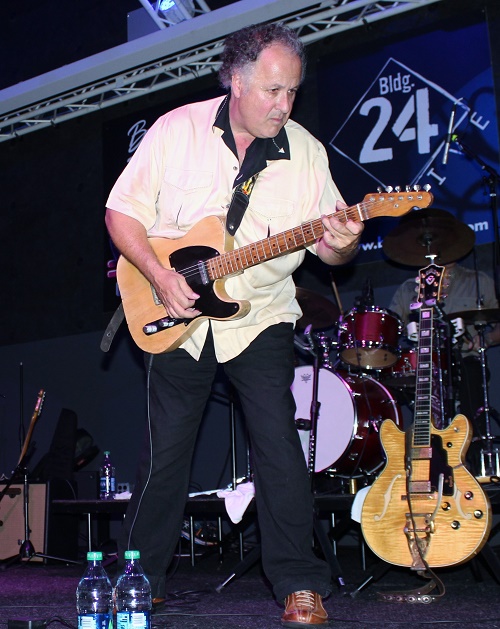
Arlen playing guitar at Building 24 in October 2014 Arlen now touches on an important point – the fluctuation in the music business. For many musicians, across the different generations, teaching had provided a stable endeavor for instrumentalists. He claims that this is why he stuck with teaching. In addition, teaching brought Arlen equity.

“I figured that no matter what, people would enjoy my playing and be interested in my playing because I would change the way people were learning the guitar. I had self-taught musicians, teaching everybody else to teach themselves.

“Many of the artists I recorded or filmed never actually sat down and ever had to explain what they did. I had Buddy Guy talk about the blues. Here is a guy who is my hero from when I was about 15 years old, telling me, “You’re the boss, tell me what to do!?” I said to him, “Buddy, just do it, just play.” All the people who I had admired for many years, some of them whom I really looked up to, suddenly there they are sitting in that chair, in front of those recording cameras for an instructional video, produced by ME!!

“I had directed more than 180 instructional videos with about 140 artists, over a 25-year span. It was quite something. We had 2 million students worldwide; we would make these documentary-type videos into films or box sets. The company that bought my business is still to this day converting things over to digital, DVDs and little snippets on the internet.”

Arlen also filmed about one thousand instructional lessons for Gibson.com, each being five or seven minutes long, but some over an hour in length. He describes them as “a meaningful vignette of an archetype, a certain aspect of guitar playing and music that is a little gem that someone might hook onto and say, “Wow. I never knew about that!””

The musician expresses, “there is a lesson to be learned in everything.” He also believes in “the timeless quality of passing all of that information onto people” and down to his family. Lexie, Arlen’s second daughter, picked up the bass guitar when she was eight years old and entered the world of performing within her teens. Now, in her mid-twenties, she is working on her third album. In the meantime, Lexie also works as a natural gourmet chef. Earlier this month, she starred in a commercial for the Food Network.

“She writes great songs,” says Arlen. “Many of them are very hard-hitting and she’s wonderful and incredible with lyrics. Give her a few chords to go with a guitar part, and before you know it, there is another song.”

Arlen’s first daughter Gillian, who had incredible poise, beauty, and dignity, learned to play the guitar, and started doing commercials at 11 years old. She also performed with Arlen at a concert when she was 12. She even received a contract to star in a television show, where she would be the main actor, guitar player, and singer. Sadly, in the late 1990’s Gillian passed away in a car accident at the age of 14, with her mother, Deborah just two days after she had recorded the theme for that show.

These talented girls learned guitar early from watching their father. Reflecting on the lessons Arlen gave students, adult performers, and his family, I wondered about the most important lesson Arlen learned from his lifetime in music. I asked, “If there were any advice you would give your younger self, what would that be?”

Arlen says, “Because I did start playing so young, I worked with many people who were much older than me. Looking back, I got the spotlight a lot, but people also took advantage. I think you have to be a little cautious about that; there are must as many predatory people out there [today] as there ever were. When you are young and happy to do anything for any money, people start to know you are not the kind of person to turn stuff down.

“Something good has always led to something else. If you do something great, the word spreads and you get called for something better the next time. For example, in my old days in New York, in the early ‘70’s, I would get called to do recording sessions. I really grew up listening to the music that came out of California, Chicago and Nashville. What made me stand out in New York at that time was, there were not too many people my age who played slide guitar, dobro or my unique string bending method. They could not even get a good sound on a guitar in New York.

“I came to New York [in the early ’70’s], into a recording session. I would hear myself play on the record what sounded like this little “chink, chink, chink” sound. I told them, “That’s not the sound I am giving you. I’m giving you this wonderful rich guitar sound,” but the guitar was not important. The guitar was secondary, and you always had to be careful of what you’d say to these folks.

“It [New York] was a horn town, where they wanted to hear strings, horns, piano and drums – jazz. Now, I think there is a wonderful movement in New York and Brooklyn where many people are embracing the roots of rock music, the blues, and the country sound again.”

Recalling this experience in New York during the 1970’s, I asked Arlen what he learned. He responded:

“[I thought], “what are they asking me to record here?” I am recording nothing on this guitar. They were so impressed with me; they saw me perform, they jumped out of their seats and the next thing I know, I am playing “chink, chink, chink” on a record. Then I realized, this is what it is [sometimes] to make a record, at least back then. In those days, it was about overdubbing, layering, getting different sounds, going for hours and hours, breaking for lunch, and then doing it again.

“It was a whole different experience that I never knew. You learn from everything you experience, and all that learning is beautiful.”

In addition to the openness to learn, and the need to protect oneself from being misled, Arlen thinks of another piece of advice he would like to give his younger self:

“Stay true, and learn from those lessons. I had recording gigs that were just nightmares. You walk out of there, and you feel like you aged ten years. The reason it was such torture is because I already had the direction I needed to go in, and they were trying to force me into another thing. That’s part of working as a session man or a musician. Sometimes you have to play backup, adhere to what they want, and be attentive to find the moments where you can shine, and be your creative best.

Slide Guitar Album Cover “You have to stay true to your music, stay ahead of the pack. Don’t try to be a trend follower, it is better to be a trendsetter. Pretty soon, people will come to you, and turn their heads to what you are saying. I think that’s a little bit of what’s happening now with The Slide Guitar Summit.”

From Hollywood films to recording studios in the south, and on television, slide guitar has become very prominent in soundtracks. Interestingly, the average layperson does not think they are listening to slide guitar. Therefore, Arlen decided The Slide Guitar Summit would help educate and seize a very special moment. He explains:

“I’ve got this wonderful breadth of people, great friends and greats who play various forms of slide guitar,” which includes Sonny Landreth, David Lindley, Rick Vito, Johnny Winter, Lee Roy Parnell, Greg Martin, Jimmy Vivino and more.

Arlen also asserts that when people think of slide, they think of blues. Slide Guitar Summit however, will expand into many different territories when it comes to slide guitar music. While listeners can expect the electric blues and Delta blues, they can also expect rock, southern rock, country, and Hawaiian. It is a little more challenging to categorize, but that is what makes it fun. Listeners can expect duets between the artists mentioned above and tributes to songs that have become classics within American music.

In his concluding words about The Slide Guitar Summit, Arlen says, “I wanted to do something that was going to catch people’s attention, and get them to appreciate it and love it. For me, I think of it as a legacy. To me, it is very much about what I am doing now. I loved getting together with these people. Some of the musicians, I had never met before or played with before, and some I had known quite a bit. So, we are going to get it all out there and make something new!”

Arlen Roth and his Slide Summit band will be in upstate New York on May 29th and 30th. Before that, he will probably hit New York City. To get the most updated information on concert dates, standby his website and Facebook.

I let Arlen take the reins of this conversation to share his amazing story. What many music listeners often forget is that music is cyclical. While the slide guitar tunes I learned when I took guitar lessons as a teenager are not the same tunes Arlen taught himself when he was a teenager; that technique transcended eras and continues to do so. What also transcends eras are the lessons musicians learn from being within the business.

Performers and recording artists continue to learn how to walk that fine line of staying open to new experiences within creating music while never losing focus on the sound and the style that makes them passionate. For Arlen, it was always about the playing and being self-taught. For other musicians, it may be about revitalizing a genre that made them happy growing up, or experimenting with various genres, or focusing on layering sounds within music, or simply about performing or collaboration. Whatever we stand for as professionals, we must never lose sight about what makes us who we are. Prosaic? Sure. Valuable though? Yes.

Works Cited

Wikipedia.org (2015 Feb 17). The Blues Brothers (Film). Retrieved from http://en.wikipedia.org/wiki/The_Blues_Brothers_(film)

Disclaimer: All Photos were published with permission

“Alone the other Night”: A Fresh Focus on Indie Pop

Official Press photo of Todd Carter

Official Press photo of Todd Carter

In Songs for a Traveler, The Looking had a specific goal – make archaic Americana folk songs great for Rock ‘n’ Roll. In their newest EP, Alone the other Night, Todd and his group celebrate an era of songwriting from not too long ago through a meditative message: never fear that you cannot successfully meet a challenge.

The opening track to the band’s new EP starts with an element rather foreign to the rockin’ folk songs from the last record – a melody line with a definite meter but free flowing rhythm. The lyrics include: Alone the other night/ I lost my mind here/ he went missing for a while/ I felt no fear/ I wonder if I’ll miss him/ Or maybe I won’t care/ chalk it up, a little whim/ I won’t feel bare. In the second chorus, Todd sings, In the morning light/ I found myself cheered/ thinking of my headless nights/ A genie force, a mindless seer/Looking under rocks and stones/ Searched around to find what’s new/… Light my mind, the heart will choose.

The next track, “Lightning my Mind,” has a rather passé verse but incredibly memorable chorus in a major key and a catchy rhythmic application of lyrics to the chord progressions. Meanwhile “Waitin’ On You” includes a verse that repeatedly plays a minor chord, and a chorus in a major chord which recites one simple message – I’ve been waiting on you/ standing here ‘til you’re passing through… There is no transition between verse and chorus, and there is no need for one. Finally, the song ends in one sad minor chord.

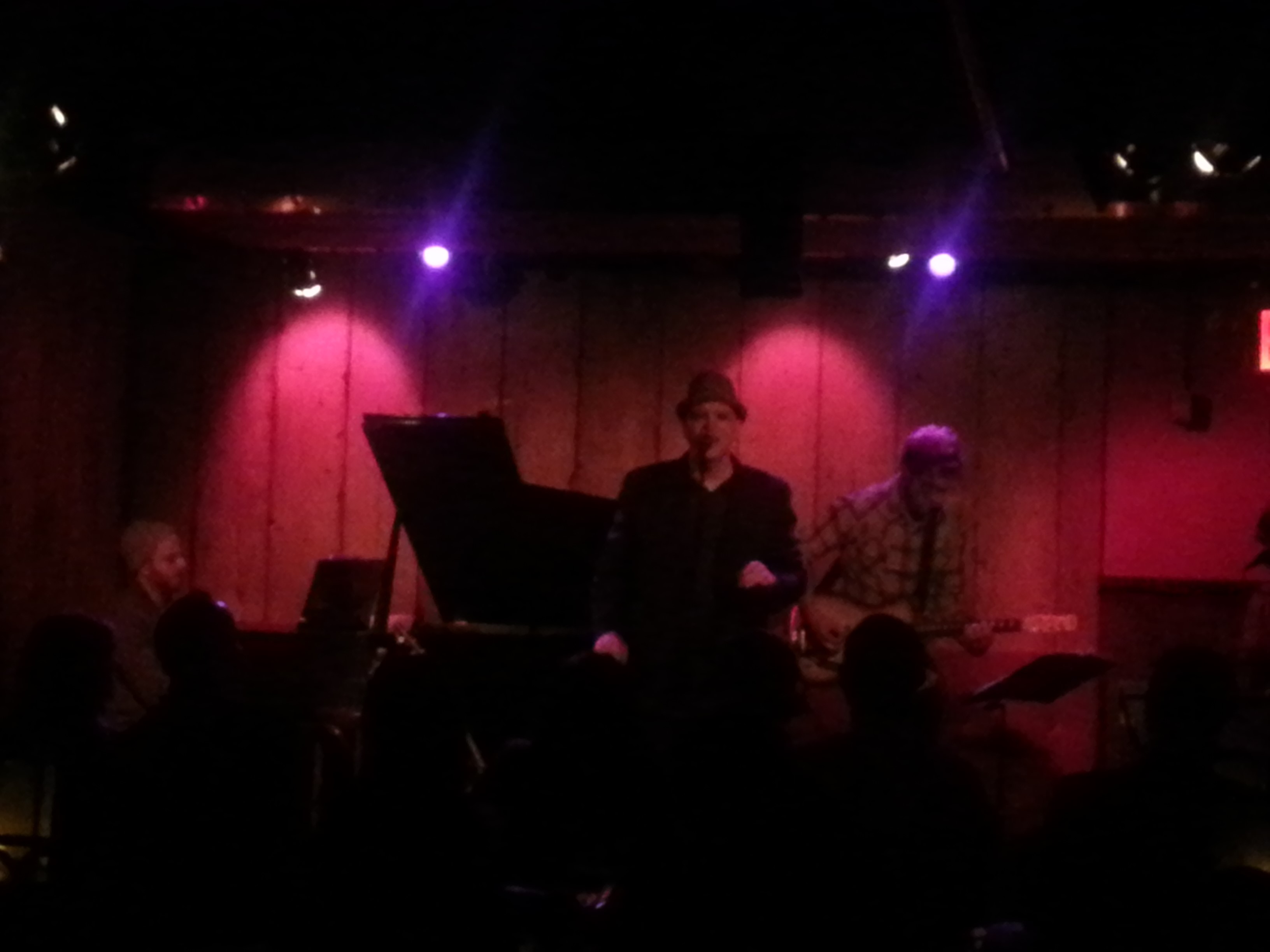
The compositional elements of these songs stylistically reflect indie-pop of the ‘90’s. An ode to the 3-minute song also appears in this EP. The Looking embrace this type of songwriting with lyrics that reflect a lesson that listeners from all generations should learn at any age – the anxiety we experience with any major or abrupt life changes dissipates. The lyrics in the first verse of “Alone the other Night,” I lost my mind here/ he went missing for a while/ I felt no fear… I found myself cheered perhaps best represent this lesson. While everybody has had the opportunity to realize this various moments throughout their lives, very few slowed down enough to notice. Todd Carter at the Rockwood Music Hall, March 2014

Although listeners will most likely have a greater affinity for “Lightning My Mind” and “Waitin’ On You”; “Alone the other Night” acts as the best opening track for that album. The meter is also slow, and the only melody (which I have had trouble singing back) is solely produced by Todd, helping to calm listeners’ minds into a meditative like state. Why not try, it lasts no more than 4 minutes. Afterward, listeners can experience those indie-pop filled tunes later in the album with a fresh focus.

In his own words, Todd says “I love the contrast and variety of the songs on this EP. It was a joy to record with Dan Rieser (Rosanne Cash, Marc Cohn), Diego Voglino (Mudville, Marshall Crenshaw). Bill Finizio (Bill T. Jones), Adam Kromelow (Alice Tan Ridley), and John Carey (Oz Noy, Steve Holley) who are such talented and accomplished musicians. It was also wonderful to work with Richard Hammond (Joan Osborne, Lucy Woodward) for the first time.”

The Best Artist Interviews of 2014!

You are right; I wrapped up the departing year yesterday with looking at what listeners found most interesting in New Music for 2014 regarding major music events in New York City. Now, I want to welcome the New Year with a look at which interviews Music Historian readers from everywhere, 88 countries including the U.S. (leading the pack), then Brazil, and Germany not far behind, found most exciting. Let’s start the countdown!

No. 5: Juicebox

Soul, a foundation that can’t go wrong: An interview with Juicebox members, Lisa, Nick, Isaac & Jamie

Juicebox Perform at the New Yorker Hotel (l-r): Isaac Jaffe, Lisa Ramey, Nicholas Myers, Aaron Rockers From the moment, they walk up on stage; people in the audience are ready to have a moment with Juicebox’s performance. In an industry full of maybes, one thing that will always be definite for this band – they will always give their listeners an unforgettable show and music that will move them.


No. 4: YUZIMA

A World of Wonderful Machines: The philosophy behind Yuzima’s new LP Yuzima poses for photo shoot, for his insta-album, BASH, to be released digitally on October 7th

YUZIMA wants to express the nature of machines – systems that leave little room to reinvent the wheel but at the same time require changes, usually brought about by the continuation of time, in order to survive.


No. 3: The Blackfoot Gypsies

The Blackfoot Gypsies: Modern Southern Rock That Helps You Release Internalized Feelings

 This Nashville-based group has the perfect American music that will help you temporarily lose yourself, feel the good and bad, beautiful and ugly, positive and negative emotions all at once. The energy from The Blackfoot Gypsies’ music vibrates in both their recordings and live performances.


No. 2: Kim Logan

Plugging into Modern Southern Rock: My Interview with Kim Logan 

Kim Logan has found her voice within the Southern and Classic Rock genre, and she flexes it freely. Whether listeners are attracted to her country songs, driving rock ‘n’ roll riffs, or blues-infused choruses, they are bound to hear the voice of a woman who delivers clever lyrics, thoughtfully written compositions, and warmly recorded sounds.


No. 1: Imagine Dragons

Imagine_Dragons Yes. This article is from two years ago. It still seems to attract new readers. Plus, why not celebrate this article a second time? 2014 was a big year for these guys too – they performed at the Grammys.

Opening Doors: Imagine Dragons’ Bassist, Ben McKee, talks about the band’s exciting journey

Ben McKee talks about the career-changing moments that have brought Imagine Dragons to this moment in time – recording a national album with producer, Alex Da Kid

Readers, thank you for a great year. Juicebox, YUZIMA, Kim, and Gypsies, thank you for the conversations and shows. Alyson Greenfield, Pam Lipshitz, and Pamela Workman thank you for the amazing experience at NMS. To everyone, Happy New Year!!!

Wrapping Up 2014: What People said about music, and what I wish to see in music reporting

In 2014, Music Historian experienced its most decorated year. The New Music Seminar opened opportunities to listen to industry experts. Through this event, I also spoke to musicians who currently modernize classic rock and Americana, (Kim Logan and the Blackfoot Gypsies), revitalize the sounds of 1970’s funk and soul (Juicebox), and pay homage to some rock genres critics have often thought of as outdated or even obsolete, including grunge (Desert Sharks). The Governors Ball Music Festival presented a chance to apply the market research, strategy and consumer studies I had gathered at Business School in real life, and an interview with The Naked and Famous. Finally, during CMJ, my business colleagues introduced me to musicians who stood up for specific causes. Janna Pelle, for example, raised awareness for pre-Leukemia. Then, YUZIMA addressed the pettiness of homophobia with his artistic flair.

Looking back on a fantastic year, I am curious people say in the final weeks of 2014 about The Governors Ball Music Festival, New Music Seminar, and CMJ. I look at what people Tweeted over past three weeks and created a word cloud analysis to understand what was trending in regards to these events. Here is what I learned.

Governors Ball Music Festival

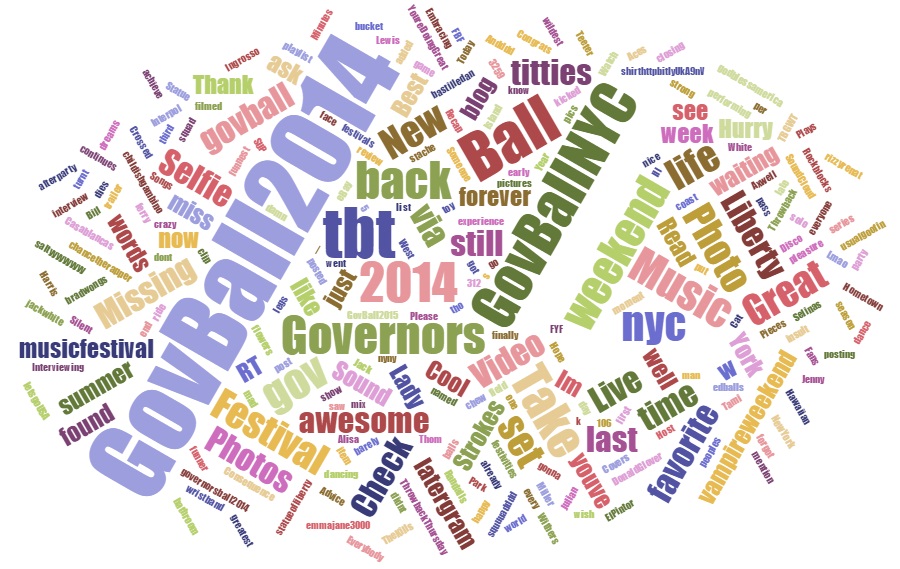
GovBall2014_Word_Cloud

“Tbt” appears in this word cloud as one of the largest after GovBall2014. Those of you Twitter fans know it stands for “Throw Back Thursday.” Naturally, one can assume that many remember the 2014 Governors Ball Music Weekend in the final weeks of December. As for musical acts that appear in the cloud, it appears that the Strokes and Vampire Weekend show up on most these Tweeters’ minds as December comes to a close. Out of all the musical acts that the Governors’ Ball brought New Yorkers; these were the two bands which came out on top.

In terms of consumers’ behavior at the festival, aside from the obvious subject, music; the words “festival,”  “photos” and “selfies” might indicate that this event was also a time for many celebrating together to make memories. Based on the activity I saw of people interacting with one another, I can say this is definitely the case.

New Music Seminar

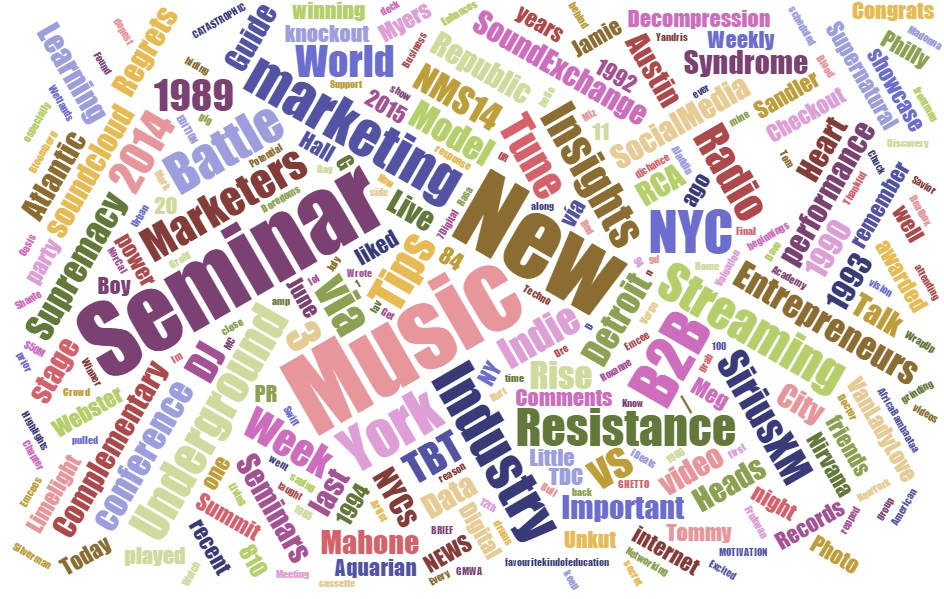
NMS_Word_Cloud In the case you notice this word cloud is more compact than the last, that is for one reason only – I wanted to make sure I gathered at least 100 Tweets for each cloud. In the case of the New Music Seminar, those Tweets extended all the way to June 11th, the day after the event concluded. Meanwhile, GovBall2014 and CMJ, included 100 Tweets that were posted between early December and now.

So what do I see for this word cloud? Aside from New Music Seminar, I see “marketing,” “insights”, “streaming,” “industry,” “underground,” “marketers,” “Tips,” “Tune,” and “Battle.” This last word most likely refers to the battle of the top three bands at the 2014 NMS looking to win prize money. These bands included VanLadyLove, Kiah Victoria and June Divided.

VanLadyLove seems to be the only band which has appeared in the cloud. This is no surprise since they won the battle of the bands at this year’s NMS. Just like the word cloud for GovBall2014, you will see TBT. So what did Tweeters throw back on Thursdays where the NMS is concerned? Pics and articles of artists from the NMS in the late 80’s and early 90’s who quickly became famous, including Nirvana and Madonna. These Tweets that go to show readers that no one can ever expect who from the NMS will make it to the mainstream in the music industry a few years.

CMJ

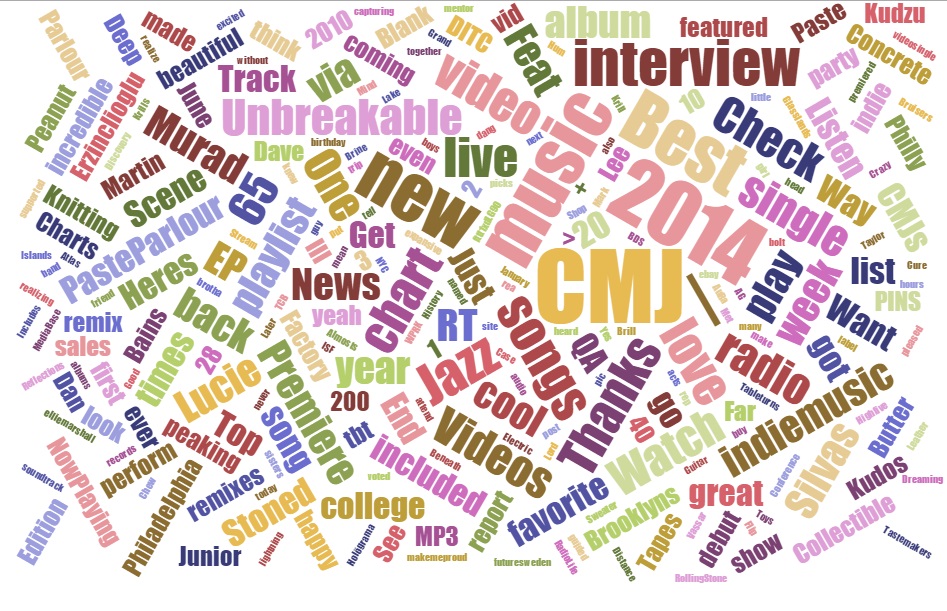
CMJ_Word_CloudIn the CMJ cloud, the words which stood out to me include “new,” “songs,” “Jazz,” “Videos,” “news,” “one,” “unbreakable,” “interview,” “best,” “premiere,” “Murad,” and “Lucie.” How relevant are these words to what people have tweeted about CMJ in the last few weeks? Here is what I observed:

Jazz refers to “The Jazz Junes” from Philly, which have been popular in many Tweets. An interview with CJAM 99.1FM (Windsor, Detriot, MI) Music Director, Murad Ezrincioglu by CMJ received plenty of attention. Then, the English-born, New Zealand-raised, Nashville newbie, Lucie Silva premiered her song “Unbreakable Us” at this event too.

Social Listening in Popular Music Research

Although only 7-10 tweets included any interest in Murad or Lucie, these are the only news sources that showed up consistently throughout all the content from the 100 posts I gathered. I have also noticed in the Tweets for the Governors Ball Music Festival and the New Music Seminar that some subjects will receive more popularity than others. Now I ask, what matters more when reporting about Twitter trends regarding an important music event, quality or quantity? Here is what I think:

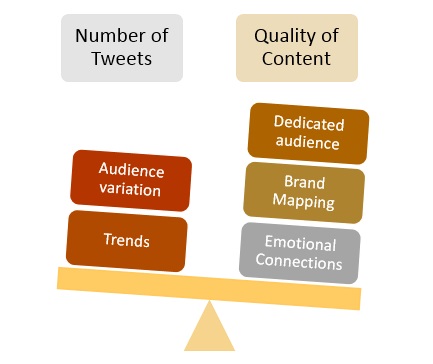
The number of Tweets leads to a clear distinction of what is popular by quantity, enough that it can be considered a trend. Further, the more people tweet about a subject, the greater the variation of the audience. On the other hand, the quality of the content of what people tweet provides insights to the concepts people consistently associate with CMJ, something known as brand mapping. In addition, the strongest content will include a specific emotion, strong mood or preferential word within the Tweet and include a link to a specific web page. Such messages include content like:

@LucieSilvas, I think I love you. This is beautiful. http://www.cmj.com/news/track-premiere-lucie-silvas-unbreakable-us

Check out this Q&A by @CMJ featuring one of our favorites Murad Erzinclioglu of @CJAMFM! http://www.cmj.com/column/on-air/qa-murad-erzinclioglu-music-director-cjam/

The smart chart I have made below shows that looking at both quantifiable and qualitative information within the content is important.

Quantity vs Quality


For whom does this information matter? A marketing consultant or public relations consultant working with a musician, or a music journalist? I would say for both. At least this is what I learned as a marketing student at Baruch College, as I completed a course in web analytics and intelligence. In this class, my final project involved working with Brandwatch, a social media listening tool and using it for the Music Historian.

While I did not know it then, I would soon learn that tools like Brandwatch looked very closely at trends on Twitter regarding specific news stories and examined both the quantity and quality of Tweets. When I did some research about the music consumer at the Governors Ball Music Festival back in June, I used this tool to see which Twitter users would be most interested in attending the event. Please read more here. Further, those who expressed interest by Tweeting about bands they looked forward to watching at the festival, made part of a specific demographic I would have never discovered otherwise.

Social listening is certainly one way to gather information about music consumers who would show interest in the musical talents at a specific event. Most importantly, social listening might also provide marketers, public relations experts and journalists information on how audiences perceive a musical event without having to reach these consumers personally.

What I would like to see in Music Journalism

While social listening is one way journalists can improve their research in regards to what people say about new bands and music; I also would like to see more actual music journalism. Just like I discussed with Janna Pelle last month, former musicians have their reasons for discontinuing music. Nevertheless, they still have an ear for music that they had developed when they played an instrument and spent more time performing.

I would like to see journalists who have played instruments once upon a time, to incorporate their musical skills into reporting on new music from rising talent. Although I understand entertaining content reaches audiences easier, readers are seldom challenged. Perhaps this is due to my bias that there is an art of asking quality questions. What are quality questions? Let me explain:

Avoid ‘yes’ or ‘no’ Answers 

These types of inquiries should only be asked if they are essential to the context of the conversation.

If your research can already answer the question, DON’T ASK!

If a publicist provides you with a press release about an artist who announces they are working on a new project, study that release. Doing so will help prevent redundancy and focus on what you really want to know about the artist. Further, the artist you are interviewing is also a business person with plenty to do. I guarantee the artist will feel like you are respectful of their time by asking questions they have not already answered through any press materials, including their social media profiles.

Stick to the music

Like many, I agree that you don’t need to get too technical with an artist about their songs. You are trying to understand what motivated a musician in their songwriting by listening to their answers to your questions. On this note, don’t ask loaded or uncomfortable questions about a performer’s personal life, finances, or families. If the musician specifies that personal values like religion, social issues or inspire their songs, then you are welcome to ask these questions. Remember to ask in a context that will not diverge from the topic you are most interested in – their music.

A Pop Album Inspired by the Evolution of the Classical Piano: Interview with Janna Pelle, Part 2

I return to my interview session with Janna Pelle, which took place on the first Thursday of November, at the Bosie Tea Parlor in the West Village. As Janna received her order of Mau Feng tea, I asked her about the challenges and rewards she experiences in her career as a musician. She responds:

Janna Pelle_Pianos_Key Change launch_11/10/2014 “Other than making money, I think the challenge is to be able to stay true to yourself. When you decide you want to do music professionally, you don’t know exactly what that would mean for you, or what you like about music. Will it give you the same sense of fulfillment that you would get in a job? Are you up for it? Do you want to do music your whole life? You need to enter with a very open mind. If you don’t do a certain thing, realize it does not mean you are selling yourself short, or failing. It means you are learning how to make yourself happy, how to support yourself, and balance all of these different things going on around music – even your lifestyle or sleep schedule. That’s the challenge, accepting what being a musician means to you.”

“It’s like taking care of a baby,” I commented.

“It is a baby!” Janna positively exclaims. “It’s like your creative brain child. And as a musician, you are always in a state of flux. I’ve been playing keyboards for other bands, making posters for them, and more. It goes back to the feeling like I am providing a service to people. That’s going to make me happy. I would prefer to do something that makes me passionate.

“I don’t know what type of audience I will reach at any time, but I know that when I perform for Beatles Fest, my own shows or a cover set, I can feel good about myself. I completed work for somebody, they appreciate the fact that I am playing their music, and that’s my job.”

The subject of audience reminded me of Janna’s plan for Key Change, the album which received the dedicated concert from earlier this week. The concept for this record involves following the chronological history of the keyboard’s evolution from harpsichord to synthesizer. Further the music in this record mixes classical with pop, and offers an ode to the versatility of the piano and all the changes it underwent throughout history to make it better.

“The evolution is really interesting,” begins Janna. “There is no other keyboard instrument like the modern piano. You can do everything with it; play delicately, legato, staccato, very high, very low, loud, or soft.

“The earlier keyboard instruments were all imperfect in some way. The clavichord was perceived as a passive instrument. Then, the harpsichord was built for really small rooms – it was the elitist’s instrument present at dinner parties for all the kings, queens and important politicians. Organs, which actually came before these instruments, were placed in churches with high ceilings and started to be adapted for concerts. Organs were, however, huge and importable. People couldn’t do anything with them, including playing very short notes as the sounds linger in the pipes for a long time. The modern day piano blends portability, mobility, long notes, short notes, and all the qualities of the earlier keyboards together. You can play harpsichord music on the piano, and anything.

“Part of the reason I love the piano is so much is because it is a solo instrument. When I came to New York, I said to myself, I don’t have all of these other instruments [with me]. With the piano, I am able to write for myself, sing and accompany myself. I also like how it is a percussion instrument. I love playing heavily on the keys and not worrying about anything really. It is not hard to produce a note, compared to the violin and other instruments, like woodwinds.”

http://www.youtube.com/watch?v=6iecWtP9BKU

As Janna worked on the album, she had the opportunity to work with a musician from Juilliard on one of her songs. This made her think about marketing to an audience of classical musicians, conservatory musicians, or dormant musicians. Janna explains:

“I am not sure what your reason for being dormant is,” Janna says, “but the people I know who say they’re a dormant musician claim it’s because of time consumption. I think many of these dormant musicians have not listened to anything other than the pieces they played growing up. I think they will find this album interesting and fresh. And there are a lot of little tasteful musical moments that music nerds will be able to appreciate.”

One song from Key Change my audience in New York City will definitely appreciate is “City Life,” in which Janna sings … So, this is city life/ for better for worse/ even on a shitty day/ I still live in the greatest place on Earth. I am sure anybody who has taken on the city at one point in their lives will relate to some of the lyrics in this song. If you live in New York, enough said.

I wondered about the moment Janna had – and I ask this of all my musical subjects – when she decided to become a musician. She answers:

“That moment is still evolving. When I graduated, I wanted to try being a musician though I didn’t know what that meant. I just knew that for a fact from the time I left school, moved back to Miami (the singer’s home town) for two months, and then came here. I could have gone right into advertising, there is an advertising school in New York. I thought about going to Spain for a little while to teach English. I earned a minor in ESL, and linguistics, and that always interested me. Yet, I felt I could do that at any age. It was mainly just feeling like it was my time to do this. I’m as young as I am ever going to be today, so it’s time to do it.”

Wherever Janna goes with her career and however long she decides to stay in music is up to her, and her future looks bright. Aside from her immediate confidence, charm and her passion for songwriting and performing, Janna has support from many different communities – her peers, patients and their families battling a serious illness, the artists who join her during a performance, the lovers of music she wins over with her songs, and the business partners who help her along the way.

Janna Pelle: The Shameless Advertiser & Musician Brings Us “Key Change”

Janna Pelle sings and plays keyboard at her Album Release concert at Pianos, for her latest record,  Janna Pelle, a young advertising grad from the University of Florida in Gainesville, builds her portfolio by helping promote a musician she knows very well – herself. Why? When a first-time professional steps into the competitive world of advertising, marketing and communications, she must stand out. Doing so sometimes requires some shamelessness.

“I had a band in college,” Janna beings. “We were called Janna Pelle and the Half-Steps. We performed covers and originals around campus and venues around the city, we were the house band of the University of Florida family events, and we performed at all of the parents’ weekends.

“My band – who were also my best friends in college – and I had just finished an album. As I was graduating, I knew I wouldn’t be in Gainesville anymore, but I did not know yet that I was coming to New York City to do music. Shameless Self-Promotion was the first album I had made without the band, and I started working on it knowing that I was going to be on my own soon. My drummer was going to law school, my bass player was going to be a teacher for Teach for America, and my guitarist would become an Apple Techie.

“When I worked on Shameless Self-Promotion, I had an opportunity to do something different. I also started working on that album knowing I would pursue music. I hate saying the word “pursue music” because I’m [already] doing it, why say the word pursue? So, I finished the whole album in a relatively short time. I had a bassist and a drummer do their part, and I produced the entire album. I knew I needed to have a product ready by the time I would decide to move where I wanted.”

I asked Janna, “And you were studying advertising?”

“Yes, exactly,” she answers. “As a result of this advertising endeavor, I felt so certain I could take a year or more without working in an agency, and do music. I am still building my advertising portfolio in the process – my album, logo, merchandise, and posters I have made for my shows are all a part of that now. At this point, I feel a certain confidence in wanting to do music as my full career. Shameless Self-Promotion was the product I needed to have before I moved to New York.”

Before physically skimming the back cover of her cd-case that proved her record was recorded in Gainesville; I stop for a second to see a nude shot of Janna on the front cover. She has her knees folded and placed up below her neck and on her feet, she wears lightning white go-go boots with her logo on them. This photograph has tasteful nudity which does not even touch risqué. Plus, I certainly could not have thought of cooler visual to match the phrase “shameless self-promotion.”

I then listen to tracks on this album like “Machine” and “Accessory,” and feel excited about Janna’s music. As I research her discography and find her 2014 release, The Show Must Go On, I learn that she courageously shares with listeners the tough experience of her father, who battled cancer. When I sat down with Janna to talk to her about her upcoming album Key Change, I discovered a lover of music history seeking to include a niche audience, in addition to her target listeners – conservatory students. Janna has come to the right blogger. I feel delighted to welcome her as my feature interview subject for November on Music Historian.

Prior to starting Janna Pelle and the Half-Steps at UF, Janna’s musical journey started at the tender age of 6, when she enrolled in piano lessons with a teacher, Rachel Currea.

“My parents enrolled me in piano lessons when I was 6. I was enrolled because I have hyperextension of the inter-phalangeal ligaments. My parents did not know how that would affect me later in life, so they wanted me to exercise my hands.

“They met Rachel, who is still one of my best friends – she’s amazing. My parents told her, ‘Whether she learns little songs only we will hear, or becomes musical; we want her to have fun and exercise her hands.’ So that’s when I learned to enjoy playing.”

Janna Pelle performs at Pianos for her album launch celebration, 11/10/2014 Janna did become musical, and eventually enrolled in a piano magnet high school, where she performed in state-wide classical recital programs. Throughout Janna’s high school education, Rachel acted as her trainer. When the young pianists had to decide on what to major in, Janna decided to continue with music without focusing on it as a degree.

“I realized I did not want to major in music, but I still wanted room for it in my schedule. Gainesville is a great music town, so I was able to form a band. I was greatly influenced by classical, rock and a little bit of jazz. Although I was no longer taking classical lessons… having a band… that experience was just as formative as my classical lessons.”

Hebrew music also slips its way into Janna’s repertoire. I wondered whether she liked Klezmer music – music I happened to play with a college ensemble at Syracuse University – and she claims her chord changes resemble that sound, but the instrumentation is very different. Listeners will not hear a wailing C-tuned clarinet in Janna’s music. However, the chord changes she talks about resonated a little with me, especially in her song, “Machine.” Further, she quotes a measure of a popular animated cartoon series television show from the 80’s. Can you guess what it is? Visit her website, www.jannapelle.com, listen to “Machine” and let me know in the comments section.

Another song that excited me is the one she performed at the CMJ showcase I reviewed last month and the one that gets listeners most excited – “Accessory.” Through the lyrics, Janna turns a romantic male partner into an object, calling him “her favorite accessory,” and how no other piece of jewelry can do what he can do to her. I asked her about the metaphor between sex and fashion. Janna explains:

“You hear the expression ‘trophy wife,’ but you can definitely have a ‘trophy husband,’ or even a ‘trophy relationship.’ You can carry around any kind or relationship as an accessory really. Janna Pelle at Pianos (l-r): Jamie Pitrelli (Bass), Leo Freire (drums) and Janna Pelle.

“The song is all about liking the presence of a person in your life and what they represent. There is nothing wrong with wanting someone as an accessory. You are proud of them and you want to show them off like an expensive bracelet. So, it is not always a negative form of objectification. You feel proud and it’s sweet when you want to show somebody off like that.”

While materialism seems to largely lingering in the background of Janna’s lyrics, the artist does not consider herself a highly materialistic person at all. She defines herself as a sentimental person. Her 2014 EP, The Show Must Go On – a dedication to her father, Tony Pelle, demonstrates this more intimate and emotional side.

Janna felt a need to write songs when her father was diagnosed with MDS, a type of cancer which is also known as “pre-Leukemia.” According to Janna, it goes without saying that songwriting served as a form of therapy for her. However, she felt humbled and happy to learn that it helped her family and listeners battling the same sickness.

“My aunt would tell me, ‘Every morning when I wake up, I listen to “Kick It In,” and look at the slide show you made about my brother [Janna’s father]. That’s how I start my morning.” That was what she did until the day he died. She always used that as therapy.

“There is a song on there for my Mom called “In Your Free Time.” [My Mom] is so devoted to other people. I know that helped her and my Dad a lot. My Dad got to hear all of the album before things got bad. Looking back, I sometimes I think I was so naïve writing these songs, but I wasn’t, I was hopeful. That’s all you can be in these situations.”

The MDS Newsletter featured Janna in one of their issues and distributed information about The Show Must Go On to all of their patients and support groups. People also started donating money to the album, which Janna in return gives to MDS research.

“That was also therapy for me, to know I was actually making a difference, raising money and awareness. I also received emails from patients and their family members who said, ‘I found your album, and it helped me express what I’m feeling now.’ That it really stuck with them. I knew the album would be therapeutic for me, but I didn’t know it would be therapy for so many other people.”

“That is good business right there. People showed and demonstrated how your product helped them,” I remarked.

“I think I would like to go into Non-Profits. Honestly. I will never feel as fulfilled as when I did knowing that I was helping people get through a seriously tough time,” she replied.

Fast-forward a few days to the show Janna put on for the release of her next full-length, Key Change. This performance took place on Monday night, November 10th, at Pianos in the Lower East Side. Here, she performed with her drummer, Leo Freire and bassist Jamie Pitrelli. She also welcomed poets, dancers, Sylvana Joyce and Sean Cunningham to sing and play violin with her in the song “Crazy,” guitarist and singer-songwriter, Jade Zabric, and even welcomed The Super Market Fairy (aka Sally Graves) to come and pass out small samples of organic food to the audience. The most sentimental portion of her show included a verbal message to the audience before she sang, “One Day at a Time.”

This slideshow requires JavaScript.

“If there is anybody in your life you maybe take for granted,” she said as she played the chords of her song on the keyboard, “think about them when you hear this song. Remember that you don’t live your day to the fullest until you tell them you love them.”

It was certainly one of the most memorable shows I have seen on the Lower East Side. The amount of additional talent involved reminded me that there is room for everybody in music. While she might be promoting herself, Janna, like Alyson Greenfield, understands that artists live in a community where they have opportunities to support each other.

Stay tuned for part 2 of my article, in which I talk to Janna about the inspiration behind Key Change. In the meantime, I leave you with this:

I’m never one to directly ask a reader to listen to an artist’s music, but if you want to try and recognize the theme song of a popular animated cartoon series from the 80’s quoted in “Machine” of a listen to it here. If you can recognize the theme song, please write it in the comments below. Thank you!

Tinderbox Arts’ Showcase at CMJ: Reviewing Artists who have been on Music Historian

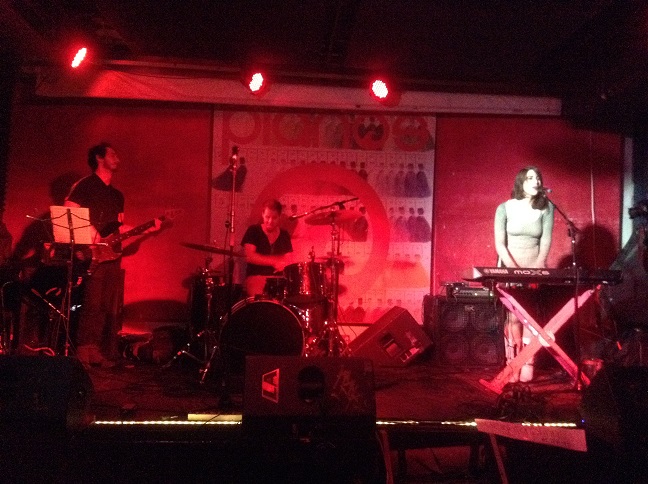
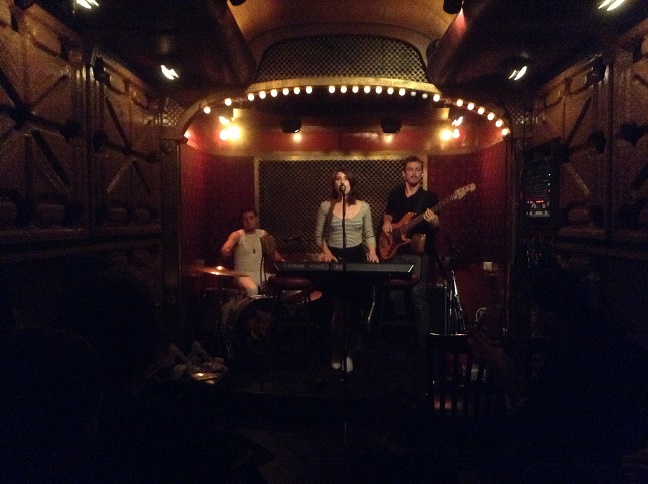
Alyson Greenfield performs solo during her set at Pete's Candy Store, 10/23/2014 as part of CMJ Last Thursday, I went to The Tinderbox Arts’ CMJ showcase at Pete’s Candy Store. This show was made possible with the help of The Catalyst Publicity Group, and hosted by Alyson Greenfield. The performance included a line-up of five bands – most of which have been interviewed by the Music Historian – that performed between 9pm and 12am the next day. This showcase was a great replacement for the Tinderbox Music Festival Alyson had hosted in the past.

Before I get into reviewing the show from last week, I want to share a little history about the Tinderbox Music Festival. In 2010, Alyson learned there was a large community of female musicians who desired to be part of a new women’s music event, specifically reflecting the current landscape of emerging talent (tinderboxmusicfestival.com/story). The festival continued annually for four years. In 2012, CocoRosie headlined the festival. Then in 2013, Deerhoof, the art-pop band headlined the fourth and last Tinderbox Music Festival.

During the four years of this large festival, Alyson established Tinderbox Arts, a company that focuses on booking shows for artists, public relations and consultation, and the former official producer of this large event. This year, she has decided that all of her company’s efforts would focus onto showcases that bring together both male and female artists who are on the firm’s roster – Todd Carter a.k.a. The Looking, Janna Pelle, Alyson, Fiona Silver, and Sylvana Joyce + The Moment.

Todd Carter a.k.a The Looking opened the set with songs from his 2013 release Songs for a Traveler. These songs included “Blue-River,” and “Old Man River.” Then, he sang a cover of the avant-garde songwriter from the 1970’s Hugo Largo’s “Second Skin.” As the guitarist plays the opening chords on his tin-like sounding Strat guitar, Todd takes time to feel the driving harmonic rhythm. Very silently calculates the volume at which he should project his voice during the sudden skin-crawling crescendo within the chorus. Todd was very precise in his vocal execution, as was his entire three-piece band on their instruments – electric guitar, drums and piano.

The Looking’s most notable skills include their ability to make music sound just right – not too loud nor soft – in any performance space. Further, if you like art music that is void of automated technology and involves instruments of classic rock, please check out this band the next time you want to head out on the town. The Looking as part of Tinderbox Arts showcase at Pete's Candy Store, 10/23/2014

Janna Pelle followed The Looking as the second act. Her ensemble included a drummer, whose set had snares, an electric bassist and a piano played by Janna. The most memorable number in her set is from her 2012 album, Shameless Self-Promotion, titled “Accessory.” This track feels like Tori Amos and Fiona Apple if they were upbeat and fearless about admitting their need for sex. The lyrics in the chorus are You are my favorite accessory/ you look so good on me/ there ain’t no other piece of jewelry/ that does what you do to me.

In terms of melody, the song does not finish on the tonic, but with a half-cadence; giving the feeling this light-hearted physical affair our songstress is having will not finish anytime soon. Our heroine might take a break, but she will not put her needs on the back burner anytime soon. Or so I hope.

In addition to songs about sex, “City Life” is one song that talks about the confusion of The Big Apple. In the chorus, Janna sings Where, where, where do I go?/ So many directions/ I don’t know where to go. The song opens with a driving cymbal and snare in the rhythm section as the bass plays a syncopated and jazzy line. On the keyboard, Janna holds out the chords for whole notes across her measures.

Janna Pelle's set at Pete's Candy Store, as part of Tinderbox Arts showcase for CMJ, 10/23/2014 During Jana’s performance, Sylvana Joyce sat down next to me to say “hello.” As Janna takes the listener further within her song, Sylvana starts to harmonize with the remainder of the chorus, I guess I’ll have to figure this out on my own. This lyric, without any pun intended, serves as a mantra for several artists.

Between performances, I also had time to mingle with other active musicians. I was introduced to a young composer who works full-time writing children’s music professionally for an app development firm. This composer has toured all over Australia with his old band, completed his Masters in Composition at NYU debt-free, and opened his own studio in Brooklyn. I would not be shocked if he had to figure out his way in the business independently too.

I then talked with Alyson about the company she manages while she continues paving her career path. Watching her performance at the line-up, Alyson exhibits how she consistently paves her way in music. I first interviewed Alyson in 2012. She was premiering the music video for her cover of LL Cool Jay’s “Mama Said Knock You Out.” At that time, she had already recorded “Understand the Sky,” which was on her album Tuscaloosa – a record that compiled acoustic guitar. In this album, her songs addressed the toils of women taking on the music business and living with the societal stereotypes often placed on them. In addition, synth-themed songs acted as meditations regarding the experiences we don’t immediately acknowledge, like human nature.

In her most recent performances from 2014, Alyson has kept her synth-work, put the acoustic guitar aside temporarily, and made room for hip-hop. Her collaboration with beatboxer Shane Maux in the song “Uncharted Places,” and other tracks – including one where the two rap about the industrial development in Brooklyn – serves as valid proof of this bold stylistic move.

This slideshow requires JavaScript.

Turning to Fiona Silver’s set, I must say her music sounded a lot better at Pete’s Candy Store than it did at the Knitting Factory. I accredit this a lot to the great sound system and the engineering, a small space, and finally, the performance skills of the songstress and her band. Fiona brought with her an electric guitarist who played a Les Paul – a perfect accompaniment to the moments Fiona pulled out her strat and ukulele. Additional players involved a drummer and bassist.

The beauty of photographing Fiona and her band up close is that I could get a better shot of her, the Elvis mic she brought and better capture her incredible stage presence. Fiona’s style of blues-singing has always been described as smoky. That night, I heard a few new tracks that brought out more fiery vocals and melodies than the firm and gentle “Sweet Escape” and “Sand Castle.” Songs like “Coming to Get You,” does not exhibit the light strumming of a uke, but a guitar melody with a metal slide. Her last song for the set, “Long Gone” resembled something more of rockabilly and surf rock.

This slideshow requires JavaScript.

These irresistible tracks got the audience to request one more song. In honor of the night that would quickly draw to a close though, the songstress left the spotlight open for the next scheduled act.

Sylvana Joyce + The Moment were the second to the last act. They opened with their latest single, “Rosie” – a song which marries classical and heavy metal music together, and repeats several beautiful minor cadences. Further, their sound is that of rock, cabaret, and classical with an Eastern European flair. Think Klezmer and Romanian folk.

The music by this band spiced up the response of the crowd. Sylvana and her crew drew in young fans who, in that cramped performance space, busted out dance moves appropriate for a punk rock concert. When I listened to the band’s next song “Chin, Chin,” the rhythm in the chorus made me want to get up and dance the sarba (pronounced Suh-R-Baa). This dance is similar to the hora but with a lot more staccato-like step and bouncing.

Sylvana Joyce + The Moment rock CMJ show, 10/23/2014 Sylvana Joyce + The Moment’s music combines both American and Romanian style. Depending on where you come from, your ear will pick up one element more quickly than the other. In order to fully understand this music, one must not think about why these different elements would work well together in the first place, but instead physically feel how these components work together to make one union. With songs which are 5 minutes long, at least, there will be plenty of time to absorb the experience of this band.

Shayna Leigh closed the night with an unplugged performance. She played with an acoustic guitarist. By the time she got up, it was already 12:30 AM, on October 24th. Although I couldn’t review her performance the way I reviewed the previous bands, I can tell she is a talented songwriter. Her original song “Crash” felt composed like a pop song. I could clearly hear a verse, pre-chorus, chorus, verse, pre-chorus, chorus, and then, a section that might have been built on a deceptive cadence (think the dominant chord, or the 5, going to the supermediant, the 6).

When a show runs that late, I will say; it is not only audience members who become tired. The artists – especially those with day jobs – also become a little too overwhelmed. Some of the audience members told Shayna, while she was taking a breather between songs that her water bottle looked like a vodka bottle. She responds, “I wish it was, I really do. But I’m not that type of person.”

It was during Shayna’s set I noticed more verbal interaction between the audience and the artist. After a long and busy day, this can be quite refreshing. Sometimes listening to music live is not all about the music; it is about the absence of structure and the presence of personable experiences within performers while they put on a show.

My experience at the Tinderbox Arts CMJ showcase this year felt like a reunion filled with music, catching up, interaction and listening. Even in a large and robust places like New York City, there are moments when we can break down barriers and get close to the artists.

Music Historian’s thoughtful interviews with independent artists show just how the musical landscape is evolving. Looking to the future, I hope to work and help the public get closer to these talented musicians through my blog. I just have to take things one step at a time. Happy Birthday, MH!

Works Cited

Greenfield, A. (2014). Story. Tinderbox Music Festival. (About). Retrieved from http://tinderboxmusicfestival.com/story/

Yuzima’s Insta-Album, BASH: The Pop-Up Album That Unites Anti-Homophobia & Mysticism with Punk

Yuzima Philips, Press Photo, for the BASH, the insta-album released on Oct. 7, 2014 What do you call a collection of songs, created to represent a specific theme, which are then released as an automatic response to a quickly changing world? Yuzima, the indie luminary who graced the Music Historian with his 2013 industrial-themed LP, THE MACHINE, calls it an insta-album. Since this release is very spurring of the moment and surprising, I thought an interview article of the same spontaneity with a New York City musician that has gained my artistic respect was very appropriate.

During the creation of THE MACHINE, many additional musical ideas hit Yuzima, especially during one influential visit to New Orleans. The artist also thought about what was happening in the world at that time, specifically the issue of homophobia. All of these experiences funneled down into one creation, the three song album titled BASH, which Yuzima will release digitally on October 7th.

The self-titled track on the Insta-Album opens with a heavy U2 influence in the vocals. Then there is the musical component within the guitar and drums that I have not yet heard within an indie song – polyrhythms. In this musical element, and in the case of “Bash,” the electric guitar plays the melody with syncopation and many rests. The drums work to fill in the silent spaces of this guitar melody.

Listeners taking in “Bash” will hear the intricate relationship between the instruments. Further, they will feel the physical space created by the echoes – which are recited with crescendos and decrescendos – Yuzima creates in the chorus. This chorus quickly follows a verse that contains the following lyrics, we are different yet the same, straight and we are gay. Naturally, I wondered whether the next two songs on BASH would carry the same type of instrumental feel.

“That seems to be a touchstone for me – a little bit inspired by U2 and then transformed into my thing,” explains Yuzima. “Madame Laveau has a bigness to it… I drag in synths. I think of art like the cosmos; U2, The Beatles sent out creative energy and folks like me are transmuting it, and sending it back.”

In regards to the lyrics mentioned above, Yuzima claims he was “on the fence about that lyric.”

“I thought it might be too straightforward, but I made the artistic decision that the message still needed to be said and heard. So I kept it. I don’t believe in race, in ‘black people and white people.’ I think we have interests that either unite or divide us, and that [theme] was a big part of my last record.” BASH, cover art, a pop-album by Yuzima, to be released on Oct. 7, 2014

On the subjects of interests that either unite or divide us, gay rights and the issues of homophobia comes to mind. When I was a child, I received plenty of homophobic slurs from my peers. While this eventually disappeared for me – mostly because these slurs came from bullies or classmates who were very immature and insecure with their own sexuality – for many, unfortunately, homophobic bashing does not stop in adulthood.

Yuzima claims that his pop-up album delivers a theme of anti-homophobia. The musician explains, “Homophobia is awful and cruel. At the same time, it’s insanely uncool. When folks engage in hate, it makes them look way out of touch. That’s where music comes in – artists are the purveyors of cool. By putting homophobia on blast in a punk tune… we assert ourselves.”

BASH also has a rebel post-punk theme. Meanwhile, “Madame Laveau,” is a progressive reggae-ish rock number inspired by the New Orleans voodoo legend, and “Light Love” is a spiritual pop number. Yuzima’s trip to New Orleans inspired him to creatively marry this rock ‘n’ roll genre with the wild jazz and voodoo energy of the Louisiana city.

“I loved New Orleans. You don’t know jazz until you go there. I’m always heavily influenced by places I visit. I’ve written songs about Miami, Venice Beach and New York City – where I live.

“Part of the reason I went [to New Orleans] was to inhale the scene – to be touched by the magic. The moment I touched own, I wandered the streets and [entered] a store called Marie Laveau’s House of Voodoo Readings. It was one of those transforming moments where I came out a different person and I had to write a song about it. The concept of the Insta-Album is to get that inspiration out – not have it sit around for half a year. I came back to NYC, started writing, recording and voila!”

Prior to embarking on his trip, Yuzima knew there was something down in this city he wanted to experience – voodoo. I wondered what interested him in this mystic practice. He says:

“I love the idea of something that has not been adulterated by the modern world. It’s stronger than technology. Old voodoo ceremonies seem to connect us to the spirit world and the old world [in a time] when everything didn’t have an [immediate] answer. Also, there is a hidden power in music, which voodoo kind of exemplifies.”

Yuzima poses for photo shoot, for his insta-album, BASH, to be released digitally on October 7th So, Yuzima parallels multiple themes or ideas that perhaps don’t belong together, like the purity of mysticism next to the unrefined and grimy feel of punk music. Meanwhile, the coupling of rebellion against homophobia and a spiritual trip inside Marie Laveau’s House of Voodoo Readings seems almost impossible. Come October 7th; listeners will have a chance to understand how Yuzima’s signature new age punk will connect these juxtapositions into a musical relationship that will be just as intricate and exciting as his single “Bash.”

My last question to the artist was, “why come up with this new album format? Is it for more effective marketing for a longer album coming down the line, or does it excite fans more?” Yuzima answers:

“It might be…but artists today can’t just rely on the past formats. Bands innovated before us, it’s our job to carry the torch and innovate for today.”

Yuzima also claims he plans to release two more insta-albums. Yet, one might ask themselves, why not just wait to release 10 songs in a full-length album? The answer, based on what Yuzima tells me might reside in the fact that letting a musical idea or message sit for too long will eventually lose its level of pure artistry. Further, an artist might fall in the trap of overproducing a song.

All artists will greatly benefit from the traditional process of focusing solely on a full-length or an EP. This insta-album is a new way of releasing music, especially since it can allow musicians to focus more on their art. Most importantly, this can serve as a trial and error period to see how fans receive an artist’s new musical idea. Could Yuzima be onto something? Maybe.