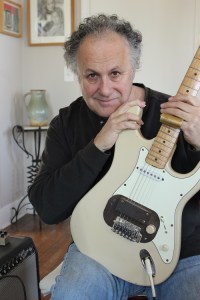
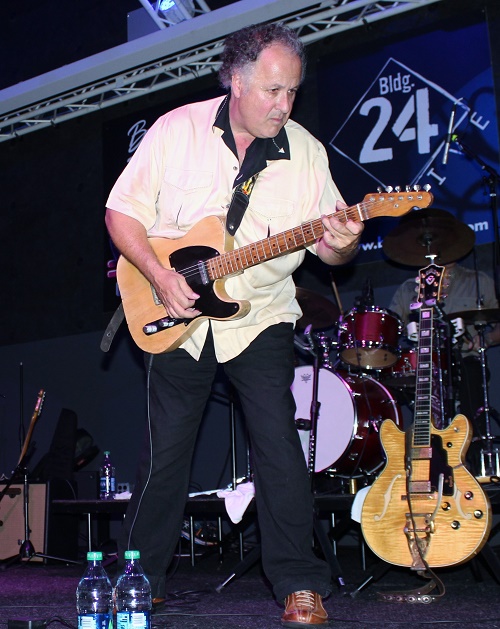
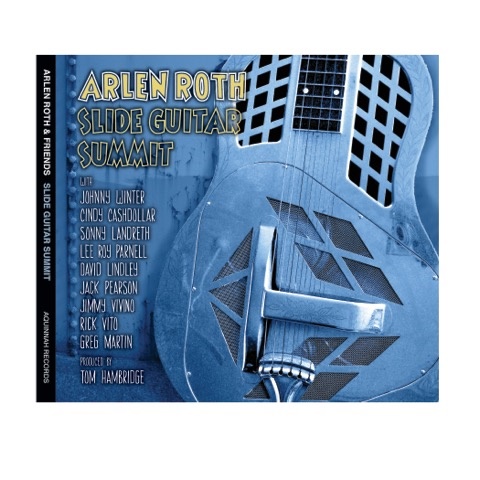
 Since the age of 17, guitarist Arlen Roth has been influencing the scene of rock music, film, and television with his slide guitar, dobro, guitar and pedal steel guitar-performing skills. His most recent album, The Slide Guitar Summit, brings together many great musicians Arlen admires, like Cindy Cashdollar, Sonny Landreth, Lee Roy Parnell, Jack Pearson, and Tom Hambridge and many more for a large concert and jam in Nashville. At the moment, magazines like Guitar Player and Vintage Guitar have planned interviews with the musician regarding his new work. Most importantly, somebody who knows Arlen personally and lives in my hometown within Huntington spoke highly of his new record. Arlen’s friend Billy said:
“The album I feel will be important to musicians interested in the bottleneck and slide formats. I don’t think any recordings have ever put the “cream of the crop” together in this way and just let them challenge and play off of each other.”
Arlen tells me, over a telephone conversation, “I was talking to a friend of mine, and I said “What should I do for this next project, what’s going on?” Simultaneously, we both said, “What about a slide guitar summit project?” Now, I am known as a guitar player, in general, who has influenced and taught many, but Slide guitar has always been a big part of what I do. In fact, there is a book about slide guitar I wrote when I was 19 years old. It is still the biggest slide guitar book in the world. This was 40 or so years ago. I don’t want to date myself too much, but that’s always been a big thing of mine – specializing in the slide guitar. I am sure you are aware of what slide guitar entails and what it means, and how different it is from other guitar playing, but it has also become the voice of American music these days.”
Slide guitar is a technique of guitar playing where the player presses down on the strings while wearing a piece of bar, brass or glass cylinder on one of their fingers. Arlen adds:
“In the old days, it used to be called Bottleneck guitar because players would take a piece of actual bottleneck and put it on their pinky or third finger, or whichever finger suited them. I prefer a heavy piece of brass. You can also alter the tuning of the guitar to an open chord – EBEG#BE for example – as opposed to standard tuning. There are some great standard tuning slide guitar players, but I prefer the open chords. This started to be common back in the ‘20’s with Delta Blue players like Robert Johnson and Son House.”
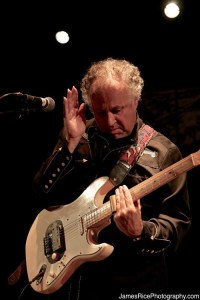
If you listen to Q.1043, WBAB, or any rock station within and around New York City and the Tri-state area, you have heard slide guitar. Whether you listened to, The Red Hot Chili Peppers’ song “My Friends,” The Black Crows’ “She Talks to Angels” (in which the guitar is tuned to the open chord), or the instrumental version of Sam Cooke’s “A Change is Gonna Come” (recreated by Arlen Roth), you heard slide guitar. Yes, I am thrilled that the first official interview article on the Music Historian for 2015 covers a guitar playing technique that has captivated all types of audiences. Rest assured; however, Arlen Roth will not pay a simple ode to the beauty and joy of playing guitar. Arlen shares his story about how he was at the forefront of bringing slide guitar into television and film. Most importantly, he talks about the importance of passing his passion of guitar to his students, family, colleagues and musicians who are gaining a new appreciation for American roots music. It is my pleasure to welcome Arlen to the Music Historian.
“When I was writing my slide guitar book at 19, I remember asking myself, “How do I know all of this stuff?” I have not even had time to learn it, but at that point, I had already been playing for nine years. I was deeply involved in the blues and in country music. So, at that time, I was the only person in New York City who was playing pedal steel guitar, dobro, and Hawaiian guitar, just because I loved that sound. I used to tune into the far off radio stations and listen to country music in Upstate New York. Whether I was listening to it from Pennsylvania or Wheeling, West Virginia or the famous WSM from Nashville. I picked up all of those stations, and I would pick up and fall in love with those sounds.
“When you say, you’re the Music Historian; that’s what we all are. We all fall in love with something like the Blues or Country, and we want to keep getting deeper and deeper into it, and it does not take very long. I can remember at 15 or 16 saying, “I love Mike Bloomfield, now I love B.B. King, now I love Buddy Guy, now I love Son House, now I love Robert Johnson.” Being so young and voracious for this material, and so you are learning ten-fold, and the speed at which you pick it all up can be amazing.”
This slideshow requires JavaScript.
Arlen was 21 in 1974. In addition to writing his book about the slide guitar (also titled Slide Guitar), he went on tour with the Bee Gees across Canada. In 1975, he toured with John Prine, then between 1976 and 1978, he performed on an episode of Saturday Night Live with Art Garfunkel, taught guitar and recorded his first solo album. In 1983, he would tour with Simon and Garfunkel. However, Arlen assures that his road to success was not always rosy.
“I was in the opening act for the Bee Gees,” recalls Arlen. “They loved my steel guitar playing, so they would have me play on their song [Arlen sings] “I’m a-Goin’ back to Massachusetts.” This is like the real original Bee Gees, before they got into R&B and disco.
“We were touring Canada, and we had just done an album with a $100,000 budget. While we were on tour, we discovered the album was being shelved. It was not going to come out. Some of these things in the music business, you never know how much delay there is. The Slide Guitar Summit, I recorded two years ago. Almost, three years ago. Sometimes, that’s how long it takes to get things together.”
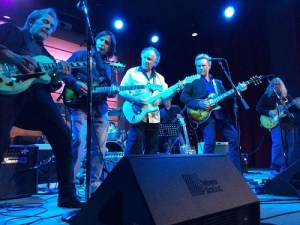
Aside from delays within record productions; Arlen also experienced plenty of challenges on large global tours, this time with Simon and Garfunkel.
“In 1983, I was teaching Paul Simon. I would also help and give him some pointers in some of his songs. Then, they asked me to do the world tour, the big Simon and Garfunkel tour. It was exciting to be on a tour that big, playing for 40,000 to 100,000 people a night.
“When you do a tour like that, the music connects with people, but more as part of an event. You are on the big screen, and one little move you make, gets 20,000 people to yell. It’s a whole different thing. I like it more when you are closer to the audience, and you have a closer rapport with the crowd.”
“True,” I said. “When you are on a global tour, you want to make a bigger event to get more money to pay back more of the expenses (operational). I’ve also noticed across the world, that in some countries, especially in Europe, music is made more for entertainment, and large events like that.”
“Yeah, it’s unbelievable,” responded Arlen. “It seems like they have festivals all the time, and these huge gatherings of people. I remember doing some of them with Simon and Garfunkel, and when the crowd got violent, there were riots and people getting hit over the head.
“We were playing “Scarborough Fair” and people are hitting each other over the head with bottles of Evian. Paul, when he saw that yelled, “Stop doing that. We will stop playing if you don’t stop hitting that guy!” People were getting crushed, running on stage and pulling your clothes; it was kind of scary.
“I also remember being in Boston, and [the crowd] getting unruly. People were hitting us in the face with glow sticks. I saw my niece in the front row, and she looked so worried because she was getting pushed from behind. Once the crowd starts pushing, they don’t stop. So, in the bigger events, try to be as safe as possible. But still, it’s exciting to be part of something on that scale.”
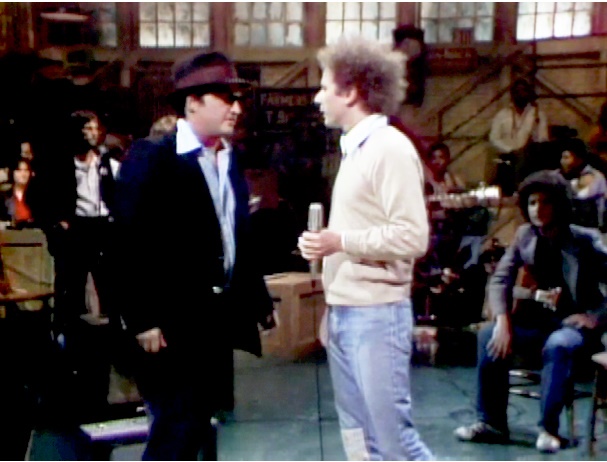
As I thought about having thousands of people watching every move a musician makes on stage, I recall reading about another major event in Arlen’s career where he performed for a large audience. This time, his guitar playing had caught the attention two actors on the set of Saturday Night Live – Dan Aykroyd and John Belushi. A jam warm-up session that night with Arlen transformed into the beginning of The Blues Brothers.
“That night in 1978, [on the set of Saturday Night Live] there was no “Blues Brothers” yet. Belushi comes up to me, puts on a hat and sunglasses and says, “Look, we are going to warm up the crowd. We’re going to put on these blues outfits, and we are going to be these blues guys.” We just warmed up the crowd with a song, which happens to be on this new album, “Rocket 88,” which I also did with Johnny Winter on the new album. 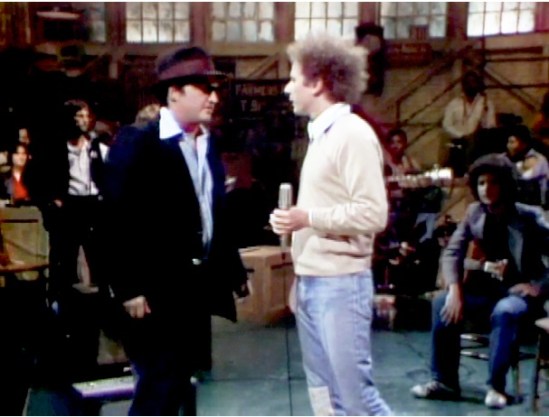
“What happens at Saturday Night Live, is you start on Wednesday, and by the time you hit Friday, you do the show over, and over. You have a rehearsal, then a dress rehearsal, then a live show. By the time you do it, you don’t even care anymore. You don’t even know it’s live, you are like blind. They keep cutting routines, changing them, and I remember I was backstage with Belushi.
“I wrote out the words for him, and he was very much an actor saying, “Quick, give me the information right now.” Then I remember Andy Kaufman was there, and everything was amazing. Then, we hit the stage and warmed up the crowd with “Rocket 88.” In fact, later that night, after the show, we all went to this bar afterward – because the party never ended with Saturday Night Live – and we were jamming and playing the blues. That’s what turned into the Blues Brothers.”
According to outside sources, The Blues Brothers became a musical sketch on SNL, then filming of the movie started in 1979 and then premiered in June of 1980. While it earned just under $5 Million on its opening weekend, it went on to gross $115.2 Million in theaters worldwide before its release on home video. The film has become a cult classic (en.wikipedia, 2015).
By the 1980’s, Arlen had taught Paul Simon, toured the world, and contributed to the beginning of The Blues Brothers. In 1986, his influence would later grab the interest of director Walter Hill, who had just started filming the film about the legendary Robert Johnson titled Crossroads. Walter invited Arlen on the set to be an authenticator for the film, to play much of the guitar in the movie and to coach Ralph Macchio on his playing, and the guitarist made sure to deliver.
“What happened in a scene – which included Robert Johnson in 1937 recording in a hotel room in San Antonio – I said, “Hey look, the guy has tuning pegs on his guitar from the 1980’s.” They [the pegs] were bright chrome, and I told them, “No, you can’t have that.” Walter had to shut everything down just because I said that. I told him, “We’ve got to get the right guitar. If I am hired here to make sure that all the guitar scenes go down right, even if the guitar is wrong. I am going to point it out.”
“The actor who came in said, “Oh, don’t worry, I’ve got it covered.” He didn’t have anything covered. He did not understand that the guitar had to be the right one for the era of the scene. So, we shot another scene instead and then, the following day; we shot the authentic and correct Robert Johnson session.
“Walter would sometimes let me sit in the director’s chair and direct the scene. He already had his camera angles set right and said, “Arlen, this whole scene is about the music, and I don’t know anything about it, and you do. So, I’m going to go in my trailer, and you be the director.” I thought, “Wow! Here I am in the middle of a Mississippi cotton field sitting in the director’s chair saying “cut.”” Everybody was looking at me like I was the director now. They did not even miss a beat. I personally think Walter did that to give me a little thrill.”
While Arlen acted as a director for a popular film, performed on television, and taught famous performers, he did not stray away from his life as a performer and a music teacher. He did not depend on these once-in-a-lifetime opportunities for his living. Arlen claims that teaching and showing an artist’s innermost passion is what he is all about.
“Many years ago, I was one of the first people to ever document famous musicians teaching. I had started a company with my late wife Deborah called Hot Licks. We formed it in 1979, and it was as far back as 1973 that I knew I would start it one day. In ’79, I started recording my teaching on audio cassettes. I then found other peers of mine – guitar players, piano players, drummers, whoever might be – anyone who would be willing to do something like this. It was a very new idea – it was not something many players embraced – the concept of laying it out on the line and saying “This is what I am about.” I am self-taught, I never took lessons, I don’t read music, I only learned in real life, in front of real people!
“I thought audio recorded lessons was a great way for people to learn because, and till this day, I still encourage my students to tape their lessons. I teach privately, and I always tell them [students], please tape it [the lessons] because you will lose everything, you will miss a lot of what we say. One day, a student said to me, “I miss those lessons on tape.” That student moved out to Colorado, and I said, “Aha! Lessons on tape. That’s what I will do someday when I need to start another business.
“Music is up and down. I was touring off and on, in between teaching and recording. When I got to the point of doing [one of the earlier albums] Toolin’ Around, I had many folks who had done videos for me, like Brian Setzer, Albert Lee, Danny Gatton – who was a big fan and friend of mine – Duke Robillard, Jerry Douglas, the incredible dobro player who performs with Allison Krauss, played on the album with me. This [album] stretched from 1989 to 1992, and it came out with 8 or 9 artists on it with me.”
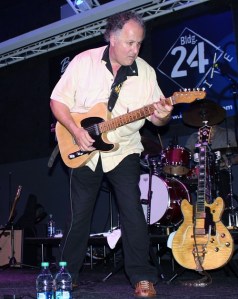 Arlen now touches on an important point – the fluctuation in the music business. For many musicians, across the different generations, teaching had provided a stable endeavor for instrumentalists. He claims that this is why he stuck with teaching. In addition, teaching brought Arlen equity.
“I figured that no matter what, people would enjoy my playing and be interested in my playing because I would change the way people were learning the guitar. I had self-taught musicians, teaching everybody else to teach themselves.
“Many of the artists I recorded or filmed never actually sat down and ever had to explain what they did. I had Buddy Guy talk about the blues. Here is a guy who is my hero from when I was about 15 years old, telling me, “You’re the boss, tell me what to do!?” I said to him, “Buddy, just do it, just play.” All the people who I had admired for many years, some of them whom I really looked up to, suddenly there they are sitting in that chair, in front of those recording cameras for an instructional video, produced by ME!!
“I had directed more than 180 instructional videos with about 140 artists, over a 25-year span. It was quite something. We had 2 million students worldwide; we would make these documentary-type videos into films or box sets. The company that bought my business is still to this day converting things over to digital, DVDs and little snippets on the internet.”
Arlen also filmed about one thousand instructional lessons for Gibson.com, each being five or seven minutes long, but some over an hour in length. He describes them as “a meaningful vignette of an archetype, a certain aspect of guitar playing and music that is a little gem that someone might hook onto and say, “Wow. I never knew about that!””
The musician expresses, “there is a lesson to be learned in everything.” He also believes in “the timeless quality of passing all of that information onto people” and down to his family. Lexie, Arlen’s second daughter, picked up the bass guitar when she was eight years old and entered the world of performing within her teens. Now, in her mid-twenties, she is working on her third album. In the meantime, Lexie also works as a natural gourmet chef. Earlier this month, she starred in a commercial for the Food Network.
“She writes great songs,” says Arlen. “Many of them are very hard-hitting and she’s wonderful and incredible with lyrics. Give her a few chords to go with a guitar part, and before you know it, there is another song.”
Arlen’s first daughter Gillian, who had incredible poise, beauty, and dignity, learned to play the guitar, and started doing commercials at 11 years old. She also performed with Arlen at a concert when she was 12. She even received a contract to star in a television show, where she would be the main actor, guitar player, and singer. Sadly, in the late 1990’s Gillian passed away in a car accident at the age of 14, with her mother, Deborah just two days after she had recorded the theme for that show.
These talented girls learned guitar early from watching their father. Reflecting on the lessons Arlen gave students, adult performers, and his family, I wondered about the most important lesson Arlen learned from his lifetime in music. I asked, “If there were any advice you would give your younger self, what would that be?”
Arlen says, “Because I did start playing so young, I worked with many people who were much older than me. Looking back, I got the spotlight a lot, but people also took advantage. I think you have to be a little cautious about that; there are must as many predatory people out there [today] as there ever were. When you are young and happy to do anything for any money, people start to know you are not the kind of person to turn stuff down.
“Something good has always led to something else. If you do something great, the word spreads and you get called for something better the next time. For example, in my old days in New York, in the early ‘70’s, I would get called to do recording sessions. I really grew up listening to the music that came out of California, Chicago and Nashville. What made me stand out in New York at that time was, there were not too many people my age who played slide guitar, dobro or my unique string bending method. They could not even get a good sound on a guitar in New York.
“I came to New York [in the early ’70’s], into a recording session. I would hear myself play on the record what sounded like this little “chink, chink, chink” sound. I told them, “That’s not the sound I am giving you. I’m giving you this wonderful rich guitar sound,” but the guitar was not important. The guitar was secondary, and you always had to be careful of what you’d say to these folks.
“It [New York] was a horn town, where they wanted to hear strings, horns, piano and drums – jazz. Now, I think there is a wonderful movement in New York and Brooklyn where many people are embracing the roots of rock music, the blues, and the country sound again.”
Recalling this experience in New York during the 1970’s, I asked Arlen what he learned. He responded:
“[I thought], “what are they asking me to record here?” I am recording nothing on this guitar. They were so impressed with me; they saw me perform, they jumped out of their seats and the next thing I know, I am playing “chink, chink, chink” on a record. Then I realized, this is what it is [sometimes] to make a record, at least back then. In those days, it was about overdubbing, layering, getting different sounds, going for hours and hours, breaking for lunch, and then doing it again.
“It was a whole different experience that I never knew. You learn from everything you experience, and all that learning is beautiful.”
In addition to the openness to learn, and the need to protect oneself from being misled, Arlen thinks of another piece of advice he would like to give his younger self:
“Stay true, and learn from those lessons. I had recording gigs that were just nightmares. You walk out of there, and you feel like you aged ten years. The reason it was such torture is because I already had the direction I needed to go in, and they were trying to force me into another thing. That’s part of working as a session man or a musician. Sometimes you have to play backup, adhere to what they want, and be attentive to find the moments where you can shine, and be your creative best.
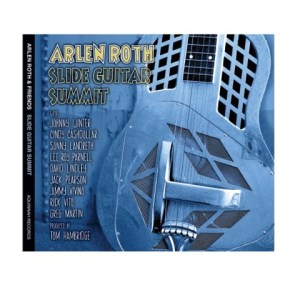 “You have to stay true to your music, stay ahead of the pack. Don’t try to be a trend follower, it is better to be a trendsetter. Pretty soon, people will come to you, and turn their heads to what you are saying. I think that’s a little bit of what’s happening now with The Slide Guitar Summit.”
From Hollywood films to recording studios in the south, and on television, slide guitar has become very prominent in soundtracks. Interestingly, the average layperson does not think they are listening to slide guitar. Therefore, Arlen decided The Slide Guitar Summit would help educate and seize a very special moment. He explains:
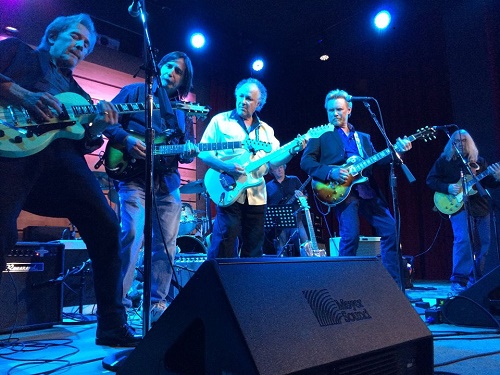
“I’ve got this wonderful breadth of people, great friends and greats who play various forms of slide guitar,” which includes Sonny Landreth, David Lindley, Rick Vito, Johnny Winter, Lee Roy Parnell, Greg Martin, Jimmy Vivino and more.
Arlen also asserts that when people think of slide, they think of blues. Slide Guitar Summit however, will expand into many different territories when it comes to slide guitar music. While listeners can expect the electric blues and Delta blues, they can also expect rock, southern rock, country, and Hawaiian. It is a little more challenging to categorize, but that is what makes it fun. Listeners can expect duets between the artists mentioned above and tributes to songs that have become classics within American music.
In his concluding words about The Slide Guitar Summit, Arlen says, “I wanted to do something that was going to catch people’s attention, and get them to appreciate it and love it. For me, I think of it as a legacy. To me, it is very much about what I am doing now. I loved getting together with these people. Some of the musicians, I had never met before or played with before, and some I had known quite a bit. So, we are going to get it all out there and make something new!”
Arlen Roth and his Slide Summit band will be in upstate New York on May 29th and 30th. Before that, he will probably hit New York City. To get the most updated information on concert dates, standby his website and Facebook.
I let Arlen take the reins of this conversation to share his amazing story. What many music listeners often forget is that music is cyclical. While the slide guitar tunes I learned when I took guitar lessons as a teenager are not the same tunes Arlen taught himself when he was a teenager; that technique transcended eras and continues to do so. What also transcends eras are the lessons musicians learn from being within the business.
Performers and recording artists continue to learn how to walk that fine line of staying open to new experiences within creating music while never losing focus on the sound and the style that makes them passionate. For Arlen, it was always about the playing and being self-taught. For other musicians, it may be about revitalizing a genre that made them happy growing up, or experimenting with various genres, or focusing on layering sounds within music, or simply about performing or collaboration. Whatever we stand for as professionals, we must never lose sight about what makes us who we are. Prosaic? Sure. Valuable though? Yes.
Works Cited
Wikipedia.org (2015 Feb 17). The Blues Brothers (Film). Retrieved from http://en.wikipedia.org/wiki/The_Blues_Brothers_(film)
Disclaimer: All Photos were published with permission

 Although Leah changed her mind about her university major, she always made sure to remember music and make that a part of her life. The singer-songwriter reflected on the transition between recording of her first album Pour Your Heart Out Like Water, and her newest one, Sleepwalker.



 Hear; Let's Listen