More than Meets the Eye: Fiona Silver discusses her music, career success and building confidence

12/20/13 Fiona Silver In her music video for the song “Sandcastle,” which she just premiered last Thursday live at The Knitting Factory in Brooklyn, Fiona Silver frolics on the beach while sporting a 1950’s inspired bathing suit – with beautiful make-up to match – while building (wouldn’t you guess it) a sandcastle. Listen to the song, and you hear a heavy bass coupled with a sweet yet depressing sound of minor 7th chords on the ukulele. Then, Fiona releases her smoky voice. Some would say they are surprised to hear a big voice come from such a petite woman.

Fiona says, “Because I have played with many styles of music, the thread that kind of ties it all together is my voice. So, people comment a lot on my voice and the thing they often say is, “I can’t believe that gigantic voice comes out of that tiny body.” I’ve probably heard that about 100 times. Your outside doesn’t always reflect your inside, and I love that.”

The second sentence in Fiona’s quote then got me thinking about how often times in music, listeners and players focus too heavily on aesthetics – the artist’s physical appearance, what they wear, and the make-up. Now, I am guilty of doing this as well, at FIRST glance. Vision is our primary sense, not hearing. When we listen though, we find there is so much more to an artist and their music than meets the eye.

In this interview, Fiona shows me that even a talented, beautiful and imaginative musician still needs to humble themselves, keep their sight on the art they create, and focus on building confidence from the inside. More importantly, music can help with all of this. I am happy to welcome Fiona Silver to Music Historian.

I asked Fiona about the solemn tone of “Sandcastle” and the lyrics. There is a specific line which Fiona describes water rising on the shore and knocks down towers made of sand. I wondered what message she wanted to convey.

“This song is pretty unique and different in composition and vibe from the rest of my songs,” she explains. “It doesn’t have a lot of hooks. It really is a story, or a poem, about how you can be so focused on something that you really don’t see the big picture. It is the water, the image of a child, or me, building a sandcastle and trying to get all of the details right; being in a state of perfectionism and not noticing that the tides are changing and time is passing. The tide rolls in and knocks down the sandcastle. It is definitely a metaphor.”

While Fiona poeticizes her lyrics and keeps them vague so that they are relatable to anybody; the songwriter and singer also writes from her own experiences. One such experience that the lyrical theme of “Sandcastle” would fit within her own life include dealing with the dilemma many independent musicians have when they are presented with a possible record deal. Fiona Silver (on guitar)_1
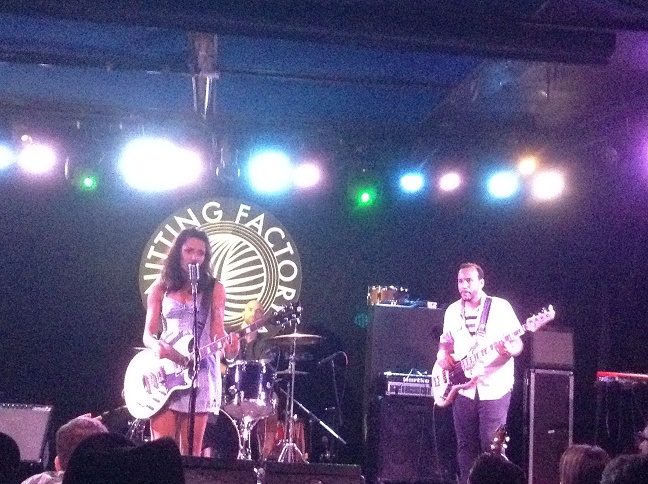
“I would like to be signed to a record label if it makes sense for me. I don’t want to be so focused on getting a deal and everything around making music, that I miss out on really being an artist. Ironically, this goes back to the song, “Sandcastle.” I have met a lot of people who are just very focused on my look, and because I can also be versatile with genres – my voice has this range where it can be soft, then raspy, and then can also be belting and loud – they really wanted to push me into pop. For me, as an artist, I want to focus on my expression and creation. I think that if I focus on what I am actually making, things will fall into place as they should.

“The industry is in an interesting place. It used to be that this [a record deal] was the goal [for a musician]. Now, things are shifting. Artistic development is crucial and it is wild how [many labels within] the industry has dropped that.

“I am not interested in being boxed-in so that someone else can make money. I would love to have a record deal with a company that could nurture my talent and help me move to the next level. I am thoroughly confident this will happen one way or another.”

Although Fiona continues to simultaneously develop her own music and keep an open eye and mind for a possible record deal opportunity, she has experienced success independently. Fiona has collaborated with producer and owner of the Shabby Road Recording Studio, Roger Greenawalt on the annual Beatles Complete on Ukulele Compilation. In addition, she received an endorsement from Luna Guitars and has become the representing artist for their ukulele line.

“Someone just gave me a ukulele randomly years ago, and I loved it; and who doesn’t? The ukulele is one of the sweetest instruments on the planet.

“When I toured in Austin for South by South West, I stayed down there for a while with my ex-boyfriend who was a BMX biker. I made a video with him at the dirt trails, he rode the trails and I played one of my songs on the ukulele. A fellow BMX biker happened to also be a filmmaker, and he works for Luna Guitars. He told me, “We are just about to launch a ukulele line, and you would be the perfect artist to represent that. That’s how I got sponsored by Luna Guitars for ukulele.”

While sponsorships help with monetary needs, Luna has also helped Fiona connect with more artists around the world, including Pipo Torres, a guitarist and songwriter in Puerto Rico who played on “Sandcastle.”

“I would have never known him if not for my sponsorship with Luna Guitars,” says Fiona humbly. “After I got sponsored, I learned about the different artists on Luna’s roster. He [Pipo] immediately reached out to me. I eventually went down to Puerto Rico for a vacation, and then met with Pipo. I jammed with him and some other great musicians he plays with and kept our connection strong since then. Now, we have this collaboration together. It is beautiful when you can connect with more musicians and people.”

Fiona has also received attention from the press. Curve Magazine named the musician one of the most desirable women next to P!NK and Tegan and Sara. In addition to feeling “honored” by the recognition, Fiona is also grateful for Curve’s support in helping give back to the New York City community that supports artists. Fiona explains:

“Curve Magazine is great. I got placed between P!NK and Tegan and Sara. Those are pretty big names in music now. Then, they featured me again in a full article in a later issue, where they talked about my music.

“They even sponsored an event I did to raise money for the Ali Forney Center – an organization that provides assistance to gay teenagers who are homeless. I put on an event where I played music, collaborated with other bands and DJ’s. We tried to raise awareness and funds for the center and have fun. Curve Magazine helped put the word out through social media.”

Fiona’s accomplishments reflect her ambitions as a young artist. Yet, all musicians in her positions who receive this great recognition all come from humble beginnings. Fiona kindly shares how she first became involved in music and how she decided to pursue music as a full-time career and lifestyle.

“My history with music is a bit varied,” she begins. “I started playing piano as a child. When I was a kid, I lived in a place that had a piano, so it worked out. Then, I moved and did not have the piano anymore. I would love to get back to that. I play around on the keyboard sometimes, but I haven’t really played anything in years.

“ I have an older brother who plays guitar, so I took his guitar and started jamming one night. I probably made the worst ruckus ever, but I felt amazing. So when I was about 13, I moved over to guitar and started taking lessons.
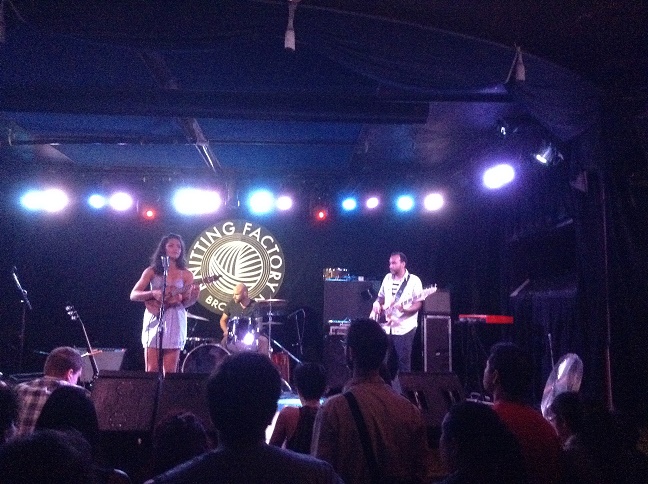
Fiona Silver_ukulele “When I picked up guitar, I started writing songs. My guitar teacher would record songs with me, then later on, I played bass in the rock band I had called Little Body and The Big Sound. Then, I picked up the ukulele.”

Fiona has always described herself as a creator. Fiona also claims that from a very early age, a tender 7 to be exact, she was determined to make a living with music.

“It really wasn’t a question throughout any of my adulthood or anytime through my teenage years,” she recounts. “I always just knew that this is what I wanted to do.”

Fiona was also born and raised in New York City, a place that is filled with opportunities, communities and audiences for music. On one hand, the saturation of culture and art sometimes proves a challenge. On the other hand, with the challenges also come rewards.

“Being in New York in particular, is kind of a double-edged sword,” explains Fiona. “The rewards come from having so many great places to play. There are many avenues where you can get your music out. But, there is also so much going on. It is really difficult to grow in a natural process without getting sidetracked by the concerns of image, marketing and business.

“In this day and age, artists before they make it big, really have to be a “jack-of-all-trades.” You have to do your own promotions, make your own flyers, social media, and all of these tasks that have nothing to do with the music you create. Those are challenges.

“A personal challenge is to have a solid band. There are so many incredible musicians in the city, and I played with great musicians, but they are also in 10 other groups. This makes scheduling difficult, but I go with the flow and keep meeting new people and play with them. In other places, like Austin, for example, where it is not so chaotic, people have more time to jam and live in the process of creating as opposed to hustling around it.

“The reward is working with so many artists and gaining inspiration. This city is very eclectic and I get exposed to so many styles.”

Our artist definitely absorbs the variety of musical styles in her own work. At the moment, she focuses on making a music video for another song, “Medicine Man.” This track differs greatly from the straightforward yet challenging “Sandcastle.” “Medicine Man” literally takes a person on a journey both musically and visually.

“I co-wrote this song with Roger Greenawalt, whom I have known for many years. It really is an example of everything I love about music. It really blends genres from disco to psychedelic to reggae.

“The video [reflects] the journey happening in the song. I wrote all of the scenes which play like a wild dream sequence. We shot in various locations like Ithaca, we shot in the basement of a gay bar in Williamsburg, and we shot in one of my favorite venues, Pete’s Candy Store, and even the studio I recorded the song in. I have so many friends in the video, and some really talented friends who helped create the video with me.  I feel if I worked with anyone else, they would have said “you are crazy.” These guys just worked with me and made it happen.

“Everything [in this video] comes back to this sense of community and other artists I respect who have a lot of imagination and just want to create. The director, Leslie Van Stelton, who also worked on “Sandcastle” and the make-up artist for that music video, DNicole also showcase their range of talents here.”

Fiona does not currently have a release date for this video. When the public does see it though, they will observe the same grace, beauty and personality of the artist with great confidence. And, of course, listeners can expect to hear that voice that travels great physical distances. Reader, I encourage you to see Fiona’s video for the song “Tonight” as well as her promo video for Luna Guitars in which she sings “Sweet Escape.” While you are on her website, click on the “about” tab and you will learn about her vocal inspirations.

As I researched Fiona’s website and learned about the singers she admired, I wondered whether she tried to emulate any of these influences through her voice or music.

“Actually, I don’t,” responds the artist. “I feel like certain characters can come through, different sides of my voice. The genres which change from soul to rock ‘n’ roll to indie, all bring out different sides of my character but I don’t think like an actor. I never think I’m going to channel a specific person. I think the energy and influences, like Billie Holiday – who is one of my favorite singers without a doubt – and Aretha Franklin, are infused together to help create my sound.”

Armed with her sense of autonomy in her musical style, the songs she creates and the strong belief in what she does and represents, one will definitely see Fiona as a confident woman. Lastly, I wanted to know whether she is always this confident as a musician and person. If she is not, I wonder how Fiona builds up that confidence.   Fiona_Silver-3
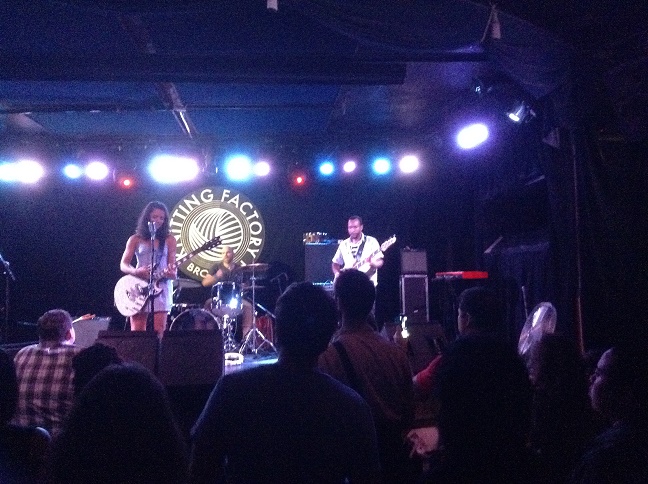
“There are times when I don’t feel as confident as other times,” says Fiona. “I think I do walk with a sense of confidence in general. Part of that comes from the love my parents gave me as a child. Part of that also comes from growing up in a tough city and needing to toughen up. Sometimes, as expressive as I am, as much as I sing and dance and do all of these outward expressions, it is also important for me to get quiet. I love to do yoga and meditate, and also watch the sun set from my roof top.

“When I don’t feel as good, I definitely reach out to people who I love for support. I have an amazing community of friends and that’s huge in life. I express myself through song and poetry, and that really helps me process any pain. When I can move through the pain, it sort of transforms it from something that hurts me to something that helps me.”

An artist’s beauty, talent and imagination can certainly help in attracting the right people who will help them with their endeavors and career path. Yet, even with all the support in the world, a young artist must also toughen up and realize that not everyone in the music industry has his or her best interest at heart. Fiona shows me a musician does not have to change their demeanor, appearance or beliefs in order to experience success through their work. One must, however, persevere in periods of difficulty.

Transforming disappointment, pain or challenges into stepping stones towards success is definitely a stride in the right direction to building confidence as an artist. This is the lesson I learn from Fiona. Further, confidence has helped Fiona focus on staying true to her style and voice, while keeping out any distractions that might be counterproductive to her art. As she continues to sculpt a career that works best for her, Fiona continues to watch her environment. She is a creative soul who has experienced so many beautiful moments in the music world, while also having seen and acknowledging the challenges that knock at her door. Fiona will continue to build her castle, but when the tides roll in, she will be ready.


“When others say “no”, find a way to “yes”: Tina Shafer of the Songwriter’s Circle and her advice for today’s musicians

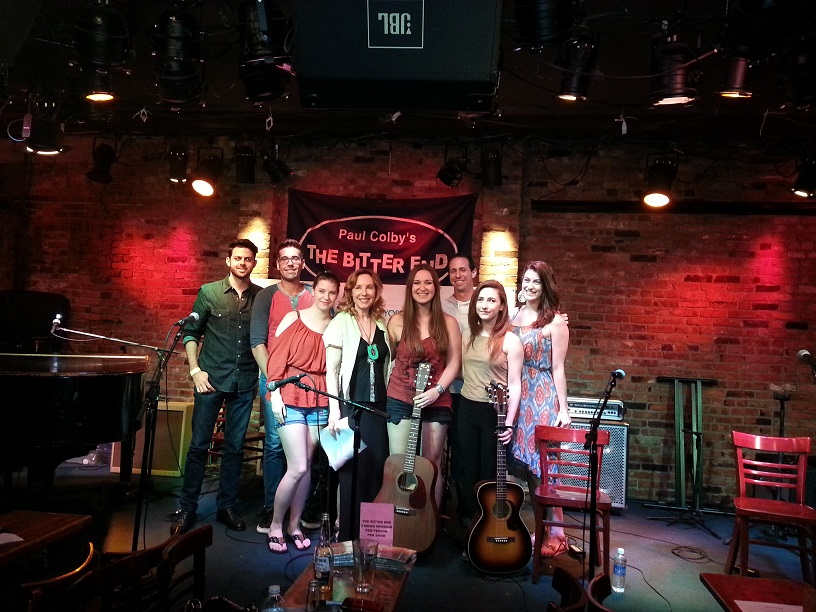
TIna at Young Performers Night 2014, at The Bitter End night club Many artists we have come to know experienced their first big break at the right place and the right time. This is especially true for Billy Porter, a former pupil of songwriter/ vocal teacher and founder of The New York Songwriter’s Circle, Tina Shafer.

“When I worked with Billy Porter – who won a Tony 2013 for his performance in the hit Broadway Musical “Kinky Boots” – he was an unknown singer with one of the most amazing voices I had ever heard. In the late 90’s he got a record deal with my help on the A&M label.   He later went on to perform “Love is On the Way” a song I co-wrote for him that became the Center piece song in Bette Midler’s film “The First Wives Club”.   Later that year, Celine Dion cut “Love is on the Way” and it ended up on her album “Let’s Talk About Love”.  The Album sold over 33 million copies worldwide because it also contained the song “My Heart Will Go On” from the blockbuster movie “Titanic.”

The songstress, who I had the pleasure of meeting in-person at a performance at the New York Songwriter’s Circle held at Bitter End last month, also talked about another former vocal student named Lana Del Ray.  Those who follow Lana know her break was very different from Billy Porter’s.

“Lana, when she was studying with me,” recounts Tina, “wrote the song “Video Games” and most of the attention she first received was through online bullying.   She is very beautiful and an easy “hate Target”. As people started listening to her they then started actually liking her music.  There was a whole backlash of people that starting standing up for her.  It became a viral phenomenon.

But then, where do you go from there? How do you keep your fan base and the customer in mind?”

Music Historian has welcomed advice on how to make it in the music industry from current and former record producers, music publishers, A&R representatives. Now, I welcome advice from Tina Shafer, who is a vocal teacher, singer-songwriter and the founder of the New York Songwriter’s Circle that helps provide a welcoming community to those who work in the beautiful, yet sometimes, lonely and cutthroat world of songwriting. I welcome Tina Shafer to my blog.

Before I get into what Tina advises to current and aspiring musicians and songwriting professionals, I want to share her story about how she became involved in songwriter and began with The New York Songwriter’s Circle.  Music served as the background to Tina’s life. Her mother was a composer, and she brought Tina up in a house where there was always music. At the age of 4, Tina started to learn music in an experimental class for young children at a conservatory in Cleveland. Tina explains:

“They [the teachers] were trying to prove they could teach difficult theory and composition to young kids.  This is similar to the way they teach languages now to young kids.

“The first time I really decided to become a songwriter was when I listened to my first Joni Mitchell record. I was in the 10th grade. From there on, I decided to pursue music and songwriting.”

Just as she finished high school, Tina made the move to New York City, by herself, where she did not know anybody. She performed in clubs, including the Bitter End, and picked up any gig she could do. After 10 years in the city, she obtained her first publishing deal as a songwriter with Warner Chappell and started working with some big names. In addition to Billy Porter, she has written for Celine Dion, Donna Summer, Phoebe Snow, and performed with John Oates (Hall Of Fame), Suzanne Vega, Marc Cohn, The Hooters, The Spin Doctors, Gavin DeGraw, to name a few.

The New York Songwriter’s Circle officially started in 1991 held the first Monday of every month at the Historical Bitter End located in New York City’s West Village.   Tina originally took over the circle as a temp for the original founder. The woman who was initially in charge left to Nashville for a trip and decided to not return. In 2016, The Circle will celebrate 25 years of facilitating rising talent. I then wondered how the business model worked. 

“The New York Songwriter’s Circle is a platform for great talent and up and coming writer/performers but her own company “Tina Shafer Inc.,” I work as an executive producer, developing talent, and putting together  the best creative package to represent that talent.  This often includes, putting together all the musicians, writers, and producers, making an LP and finding the proper promotion.  This is known as “Content packaging”.”

The last component of her business model; marketing, is perhaps most crucial. According to Professor Ana Valenzuela, a faculty member at Baruch College, 75% of a plan for any type of business involves marketing. The other 25% are finances. Marketing enables entrepreneurs to understand who they are as a business, which customers they serve, and what makes the customers return to use the product or service.

Based on what I learned at the New Music Seminar earlier this summer, the same holds true for musicians. They must make music for their audiences. On the same token however, the music industry has changed dramatically in the last 10 years, making artists perhaps more vulnerable.

“When Vanessa Carlton – another Grammy nominated artist and student of Tina’s appeared at The New York  Songwriter’s Circle before making it big – (in 2002), some of these new artists received $400,000 advances  on their first record,” said Tina. She adds that in those days, record labels fostered artists’ development, now, labels do not want to pay for this. On the other hand though, Tina, just like Daylle Deanna Schwartz, asserts an artist does not need a record deal. She explains:

“All you [the artist] need is a great booking agent and advisor. Then you tour, make money from that, and create a record on your own. In a way, this is good, but it costs money to have a booker, a website, you have to pay for so much.

“Now, you have to be self-propelled. Ed Sheeran, for example, was couch surfing and writing with everyone and anyone he could when he started out, then got some air time. Then, he started touring with Taylor Swift.”

While so much has changed in the music industry, Tina reassures songwriters that even when record labels stopped paying for artistic development, Napster started satisfying customers who could get content for FREE, and self-recording and digitization has become more prominent; the only thing that has not changed is the need for great content. In other words, excellent records, songs, playing and performances. We are slowly catching up to the ways of the internet and trying to find avenues to get payment for content.

However, like everybody working in music, I heard a lot of ‘no.’ Even while I was in college, many of my colleagues who were vocalists were told they would have the hardest times finding work after graduation. Now, I find myself talking with a Tina Shafer, who is a conservatory-trained vocalist and guitarist who managed to make her dreams of being a singer-songwriter come true. Naturally, I wanted to know whether she had any advice for someone who is currently in college or in the music industry and receives a lot of discouragement.

“Anyone who goes into the arts will almost always hear that they are not going to make it,” says Tina. “You have to find a way to say, “that is not going to be me”. You have to recognize your strengths.  You may be an ensemble player, you may be a soloist, there are many avenues of music to explore”. “When people said “no”, it gave me [the chance] to find a way to say ‘yes.’”

Tina carries these encouraging words to her sons. Her oldest, Ari Zizzo who is 18 and becoming a well-known teen songwriter.  He has so far, opened up for artists like Mumford and Sons and this summer will open for Emblem3 and Demi Lavato at the Pop Tarts Concerts in Chicago.

Thomas, her youngest who is 16, is a sophisticated writer who hopes to become a film critic. The boys’ father is also a music producer. (Peter Zizzo)

Tina Shafer at the Songwriters Circle on July 7, 2014, The Bitter End In addition, Tina applies this lesson to The New York Songwriter’s Circle. While her company also works to help artists create content, Tina confirms that musicians must push themselves to connect with their own fan base, communicate with their customers directly, and get out into the performance spaces. In addition, good music will not change, and a great song has a way of rising to the top.

One might bump into a cynic who discourages them from continuing with the music industry, but remember this – while music is an undervalued industry, music consumption will double within ten years. Thanks to digital technology, the artist, who I believe can now become more personally involved in the marketing and distribution, has the chance to ultimately get closer to the consumer via social media. Therefore, the consumer can have a better relationship with the product. This gives way to great branding opportunities exist for today’s musicians. Also, musicians trying to fund a record through KickStarter.com help create business while increasing communication with their supporters and customers. Finally, digital vehicles like iTunes and Spotify can immediately deliver music to buyers. Fantastic customer service, right?

If you are a musician and worry about making money, your best option is to focus on the customer. A returning customer, whether it is a loyalist who will come to your shows or always buy a new record, will bring you the most financial return. Lastly, I can attest, that customers return for the good music. So don’t stop doing what you’re doing. Tina didn’t stop. If you happen to be a singer-songwriter looking for some help, check out The New York Songwriter’s Circle www.songwriters-circle.com

You can also check out Tina Shafer directly Tinashafer.net.

The Allegory, History and Humanism in Sylvana Joyce + The Moment’s Gypsy Rock

Sylvana Joyce + The Moment (l-r): Peter Bellomo, Sean-David Cunningham, Nick Salgo, Sylvana Joyce, Christopher Smith “Comrade” by Sylvana Joyce + The Moment, a track from their 2012 debut, For You, greets listeners with a Doina, the freestyle violin playing found in Klezmer music. Further, in the song, the Habanera rhythm – and yes, I do mean the one from the song that made Georges Bizet’s Opera Carmen an internationally recognized hit – will tempt a listeners’ curiosity. Let the track play further, and you will be led to a driving gypsy-like folk dance.

I started listening to Sylvana’s music after I saw her and her violinist, Sean Cunningham open for Todd Carter’s performance at the Cutting Room back in June. I covered her performance and we communicated back and forth. I mentioned how moved I was by her story of how the Romanian folklorist musician, George Sbarcea, was her grandfather. I then invited her to read some of my father’s story. We learned that both of our parents had nearly identical stories about how they left Romania during one of the worst eras of communism in Eastern Europe.

Naturally, I wanted to learn more about her background. More importantly, I was interested specifically in how she would describe her style of music, which she titled Gypsy Rock.

“It’s an interesting question. Gypsies around the world get a terrible rap. In fact, there are still rumors in the states that all Romanians are gypsies,” explained Sylvana.

“Yes!” I respond. “What do you say when someone claims “Oh, you’re Romanian, you must be a gypsy?”

She says, “Being a gypsy is an idea. It’s the idea that your home is not a place, it’s a feeling, and it’s a relationship you have with a person or an ether. I feel because our style is so diverse, we are a nomadic tribe wandering the world of genre. We fall in love with everything we come across, and we make it ours. I believe Gypsy Rock reflects the sentiment of wandering and finding our own version of an eclectic assortment of genres.

“We are all very passionate about what we do,” Sylvana claims as she focuses on the band. “We are all conservatory trained. We have all fallen in love with music and married music. I think, in the end, that is the most important thing that comes through and helps us connect with others.”

Like many, I readily observe how music can connect the artist with the public. What interest me the most is finding an artist who can describe the experience through his or her own point of view. I welcome Sylvana Joyce to do just that right here on Music Historian.

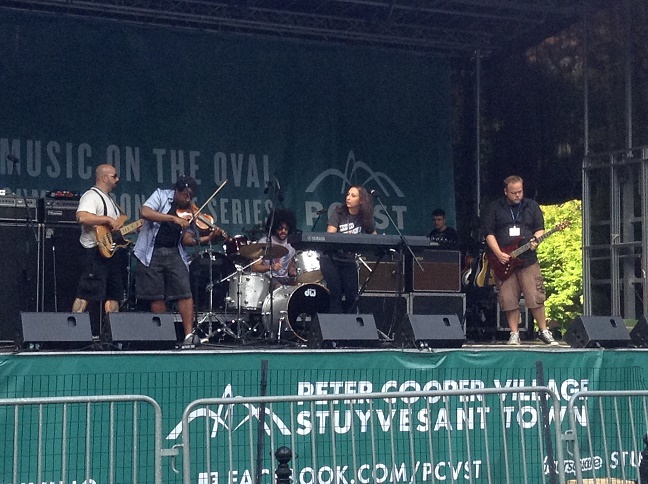
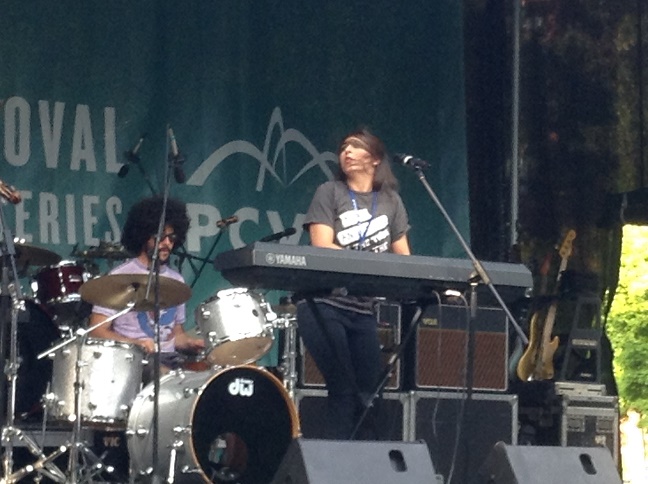
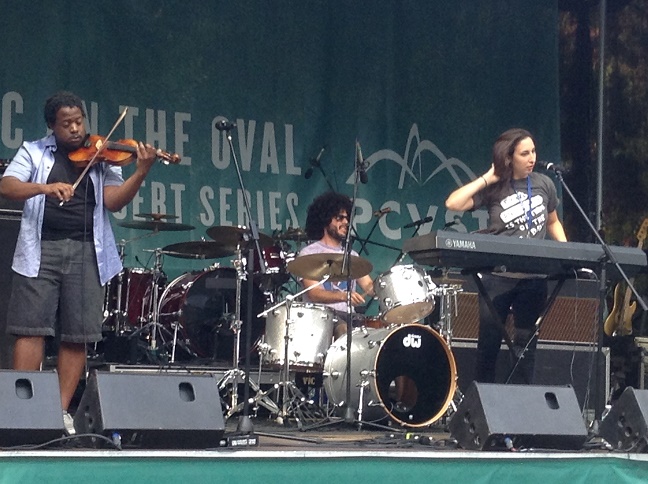
My talk with Sylvana about her music started in a model apartment within the Stuyvesant Town/ Cooper Village complex somewhere between Alphabet City and FDR Drive. Following Sylvana Joyce + The Movement’s hour-long set at the Oval, we were escorted to the apartment complex. When Sylvana, her guest, per diem bassist in The Moment, and I arrived at the apartment, we all had a look around the place and commented on the excellent space. Sylvana and I then headed to the small kitchen for a beer and then proceeded to the dining room table a few feet away to conduct our interview.

Sylvana, the singer, songwriter and pianist claims that she grew up in New York City, where she has gotten to know some of her band members from playing in a conservatory setting with them as a child. As a city-native, the bold and energetic artist reminds me how New York can be a tough scene for musicians.

“[While] I feel it’s easy to get lost in New York City, we don’t find that in smaller towns. That’s kind of been our goal – to find community-based places, play there, and go from there. One of our strengths is that we can perform to any kind of crowd.”

Although community-based places are sometimes overlooked by new music enthusiasts, these spaces enable the performer and audience members to have a better listening experience. For the musician, the sound system and the listening experience beats that of a brownstone pub. In addition, the listener can enjoy a pleasant, spacious spot on a clean lawn, sitting on a blanket with friends and breathe in an open space while experiencing the music.

Aside from discovering their love for giving community-based concerts, Sylvana Joyce + The Moment quickly learned that industry players have an interest in their music. In just six months of the band’s inception, Sylvana Joyce + The Moment were winning international competitions, and even gained a week long coverage from MTV about the band, which included a new recording of their single, “The Break.” The music video can be viewed here.

“MTV was a complete shock to me,” explained the artist. “I sent my music [to an acquaintance at the headquarters], it was this demo we recorded in somebody’s apartment. Someone [the person who listened to the song] just fell in love it with, so we were really excited.”

“That is one step though,” Sylvana continued. “You have a long way to go. We’ve been a band for four years… we’ve been moving up the ranks… it’s been a learning experience for me. I feel good.”

The group’s single, “The Break,” which has received the most attention successfully straddles the musical world of the 2 to 3-minute rock song, and the complex Eastern European-fused cabaret music. I then had two questions for Sylvana: What did she enjoy so much about Romanian folk music? Are the subjects within her songs inspired by real-life, fantasy, or the escaping into fantasy as a way to deal with real life?

As I asked the first question, I brought up George Sbarcea again. Sylvana laughed, “Oh my God, I have not heard his last name said correctly in forever!”

She continues, “Something that is really interesting… a lot of Eastern European folk music is minor. Romanian music is upbeat and major. It [might include] a few interesting minor melodies, but it has a very major and happy-sounding basis.

“We are almost putting a certain genre of music… rock ‘n’ roll on a pedestal. I want the next generation of musicians to start thinking outside the box a little bit. I may be involved in projects that put together rock bands of completely crazy assortments of instruments. I want anyone who plays any instrument to feel like they can be in a rock band because it’s true!

“I hope I can contribute in my own way, both as a performer and instructor. I’m happy I am going to teach music while playing. I think being an example and giving back is important in life.”

In addition to serving as a tool that can help artists reciprocate to the communities that fostered the musical development all each band member; songwriting has also become a form of therapy for Sylvana. Sylvana and drummer, Nick Salgo

“I kind of had a tough childhood. My father left when I was young, and my mom struggled to make ends meet. It [songwriting] was a way of expressing all of those difficult, sometimes ineffable situations. What I couldn’t put into words, the music would take over.

“I’ve actually been writing music since I was a little kid… around the age of 4 or 5, just as silly and imaginative play. I just got very interested in the fact that musicians would put thought into what words went well with the music. I thought the marriage of the two was very interesting.

“I only shared my music with my closest friends, but I would usually feel so embarrassed that I did, I would regret it later, and then have nightmares. When I put a band together 4 years ago, that’s when I started to take it seriously, and I thought I could do something with it, and when I was the crowd respond, I then said to myself, it was a possibility.”

Songwriting serves as a form of therapy for many musicians. A listener most quickly detects this in the lyrics, especially if they directly speak of a delicate situation that one hears of commonly. However, many artists will not address a story involving an issue or a personal problem directly. Instead, they might create an allegory or an allusion. Sylvana accomplishes this in “Comrade.”

“All the songs I have written have some application to my life, but then I will always put in a little bit of allegory and allusion. “Comrade” is loosely based on the story of MacBeth, and how he was so power hungry. He wanted to be adored [so much] that he didn’t listen to reason, became swayed and seduced by magic, and skipped the process of gaining power with integrity. He chose the quick route [to power] and then lost the ability to choose his own fate.”

As Sylvana helped me recall the Shakespearian story which I read many years ago, I was then reminded of the character Morgan from a recent flop-of-a-series about King Arthur produced by Starz called Camelot. I explained to Sylvana that like MacBeth, Morgan – who is Arthur’s half-sister – is so hungry for the throne, she depends on black magic to help her devise a plan that will kill her half-brother. The anti-heroine though has difficulty controlling her powers and depends on the help of her mentor, a nun who has been banished from her own convent. The nun reminds her that the best way to gain power is through earning the trust of her people, the commoners. Adding an adjacent story seemed to interest Sylvana. She then went on to apply another recent (non-fictional) story to the song “Comrade.” This story is about a malicious historical figure many Romanians know too well, Romania’s last communist dictator, Nicolai Ceausescu.

“You know,” Sylvana begins, “Comrade” also reminds me of the stories my mom told me about Ceausescu. Ceausescu’s right hand, his entourage, would try to shield him from the truth of what his regime really created in the country. When he would visit the places of peasant’s, his entourage would arrive early and put nice things in people’s homes to make it seem like they were not living in squalor.

“I feel like, as responsible as he was for his fate, he just wanted to be loved, and this kind of fueled his decision making and it ended in a tragic way. He was such a purist, and idealist that it all went horribly wrong. So, “Comrade” for me, the song, is about bringing something humanist to that fatal flaw of wanting to be loved and going to lengths, and how this desperation distorts everything.”

The lyrics within the chorus of “Comrade” are – Could it be/ that you’ve been made a fool/ by you, yourself?/Turn back now/ it’s better for your pride/ to bruise than lose your soul. This is followed by the second verse, Memories, of all the people who made fun of you/ would creep into your consciousness/ and keep you up at night/ now they have become/ the people who will work for you/ they are on their knees smiling/ and reciting popular poetry/ through their teeth.

Aside from “The Break,” most of Sylvana Joyce + The Moment’s songs are not the 2 to 3-minute tracks that many artists try to reproduce in the rock genre. While some bands have written great songs within this play-length, I have read comments from a handful of listeners who stream this type of rock music for free on Youtube, who often say, they want the songs to be longer. Sylvana’s music helps fulfill that wish with her 6 to 8-minute tracks, and “Comrade” serves as an example. Further, this length allows for so many different compositional movements, that it almost seems to be an eclectic circus of styles and genres facilitated by a classical music backdrop. I wondered whether Sylvana finds herself traveling throughout different genres in one song.

“I grew up listening to classical music, not rock music. That came later in life, and also through the band introducing me. I think that classical influence, especially with Sean and I having played chamber music as kids, comes into play as we are creating the music together,” explains Sylvana.

Now that we have landed on the subject of creating music, I had to ask Sylvana the following question, “When you come in with a song, do you present a basic idea, and then all of this improvisation happens, which eventually turns into a solid song?”

“It is that way for many songs,” she begins. “Sometimes, I have specific parts that I write for players, but [really] many influences come together to create something really special.

“This act can lend itself to being very folk-based. The harder rock sound, [produced by] Chris’s guitar playing, is influenced a lot by metal. Then, Pete’s bass playing is very funk influenced. Our drummer, he went to school for contemporary jazz. Sometimes, I want to reign it in, but other times, I want to let it loose and make room for something eclectic.”

Sylvana claims the entire group contributes the final sound within all the songs. “I will come up with a script of the song, let’s say, and we’ll have our own characters which we play in our performances – a grand opening of its own kind, like a movie, play or story.”

She then adds, “I think something special about the group, is that I found musicians who I trust creatively.” This sense of security is critical to all musicians, and any ensemble working creatively together. Further, one must have trust especially if they want to be successful in their future endeavors. Sylvana Joyce + The Moment currently have a few immediate projects. One includes a new record, which does not yet have a title.

“I think us as a recording band, and live artists are two different experiences. I’m trying to converge that into one cohesive sound in this upcoming record,” claims Sylvana.

An additional creative endeavor that will serve more as a Public Relations tool is Sylvana Joyce + The Moment’s appearance in a South Korean indie film, produced by an independent agency TreeFilms. Sylvana talks more about how the film and how the band became involved.

“The violinist of the band, Sean, performs in train stations every other day. A filmmaker visiting from South Korea one day noticed him, and Sean invited him to come see our set at the Brooklyn Bowl later that night. [This happened a few months ago]. He [the filmmaker] was so taken by our theatrics and music that he wanted to make a movie about us.

“In the film, Sean is a musician who is dealing with the death of a friend. I am the friend he loses, and I am actually a ghost. The story in the film is about loss and grief, and how a musician deals with it. I show up wherever he [Sean’s character] goes. He [The director] actually just finished filming.”

At this period in our interview, we have come back to another allegory. This film has a fictional subject, but the theme can be applied to a situation very many experience – loss. Then, there is also the topic of fear, the kind that is brought about by a corrupt political idealist with a desperate wish – wanting to be adored by the masses, but not loving yourself first – like “Comrade” might suggest. Aside from the allegories and allusions, Sylvana also hopes to help people overcome fear through music. She explains:

“I feel that music is one of the most powerful antidotes to fear. It reminds us that we cannot always worry about [fear]. I also feel like success for me will come when I have given everything I can do creatively.” In my view, I believe Sylvana will feel successful when she knows her music will impact somebody positively.

Based on what I see from this artist, the wider the performance space, the better. Sylvana can make her theatrics, dramatic character and boldness visible to all, which is why this band works well in a community-based space. In addition, the absence of walls makes it easy for that sound to travel and bring in passing audience members at their own volition.

On the subject of performances, the band will have a concert, celebrating the release of their new single, “Rosie.” The show will be on August 24th at Rockwood Music Hall at 8pm.

In addition to unrestricted physical space for her shows, as a songwriter, Sylvana exercises little control over others, yet enough control of herself. She embraces freedom enough to welcome to new ideas and accept other players’ roles within her music. For the community of classical, Eastern European, traditional Romanian and Gypsy music lovers, and fans of eclecticism; Sylvana Joyce + The Moment is a force to be reckoned with.